
Samarra
Abbasid capital of golden domes and a spiral that climbs the sky.
About Samarra
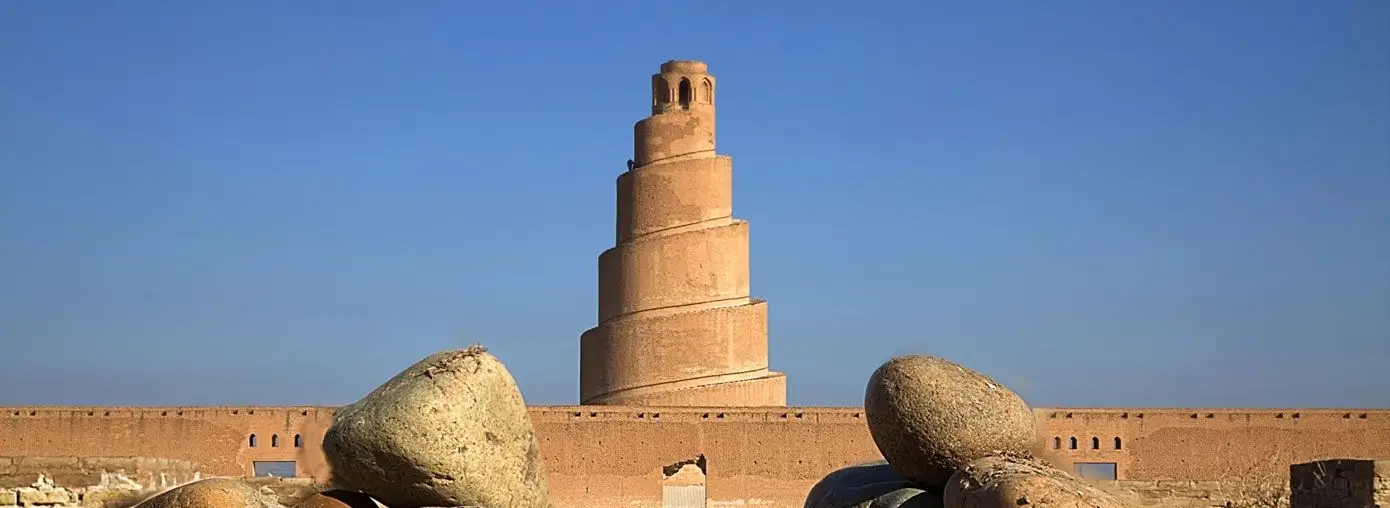
Samarra sits on the east bank of the Tigris about 125 kilometers north of Baghdad in Salah ad-Din governorate, a compact city of roughly 350,000 people that punches far above its weight historically. For a brief, brilliant stretch in the ninth century it was the political center of the Abbasid Caliphate, and the urban experiment left behind monuments still visible today: the audacious spiral Malwiya minaret, the vast footprint of the Great Mosque, and the gold-domed Al-Askari Shrine that draws Shia pilgrims from across Iraq, Iran, Lebanon, and the Gulf. Modern Samarra is a working Sunni-majority city wrapped around a globally significant Shia pilgrimage site, and that layered identity gives any visit a particular texture. Expect security checkpoints on the approach, a relatively short visitor circuit clustered in the old core, warm hospitality at tea stalls, and the sense of standing inside a once-imperial capital that the desert has mostly reclaimed but never quite erased.
Samarra through history
The site has been settled since prehistory, but Samarra's defining moment came in 836 CE when the Abbasid caliph al-Mu'tasim moved his court here from Baghdad, partly to house his Turkic guard away from the capital's crowds. For roughly 56 years, until 892, Samarra was the imperial seat, and successive caliphs built a sprawling palace and mosque complex stretching tens of kilometers along the Tigris. The Great Mosque with its iconic Malwiya minaret dates to this period under al-Mutawakkil. The Al-Askari Shrine grew around the tombs of the tenth and eleventh Shia imams. In February 2006, sectarian bombers destroyed the shrine's golden dome, a watershed in Iraq's civil conflict; reconstruction was completed by 2009 and the dome shines again today.
- 350,000
- 836
When to visit
October through April is the comfortable window, with daytime temperatures from the high teens to the mid-twenties Celsius and cool evenings. November to February can be genuinely cold and occasionally rainy but pleasant for walking the heritage sites. Summers from June through August are brutally hot, regularly 42 to 48 degrees Celsius, and most visitors limit outdoor time to early morning and after sunset. Plan around Shia commemorations — Arbaeen, Ashura, and the martyrdom anniversaries of Imam al-Hadi and Imam Hasan al-Askari — when pilgrim numbers and security posture both spike. Friday mornings are quieter at the heritage monuments; the shrine itself is busiest on Thursday evenings and Fridays.
What to eat in Samarra
Samarra's food is solidly Iraqi heartland cooking, leaning toward grilled meats and slow-cooked stews. Look for masgouf, the split and slow-grilled Tigris carp that is a national dish, available at riverside restaurants when the catch is in. Quzi, a whole slow-roasted lamb over spiced rice with raisins and almonds, appears at celebration meals. Kebab Samarra, a regional take on minced lamb skewers seasoned with onion and parsley, is widely available at the small grill houses around the shrine. Tashreeb, bread soaked in lamb or chicken broth, is a hearty pilgrim staple. Sweet shops near the haram sell baklava, kleicha (date-filled cookies), and sticky pilgrim sweets. Tea is constant and often complimentary.
Getting there
Most visitors come from Baghdad, a 90-minute to two-hour drive north on the main highway depending on checkpoint queues. Hire a private driver through a Baghdad-based tour operator or a trusted hotel; this is the standard, safest, and most efficient option and typically costs 80 to 150 USD for a day return with waiting time. Shared taxis (kia minibuses) run from Baghdad's Al-Allawi garage to Samarra for a few thousand dinar but require Arabic and patience at checkpoints. There is no commercial airport in Samarra; the nearest is Baghdad International. Foreign visitors should expect ID checks at multiple security points; carry passport and Iraqi visa or e-visa printout, and let your driver handle the conversation.
Getting around
Samarra's main visitor sights are clustered tightly enough that a single driver-and-car arrangement covers the day comfortably. The Al-Askari Shrine, the Great Mosque ruins, and the Malwiya minaret are within a few kilometers of one another, and your Baghdad driver will normally include local circulation. On foot, the shrine precinct itself is walkable, with security screening at the gates and free shoe storage; modest dress is required, and women should bring a chador or long abaya, which are often provided at the entrance. Local taxis exist for short hops between the shrine and the minaret but are not metered; agree on a fare in dinar before getting in.
Money & payments
Samarra is firmly a cash city for visitors. Bring dinar and USD from Baghdad — ATMs in town are limited and frequently empty. Moneychangers exist near the central market but rates are weaker than Baghdad's Al-Kifah Street. The Al-Askari Shrine is free to enter; tea, food, taxis, and small souvenirs are all cash, with vendors more comfortable in dinar than dollars for small amounts. Your Baghdad driver is usually paid in USD for the full-day trip.
Safety
Be honest with yourself: Samarra has had episodic security incidents over the past two decades, and Salah ad-Din governorate as a whole still requires more situational awareness than Baghdad or the Kurdistan Region. That said, the Al-Askari Shrine has been a continuously operating pilgrimage site through almost all of that period, and day-trip visits from Baghdad with a reputable local driver are routine and generally smooth in 2026. Practical guidance: travel with an Iraqi driver or licensed tour operator, never independently by rental car; go as a day trip rather than overnight unless your operator specifically recommends a vetted hotel; carry passport and visa documents at all times for checkpoints; dress modestly and follow your guide's lead at the shrine; avoid photographing security personnel or checkpoints; and check your embassy's current travel advisory before booking, as conditions can shift.
Plan your visit — free in the app
Get app