
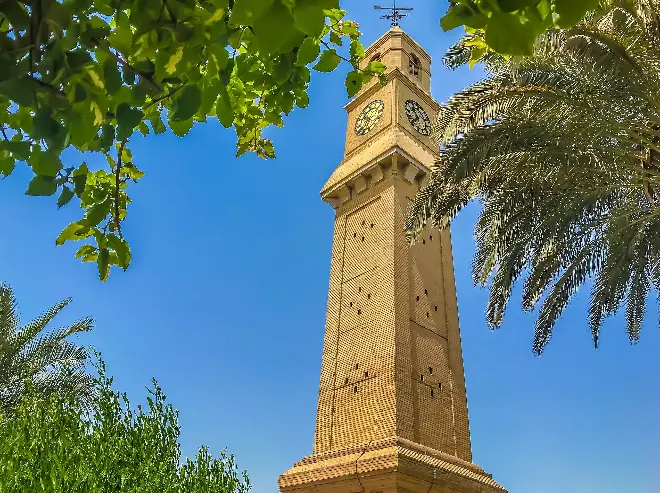
Al Qishla Clock Tower
Al Qishla Building
The Qishla Clock Tower was built in 1869 during the rule of Governor Midhat Pasha, serving as a means to wake the soldiers every morning inside the Ottoman barracks. The tower was constructed as a hollow structure rising to a height of 23 meters. It stands on a square base with each side measuring 4 meters, then narrows gradually in a pyramidal form until it reaches 2.80 meters at the top. The walls contain several small openings used for lighting and ventilation, and the tower is crowned with a vertical metal arrow connected to a horizontal one that functions as a wind indicator.
At the top of the tower, a large four-faced clock was installed, manufactured in Britain by the English company Groydon. Some accounts claim it was a gift from King George V, while official sources agree that it was actually placed in the tower in 1927 during the reign of King Faisal I.
The history of this clock is tied to the same manufacturer that produced London’s famous Big Ben. It is regarded as one of the oldest and most valuable large mechanical clocks in the region. Sources also affirm that its installation came only a few years after that of Big Ben, with a similarity in craftsmanship and the quality of the materials used.
The Qishla Clock operates through a manual mechanical system, powered by a large iron key. The appointed clock-keeper climbs 72 steps to the top of the tower to wind the mechanism and adjust the time. The clock continues functioning for ten days before requiring another winding.
Notable Historical Events
1917: After British forces entered Baghdad and defeated the Ottomans, the British flag was raised over the clock tower, marking a turning point in the city’s history.
During the same period, the Qishla building was used as housing for British officers and their families.
1921: Al-Qishla Square witnessed a significant event—the coronation of King Faisal I as King of Iraq.
Despite the tower’s endurance through the decades, it suffered acts of theft and looting after foreign forces entered Iraq, affecting some of its parts and the wooden doors at its top. However, the structure itself was not damaged, and it underwent maintenance in the 1930s that preserved its original form.
Some researchers draw comparisons between the Qishla Clock Tower and the Clock Tower of Sheikh Abdul Qadir al-Kailani, built in 1889 in Baghdad, due to their similar shapes and mechanical nature.
Although the clock no longer rings today, the Qishla Tower still stands as one of the most prominent Ottoman architectural landmarks in the Iraqi capital, maintaining its status as an important historical and cultural site in the heart of Baghdad.
Al Qishla Clock Tower
Arabic · English
Hear this stop narrated — free in the app
Get app