
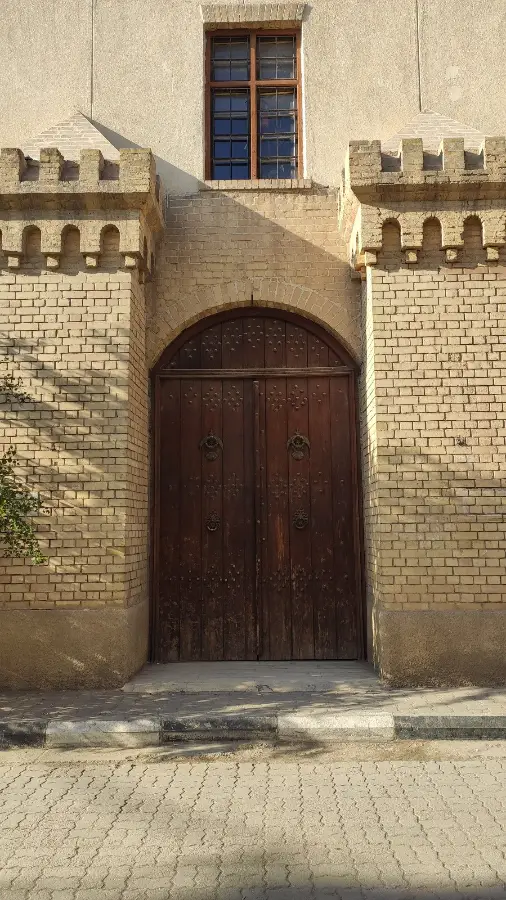
Al Qishla Building
The Qishla building (formerly the Mawfaqiyya School, Or the old government building or the government palace) is considered one of the most prominent historical landmarks of Baghdad. It is an Ottoman structure located on the Rusafa side, in the old central district of the capital, in the Al-Saray quarter opposite Al-Saray Mosque, on the eastern bank of the Tigris River. The name “Qishla” comes from the Turkish word qashlan, meaning “winter quarters,” and it was used to refer to barracks or places where soldiers were gathered during the winter season.
The Qishla was constructed in 1861 during the rule of the Ottoman governor Namik Pasha, with the aim of providing a suitable place for Ottoman soldiers to assemble in wintertime. However, the building was not completed during his tenure; construction resumed later under Governor Midhat Pasha, who took office in Baghdad in 1869.
In its early days, the Qishla consisted of a single floor, and then Midhat Pasha added a second floor along with several additional rooms, expanding its capacity to host soldiers. The construction used remains of the eastern Abbasid wall of Baghdad, which gave the building a historical and architectural character linked to the city’s Abbasid roots.
The site of the Qishla was chosen over the land that once housed the Mawfaqiyya School, which had been built by Muwaffaq al-Khādim during the Abbasid era. The ground beneath this area still contains foundations of several Abbasid palaces and buildings, making the location rich in successive historical layers.
The phases of construction were affected by long interruptions due to a lack of financial allocations and the Ottoman Empire’s preoccupation with wars and military operations. This “ebb and flow” continued until Midhat Pasha arrived, taking great interest in completing the Qishla and personally overseeing its final stages. He also ordered the demolition of parts of the eastern wall of Baghdad, as it was no longer needed after the introduction of modern weaponry (cannons, rifles, machine guns, mines). Stones from the wall were used to complete the building. After its completion, the Qishla became the headquarters of the governor, the army commander, and senior officials of the province.
The Qishla witnessed a major historical event in 1921, when King Faisal I was crowned King of Iraq in its courtyard, making it a central site for official ceremonies of that era.
In the following decades, the buildings of the Qishla were used by the Ministries of Finance and Justice, before the Iraqi State Board of Antiquities took charge of its preservation and restoration, turning it into a museum for displaying heritage artifacts and valuables, and transforming it into a significant cultural and tourist destination in the heart of Baghdad.
The Qishla stands as a testament to an important architectural and military phase in the Ottoman history of Baghdad, and as a distinguished example of nineteenth-century military architecture. It also carries within its walls the memory of pivotal events in Iraq’s history, from the Ottoman era to the monarchy.
Al Qishla… Between the Records of Governors and the Shadows of Kings
3 Min · Arabic · English
4 stops to discover
- 1Premium
Al Qishla Clock Tower
The Qishla Clock Tower was built in 1869 during the rule of Governor Midhat Pasha, serving as a means to wake the soldiers every morning inside the Ottoman barracks. The tower was constructed as a hollow structure rising to a height of 23 meters. It stands on a square base with each side measuring 4 meters, then narrows gradually in a pyramidal form until it reaches 2.80 meters at the top. The walls contain several small openings used for lighting and ventilation, and the tower is crowned with a vertical metal arrow connected to a horizontal one that functions as a wind indicator. At the top of the tower, a large four-faced clock was installed, manufactured in Britain by the English company Groydon. Some accounts claim it was a gift from King George V, while official sources agree that it was actually placed in the tower in 1927 during the reign of King Faisal I. The history of this clock is tied to the same manufacturer that produced London’s famous Big Ben. It is regarded as one of the oldest and most valuable large mechanical clocks in the region. Sources also affirm that its installation came only a few years after that of Big Ben, with a similarity in craftsmanship and the quality of the materials used. The Qishla Clock operates through a manual mechanical system, powered by a large iron key. The appointed clock-keeper climbs 72 steps to the top of the tower to wind the mechanism and adjust the time. The clock continues functioning for ten days before requiring another winding. Notable Historical Events 1917: After British forces entered Baghdad and defeated the Ottomans, the British flag was raised over the clock tower, marking a turning point in the city’s history. During the same period, the Qishla building was used as housing for British officers and their families. 1921: Al-Qishla Square witnessed a significant event—the coronation of King Faisal I as King of Iraq. Despite the tower’s endurance through the decades, it suffered acts of theft and looting after foreign forces entered Iraq, affecting some of its parts and the wooden doors at its top. However, the structure itself was not damaged, and it underwent maintenance in the 1930s that preserved its original form. Some researchers draw comparisons between the Qishla Clock Tower and the Clock Tower of Sheikh Abdul Qadir al-Kailani, built in 1889 in Baghdad, due to their similar shapes and mechanical nature. Although the clock no longer rings today, the Qishla Tower still stands as one of the most prominent Ottoman architectural landmarks in the Iraqi capital, maintaining its status as an important historical and cultural site in the heart of Baghdad.
- 2Premium
Saleem Al Basri Statue
The bronze statue of the Iraqi artist Salim Al Basri, created by sculptor Fadhel Misir, is one of the sculptures that embody a prominent figure in the history of Iraqi drama. The artist Salim Al Basri was born in 1926 in the Bataween district of Baghdad. He was an Iraqi actor and screenwriter known for the character “Haji Rady,” a role that remained beloved by audiences for many years. In 1942, he joined the first civilian acting troupe near Al-Rasafi Square on Al Rasheed Street a troupe whose headquarters, according to accounts, occupied what used to be the dome of the tomb of a Baghdadi Sufi saint. He stepped away from acting between 1944 and 1948, then returned to perform the play Salim Al-Basri in the Training Square. In 1950, he enrolled in the College of Arts and Humanities, Department of Arabic Language, at the University of Baghdad, graduating in 1954. He studied under distinguished professors such as Jabra Ibrahim Jabra, Jamil Saeed, and Abdul Aziz Al Douri, who was the dean of the college at that time. After graduating, he became the head of the university theater at the College of Arts, University of Baghdad, where he played a notable role in advancing theatrical activity on campus. Among his most prominent theatrical works: An Artist Against His Will The Desert Among his most famous television works: Under the Razor The Eagle and the Eyes of the City In his later years, Salim Al Basri withdrew from the spotlight until he passed away in Baghdad on May 9, 1997.
Frequently asked questions
What are the opening hours of Al Qishla Building?
Al Qishla Building is open 24 hours.
How much does it cost to visit Al Qishla Building?
Admission to Al Qishla Building is free.
How long should I spend at Al Qishla Building?
Plan about ~ 2 Hours for Al Qishla Building.
When is the best time to visit Al Qishla Building?
Mid-morning to early afternoon, ideally on a weekday for fewer crowds. Photogenic in early evening light.
Does Al Qishla Building have an audio guide?
Yes — a narrated audio guide for Al Qishla Building is available in the Travel Tale app.
Where is Al Qishla Building located?
Al Qishla Building is in Baghdad.

Hear the full audio story — free in the app
Get app