
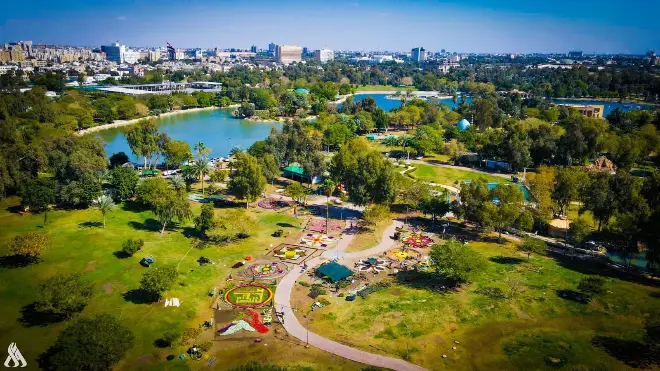
Al Zawra'a Park
Al Zawra'a is Baghdad's largest public park, spread across roughly three square kilometres in the western Mansour district. Established in the early 1970s on land that was once an army camp, it has become the city's default day-out: tree-lined walks, paddle boats on a long artificial lake, the Baghdad Zoo (around 1,000 animals after the post-2003 rebuild), a vintage amusement park, an aquarium, and the Zawra'a Tower, whose viewing deck looks across the surrounding neighbourhoods. Friday afternoons bring extended families spreading picnic mats under the eucalyptus trees, kids on bumper cars, and the smell of grilled samoun sandwiches drifting from kiosks along the main paths.
Baghdad's Great Park
Narrated guide available in the app
2 stops to discover
- 1Premium
Baghdad Zoo
Baghdad Zoo is a zoo located in the heart of the Iraqi capital Baghdad, specifically inside the famous Al Zawraa Park on the Karkh side. For decades, it has been considered one of the largest and oldest zoos in the entire Middle East region. The zoo extends over a vast area estimated at about fifty dunams within the larger Al Zawraa Park area, and today represents one of the most important recreational and educational destinations for Iraqi and Baghdadi families alike. To discuss the roots of this zoo, one must go back to very distant history, as the idea of collecting and displaying animals in Baghdad is not a product of the modern era, but extends to the depths of Mesopotamian history. The king of the Middle Assyrian Empire, Ashur Bel Kala, established zoological and botanical gardens during the eleventh century BC, and among the famous animal collectors in Mesopotamia were King Ashurbanipal and the King of Babylon Nebuchadnezzar II. In the Abbasid era, what was known as "Hayr Al Wuhush" (Wildlife Enclosure) was established essentially a royal zoo alongside "Dar al-Shajara" (House of Trees) on the eastern side of Baghdad, during the reign of the Abbasid Caliphs between 295 and 320 AH (corresponding to 908 to 932 CE), indicating that Baghdad has known the concept of zoos for more than a thousand years. As for the modern Baghdad Zoo, it was established in the 1960s in the Al-Sikak area of Baghdad, with modest and simple beginnings in terms of both the number of animals and staff. When Al-Zawraa Park was built in 1973 during the presidency of Ahmed Hassan Al Bakr, the zoo was moved to its current location inside the park in 1974, beginning a new phase of development and expansion. The zoo then began to develop gradually through importing and bringing in unique and rare animals from regions far from Iraq and from different continents around the world. With the breeding of these animals, it was natural that the numbers of specialists and those interested in zoology increased veterinarians and workers experienced in the art of dealing with both predatory and domesticated animals. However, in its early stages, the zoo was small and inadequate, with animal enclosures that were cramped and considered inhumane by international standards. After the First Gulf War in 1991, Iraqi zoos in general suffered from the consequences of international sanctions imposed by the United Nations on Iraq, leading to severe limitations in providing the necessary food, medicines, and vaccines for animal care. In the spring of 2002, the zoo was closed by order of President Saddam Hussein to undergo renovations and improvements. Then came the great catastrophe with the invasion of Iraq in 2003, when Baghdad Zoo was subjected to massive destruction during the battles that preceded the fall of Baghdad. Saddam Fedayeen fighters took defensive positions around the zoo when American forces began the Battle of Baghdad, forcing zoo workers to stop feeding the animals in early April of that year for their personal safety. The result was tragic by all measures: of the 650 to 700 animals living in the zoo before the invasion, only 35 animals survived by the eighth day of the invasion, and most survivors were large animals. The zoo was also subjected to widespread looting and theft of its facilities and contents, adding another dimension of suffering to this ancient Baghdad landmark. But despite this great destruction, Baghdad did not surrender and its people did not abandon their zoo. Intensive maintenance and restoration work was carried out on the zoo in the years following the invasion, and a long journey of rehabilitation and reconstruction began. New animals were brought in and cages and veterinary facilities were rehabilitated, until the zoo gradually returned to life. Today, Baghdad Zoo houses approximately 750 animals of multiple varieties and nearly 75 different species including birds, mammals, predators, ruminants, and reptiles. Among the distinctive and rare animals in the zoo is the white lion born in Baghdad itself a rare species resulting from a genetic mutation, displayed to visitors for two hours daily. The zoo also contains lions known as the Presidential Lions, some of which were gifted by the Russian circus to Iraq in previous years. There are also long-lived turtles that may live up to 250 years, while the average lifespan of lions and tigers in the zoo ranges between 14 and 20 years thanks to the medical care and vaccines provided to them. The zoo today contains a complete veterinary medical clinic equipped to perform various surgical operations, a pharmacy containing all necessary veterinary medicines, and a veterinary medical staff working in morning and evening shifts to care for the animals and monitor their health. The zoo also employs experienced trainers and breeders who deal with predatory animals with high skill and knowledge some have worked in this field for many years until the animals recognize them and distinguish their scents from far distances. The zoo receives large numbers of visitors from inside and outside Iraq, especially during weekends, holidays, and national and religious occasions. The zoo is considered an important educational place that provides children and families the opportunity to learn about different types of animals and see them up close. Some domesticated animals can be fed by visitors, providing an enjoyable interactive experience. The zoo's location inside the larger Al Zawraa Park is an additional advantage, as visitors can combine visiting the zoo with strolling through vast green spaces and enjoying the amusement park, Al Zawraa Tower, and other diverse facilities the park offers. Despite all the ordeals and challenges it has faced over the decades, Baghdad Zoo remains a living witness to a long history extending from "Hayr Al Wuhush" in the Abbasid era to the present day, through phases of prosperity, destruction, and reconstruction. It represents today a symbol of Baghdad's resilience and its people's ability to rise again after every crisis, and remains one of the most important recreational and educational landmarks in the heart of the Iraqi capital, attracting visitors from all over Iraq.
- 2Premium
Al Zawra'a Tower
Al Zawraa Tower was established in 1975 in Baghdad and is located in Al Zawraa Park near the Al Harithiya area, designed by Iraqi architect Adnan Zaki Amin. The tower rises approximately 40 meters and contains a circular rotating restaurant whose floor revolves around the tower. It is in the shape of an onion dome, which provoked a number of criticisms due to its shape. However, this tower remains the only tower in Iraq designed entirely by an Iraqi architect Engineer Adnan Zaki Amin, who was able to undertake bold designs. The tower was closed after the American occupation of Iraq in 2003. The tower was supposed to be double or more than its current height, but in the final moments, a security committee in the Republican Presidency objected to completing its construction because the height posed a security threat to the Republican Palace building. It was also said at the time that the reason for the objection was the aircraft runway at the adjacent Al-Muthanna Airport near Al Zawraa Park, which would obstruct aircraft taking off and landing there. Construction was stopped and then completed at a height of 50 meters. Consequently, the tower lost much of its beauty and splendor because it became short relative to the size of its large dome.
Frequently asked questions
What are the opening hours of Al Zawra'a Park?
Al Zawra'a Park is open 24 hours.
How much does it cost to visit Al Zawra'a Park?
Admission to Al Zawra'a Park starts at 1,000 IQD.
How long should I spend at Al Zawra'a Park?
Plan about ~ 3 Hours for Al Zawra'a Park.
When is the best time to visit Al Zawra'a Park?
Friday afternoon for the family atmosphere; weekday mornings if you want a quieter walk or to see the zoo without crowds.
Does Al Zawra'a Park have an audio guide?
Yes — a narrated audio guide for Al Zawra'a Park is available in the Travel Tale app.
Where is Al Zawra'a Park located?
Al Zawra'a Park is in Baghdad: Mansour District, Baghdad.

Hear the full audio story — free in the app
Get app