
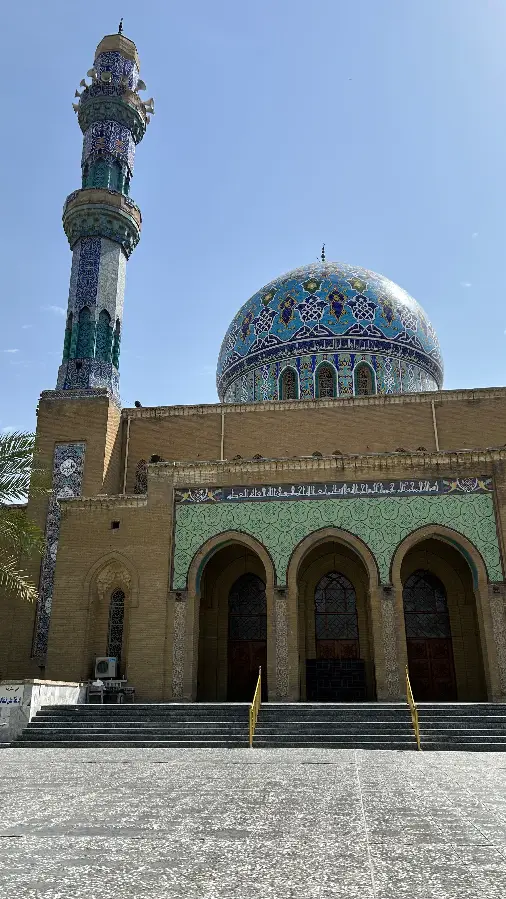
17th of Ramadan Mosque
The story of the mosque begins in 1355 AH / 1938 CE, when the foundation stone was laid during the reign of King Ghazi, funded by the Directorate of Endowments. It was originally intended to be named King Faisal I Mosque.
On July 10, 1940, construction began during the regency of Prince ’Abd Al Ilah, but soon halted. In 1951, a new committee was formed to resume construction and rename it King Faisal II Mosque. Work continued until 1953, then stopped again. The name was later proposed as Al Alawiyya Mosque.
Eventually, under President Abdul Karim Qasim, construction resumed once more. It was planned to be called Al Jumhuriyya (Republic) Mosque, but when it officially opened on July 14, 1959 Iraq’s national day commemorating the 14 July Revolution Qasim named it The Martyr’s Mosque (Jami‘ al-Shahid). However, it remained closed to worship for four more years.
Finally, on December 6, 1963, the first Friday Prayer was held there under President Abdul Salam Arif, and it was officially inaugurated as The 14th of Ramadan Mosque, in honor of the 1963 revolution (14 Ramadan 1383 AH).
After the fall of Saddam Hussein’s regime in 2003, the name was changed once again to its current title: The 17th of Ramadan Mosque, commemorating the historic Battle of Badr.
The mosque spans over 5,000 square meters, accommodating more than 2,500 worshippers. It features:
• A prayer niche (mihrab) topped with a beautifully decorated dome adorned with intricate Islamic motifs
• A tall minaret with two balconies (ḥawḍayn), covered in iconic blue Karbala-style tiles (al kashī al Karbala’ī)
• A dedicated residence for the imam and preacher
• A hall for religious events and mourning gatherings
• A women’s prayer area
• An administrative and service room
• A tranquil garden surrounding the sanctuary, enhancing the spiritual ambiance of the place
Where Time Prays and Memory Echoes
3 Min · Arabic · English
Frequently asked questions
What are the opening hours of 17th of Ramadan Mosque?
17th of Ramadan Mosque is open 24 hours.
How much does it cost to visit 17th of Ramadan Mosque?
Admission to 17th of Ramadan Mosque is free.
How long should I spend at 17th of Ramadan Mosque?
Plan about ~ 30 min for 17th of Ramadan Mosque.
When is the best time to visit 17th of Ramadan Mosque?
Outside prayer times — mid-morning (after sunrise prayer settles) or mid-afternoon. Avoid Friday noon prayer.
Does 17th of Ramadan Mosque have an audio guide?
Yes — a narrated audio guide for 17th of Ramadan Mosque is available in the Travel Tale app.
Where is 17th of Ramadan Mosque located?
17th of Ramadan Mosque is in Baghdad.

Hear the full audio story — free in the app
Get app