
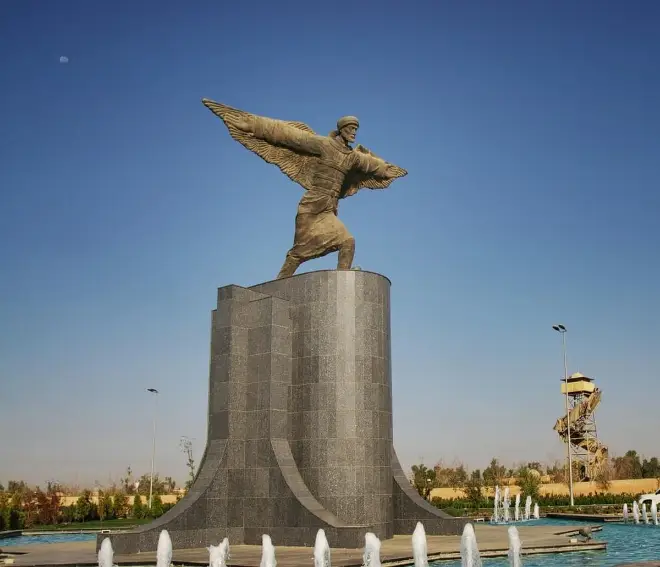
Abbas Ibn Firnas Monument
Abu Al Qasim Abbas ibn Firnas ibn Wirdas Al Takurini was a Muslim Andalusian polymath, inventor, and scientist, renowned for his early attempt at human flight. Born in Ronda, Al Andalus, during the Umayyad period, Ibn Firnas was also a celebrated poet and an accomplished scholar in mathematics, astronomy, chemistry, and engineering.
He made diverse contributions to the sciences of astronomy and mechanics. He designed a mechanical device that simulated the motion of planets and stars and discovered a method for producing colorless glass. This innovation led to the creation of magnifying lenses for reading, known at the time as “reading stones.”
Born in the village of Takurunna near Ronda, Ibn Firnas grew up in Cordoba, where he studied and excelled in philosophy, chemistry, and astronomy. He was a contemporary of several Umayyad rulers, including Al Hakam I, his son Abd Al Rahman II, and his grandson Muhammad I. He became close to the royal court and its poets, and Abd Al Rahman II even appointed him as his personal astronomy tutor. He earned the honorary title “The Sage of Al Andalus.”
As a poet, he was eloquent and refined, and he is credited with deciphering the complex poetic system laid out in Al Khalil ibn Ahmad Al Farahidi’s Book of Prosody. He also had deep knowledge of music and was a skilled (lute) player.
Ibn Firnas gained widespread fame for inventions that were far ahead of his time. At one point, he was accused of heresy and atheism, and a public trial was held in the Great Mosque. However, he was acquitted, as the charges were deemed exaggerated and rooted in ignorance.
Among his many innovations, he designed a water clock known as Al Miq ta, and succeeded in producing transparent glass from stone. He invented optical lenses for medical use and constructed an astronomical device called Dhat Al Ḥalaq (“The Ringed One”) that mimicked the movements of celestial bodies. He also developed a method for cutting quartz in Al Andalus, eliminating the need to send raw stones to Egypt.
In the realm of writing, he is credited with inventing the world’s first fountain pen: a cylinder connected to an ink reservoir that allowed ink to flow to a pointed nib centuries ahead of its time.
Within his own home, Ibn Firnas built a room designed to simulate the night sky. Visitors could see stars, clouds, lightning, and hear thunder controlled by devices he operated from a laboratory beneath the chamber. He also invented innovative types of metronomes to regulate musical rhythm.
Yet his most legendary achievement remains his documented attempt at human flight. Near the palace of al-Ruṣāfa in Baghdad, as recorded by the historian Al Maqqari, Ibn Firnas launched himself with a pair of wings of his own design making him the first person in history to attempt flight through a scientific, recorded method. His feat predates the less-documented flight experiment of Eilmer of Malmesbury in England (c. 1000–1010 CE).
Andalusian Bird
3 Min · Arabic · English
Frequently asked questions
What are the opening hours of Abbas Ibn Firnas Monument?
Abbas Ibn Firnas Monument is open 24 hours.
How much does it cost to visit Abbas Ibn Firnas Monument?
Admission to Abbas Ibn Firnas Monument is free.
How long should I spend at Abbas Ibn Firnas Monument?
Plan about ~ 30 min for Abbas Ibn Firnas Monument.
When is the best time to visit Abbas Ibn Firnas Monument?
Mid-morning to early afternoon, ideally on a weekday for fewer crowds. Photogenic in early evening light.
Does Abbas Ibn Firnas Monument have an audio guide?
Yes — a narrated audio guide for Abbas Ibn Firnas Monument is available in the Travel Tale app.
Where is Abbas Ibn Firnas Monument located?
Abbas Ibn Firnas Monument is in Baghdad.

Hear the full audio story — free in the app
Get app