
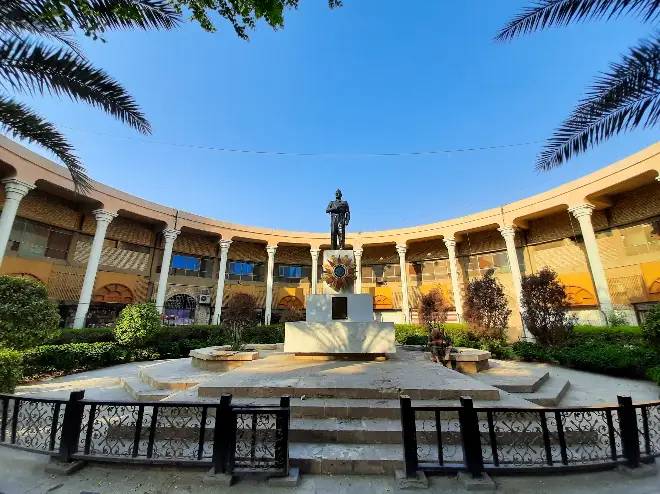
Abdul Karim Qasim Statue
Along the historic Al Rasheed Street, stands the statue of Abd Al Karim Qasim as one of the modern commemorative landmarks that bear a blend of national symbolism and artistic expression.
This monument was erected in 2005 in honor of Brigadier Abd Al Karim Qasim, the leader of the 14 July 1958 Revolution, which ended the monarchy in Iraq and declared the establishment of the Republic of Iraq.
The statue was crafted by the prominent Iraqi sculptor Khalid Al Rahal, using bronze, to embody in the features of the face and the posture of the body a focused image of the leader who carried on his shoulders the dreams of his people for change, and who represented a profound historical turning point that redrew the map of power and state in modern Iraq.
The statue was placed in Abd Al Karim Qasim Square, which was specially created to commemorate his legacy, in a central location in the city, where the daily movement of citizens intersects with the national memory.
Over time, the statue became a visible symbol of a pivotal transitional phase in Iraq’s history, especially as Abd Al Karim Qasim was the first republican ruler of Iraq after the fall of the monarchy, holding senior positions that combined Prime Minister, Minister of Defense, and Commander of the Armed Forces.
Abd Al Karim Qasim was born on Saturday, November 21, 1914, in Al Mahdiya district, one of Baghdad’s popular neighborhoods, to a poor family a Sunni father who worked as a carpenter, and a Shiite mother from the Banu Tamim tribe. His family later moved to the Al Suwaira district in search of livelihood, where he began his elementary studies, before returning to Baghdad to complete his education.
He worked briefly as a teacher, then joined the military, entering the Military College in 1932, and graduated with distinction in 1934 as a second lieutenant.
He rose through the ranks until he became a brigadier, participating in several wars and military movements, including the Palestine War, the Euphrates uprisings, and the May 1941 movement.
He received numerous medals and was described in military reports as an excellent and ethical officer, qualified to be among the major leaders.
Qasim was one of the founders of a secret organization known as "Mansuriyah Al Jabal", then joined the Free Officers Movement and became a member of its higher committee. He took part in planning and executing the 14 July 1958 Revolution alongside Abd Al Salam Arif, which overthrew the monarchy through a republican declaration broadcast from Iraqi Radio, accompanied by bloody events, most notably the execution of the royal family, marking the start of a new rule that sparked widespread internal and external controversy.
During his rule, Qasim carried out a wide range of political, social, and economic reforms: he abolished the feudal system, enacted agricultural reform laws, distributed state lands to peasants, passed the 1959 Personal Status Law granting Iraqi women unprecedented rights, established residential districts for employees and low-income citizens, linked rural areas with cities through road projects, built hospitals and schools, and armed the Iraqi army through agreements with the Soviet Union. He directed Iraq toward a policy of positive neutrality instead of alignment with the Western bloc, ended British influence in the country, withdrew from the Arab Union with Jordan, and provided financial and military support to liberation movements in the Gulf, Jordan, and Palestine. He also sought to establish a Palestinian Liberation Army, making him a controversial figure a mix between a popular reformist leader and a decisive head of state.
Despite his achievements, his rule witnessed political unrest and internal conflicts between nationalist and leftist forces. He faced multiple coup attempts, until the decisive day came on February 8, 1963, when he was overthrown in a bloody coup led by Ba’athists and Arab nationalists, arrested, and executed the next day, February 9, thus ending a fierce chapter of Iraq’s history and beginning another with a different vision and approach.
In the end, this statue serves as a memorial icon for a figure who captivated the nation and embodied broad hopes and great ambitions for a people longing for justice, dignity, and sovereignty. It reminds everyone who passes through Abd Al Karim Qasim Square of a turbulent history rich in transformations, and of a leader who never left the conscience of Iraqis, no matter how differing opinions about him may be. His statue remains standing in the heart of Baghdad just as he stood one July morning and declared to the people that Iraq had entered a new era.
The Voice of the Poor, in the Heart of Bronze
4 Min · Arabic · English
Frequently asked questions
What are the opening hours of Abdul Karim Qasim Statue?
Abdul Karim Qasim Statue is open 24 hours.
How much does it cost to visit Abdul Karim Qasim Statue?
Admission to Abdul Karim Qasim Statue is free.
How long should I spend at Abdul Karim Qasim Statue?
Plan about ~ 20 min for Abdul Karim Qasim Statue.
When is the best time to visit Abdul Karim Qasim Statue?
Mid-morning to early afternoon, ideally on a weekday for fewer crowds. Photogenic in early evening light.
Does Abdul Karim Qasim Statue have an audio guide?
Yes — a narrated audio guide for Abdul Karim Qasim Statue is available in the Travel Tale app.
Where is Abdul Karim Qasim Statue located?
Abdul Karim Qasim Statue is in Baghdad.

Hear the full audio story — free in the app
Get app