
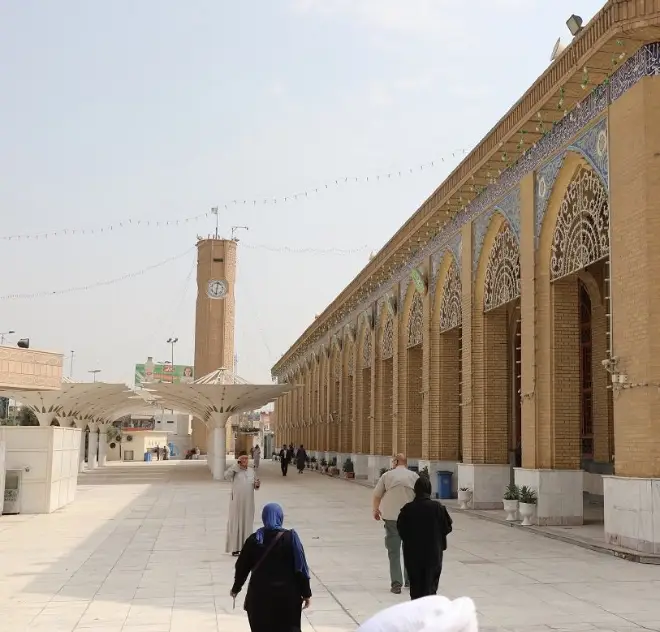
Abu Hanifa Al Nu'man Mosque
In the heart of Al Adhamiyah, Baghdad, stands the Grand Mosque of Al Imam Al Azam, a majestic landmark that embraces within its walls the shrine of Imam Abu Hanifa Al Numan Ibn Thabithe jurist of Iraq and founder of the Hanafi school of Islamic jurisprudence.
Born in Kufa in 80 AH (699 CE), Imam Abu Hanifa passed away in Baghdad in 150 AH (767 CE), and was buried in the very spot where the mosque would later rise, becoming a revered pilgrimage site for Muslims from Iraq and across the Islamic world.
Historical accounts suggest that Imam Abu Hanifa studied under Imam Jaʿfar Al Sadiq for a brief period. He is famously quoted as saying, “Had it not been for those two years, Al Numan would have perished,” referring to that time of tutelage. Some narratives recount scholarly debates between the two on the topic of analogical reasoning (qiyas), highlighting an intellectual link between their schools of thought, despite later methodological divergences.
The mosque was first built beside the grave in 375 AH, then underwent a major expansion in 459 AH / 1066 CE, when a shrine, dome, and large school were added. That school one of the oldest religious institutions in Islamic history is known today as the “College of Imam Al Azam” and is considered among the world’s three oldest universities.
When Hulagu Khan invaded Baghdad in 1258 CE and many centers of knowledge fell into ruin, much of the city was destroyed. Yet, thanks to the presence of Imam Abu Hanifa’s shrine and school, the neighborhood of Al Adhamiyah remained a vibrant hub of faith and scholarship. Without this intellectual beacon, the area might have vanished from the map like many others.
The mosque suffered multiple attacks during the Safavid occupation, repeatedly demolished for sectarian reasons. However, its stature was restored with the Ottoman conquest of Baghdad in 1534 CE, when Sultan Muhammad Ibn Mansur Al Khwarizmi ordered its revitalization, reinstating its role as a major spiritual and academic center.
Under Mamluk governor Sulayman Pasha Abu Layla, the shrine was renewed, and its dome and minaret were constructed in 1757 CE. A significant restoration followed in 1291 AH / 1874 CE, commissioned by the Valide Sultan, mother of Sultan Abdulaziz, adding Ottoman elegance infused with Abbasid heritage.
Until 1911 CE, the Imam Al Azam School remained the sole religious educational institution in Al Adhamiyah, complemented by a few traditional kuttab (Qur’an schools). It produced generations of jurists, preachers, and scholars who contributed to religious, mathematical, and astronomical knowledge, reinforcing the mosque’s role as a beacon of intellectual life.
In 1957 CE, the construction of the Jisr Al Aimma (Bridge of the Imams) led to the demolition of part of the mosque’s eastern fence to extend the road. A 25-meter cylindrical clock tower was then erected in 1961, crowned with the famous Adhamiyah Clock, which continues to tick precisely to this day. In 1973, the tower was adorned with golden aluminum, giving a modern touch to this timeless structure.
Up until the late 1960s, the mosque was surrounded by orchards and residential homes. These scenes gradually gave way to open gardens and public spaces, particularly near the Bridge Garden (Hadiqat Al Jisr), offering the mosque an open breathing space worthy of its historical aura.
On April 10, 2003, following the U.S. invasion of Iraq, a battle in Al Adhamiyah severely damaged parts of the mosque’s minaret, clock, shrine, and buildings, halting Friday prayers for the first time. Yet the people of Al Adhamiyah its men and youth rose up to clean and protect the mosque from further harm. Prayers resumed the very next Friday, followed by extensive restoration efforts led by the Sunni Endowment Office, the Mahsub family, local firms, and community initiatives.
Today, the mosque blends Abbasid structural design with Ottoman decorative finesse. Its dome, minaret, interior engravings, mosaics, windows, and ornate tiles bear witness to the richness of Islamic art shaped through centuries of restoration and transformation.
The mosque continues to host religious lessons, sermons, and spiritual gatherings that draw believers from all corners. It stands today not just as a house of worship, but as a symbol of tolerance, knowledge, and Islamic heritage in Iraq a living museum that narrates Baghdad’s story from the Abbasid era to the post-occupation present.
A Beacon That Never Goes Out
5 Min · Arabic · English
Frequently asked questions
What are the opening hours of Abu Hanifa Al Nu'man Mosque?
Abu Hanifa Al Nu'man Mosque is open 24 hours.
How much does it cost to visit Abu Hanifa Al Nu'man Mosque?
Admission to Abu Hanifa Al Nu'man Mosque is free.
How long should I spend at Abu Hanifa Al Nu'man Mosque?
Plan about ~ 30 min for Abu Hanifa Al Nu'man Mosque.
When is the best time to visit Abu Hanifa Al Nu'man Mosque?
Outside prayer times — mid-morning (after sunrise prayer settles) or mid-afternoon. Avoid Friday noon prayer.
Does Abu Hanifa Al Nu'man Mosque have an audio guide?
Yes — a narrated audio guide for Abu Hanifa Al Nu'man Mosque is available in the Travel Tale app.
Where is Abu Hanifa Al Nu'man Mosque located?
Abu Hanifa Al Nu'man Mosque is in Baghdad.


Hear the full audio story — free in the app
Get app