
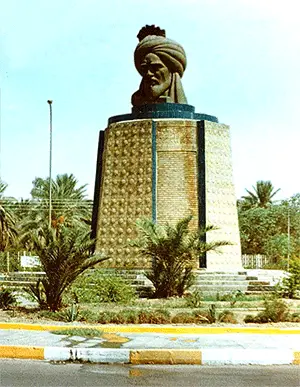
Abu Jaffar Al Mansour Monument
Abu Jaffar Al Mansur, born as Abdullah Ibn Muhammad Ibn Ali Ibn Abdullah Ibn Al Abbas Ibn Abd Al Muttalib Al Hashimi Al Qurashi, came into the world in November 713 CE (Safar 95 AH) in Al Humaymah, a town in the district of Jordan. He was raised in a prominent Abbasid household renowned for its scholarship and noble lineage. From an early age, he memorized the Qur’an and studied Arabic literature and grammar, gaining a reputation for eloquence and rhetorical skill. His religious and familial upbringing deeply shaped his later political and intellectual character.
Al Mansur was actively involved in the early secretive Abbasid revolutionary movement, traveling between major Islamic cities such as Basra, Kufa, Mosul, Mecca, and Damascus, rallying support for the Abbasid cause and laying the groundwork for the eventual overthrow of the Umayyad dynasty. Constantly pursued by Umayyad authorities, these years of clandestine activity gave him vital experience in political strategy and underground organizing.
As the Abbasid revolution intensified and ultimately succeeded, Al Mansur played a pivotal role in supporting his brother Abu Al Abbas Al Saffah, the first Abbasid caliph. He assisted in the administration of the newly founded caliphate, especially in military and administrative affairs, until Al Saffah’s death in 136 AH, at which point Al Mansur ascended to the caliphate on 13 Dhul-Hijjah, becoming the second Abbasid caliph.
His reign was immediately challenged by power struggles, notably a rebellion led by his uncle Abdullah Ibn Ali, who contested the caliphate. Additionally, the powerful commander Abu Muslim Al Khurasani, hero of the Abbasid revolution in the east, posed a significant threat to centralized authority. Al Mansur summoned Abu Muslim to the capital Al Mada’in, where he had him executed in 137 AH, effectively consolidating his rule.
Throughout his reign, Al Mansur faced numerous uprisings, including the revolt of Muhammad Ibn Abdullah (known as “Al Nafs Al Zakiyya”) in Medina, rebellions in Khurasan and Sijistan, and continued unrest from Kharijite groups on the fringes of the empire. He also engaged in border conflicts with the Byzantines. Despite these challenges, Al Mansur succeeded in suppressing opposition and reinforcing the authority of the caliphate.
Among his greatest legacies was the founding of Madinat Al Salam, later known as Baghdad, a purpose-built capital strategically located at the heart of the Abbasid realm. Al Mansur meticulously chose the site and ordered the city’s construction in a circular layout, surrounded by walls and moats, with the caliphal palace and great mosque at its center. Baghdad would go on to become the political, intellectual, and cultural capital of the Islamic world for centuries.
Al Mansur reformed the state’s administrative and fiscal systems, establishing diwans (bureaus), streamlining taxation, and focusing on justice. He created the Diwan Al Mazalim, a court for public grievances, and emphasized frugality and efficiency in governance. He was known for strictness, austerity, and personal oversight of state matters, which contributed to institutional stability and state-building.
He died while performing the Hajj pilgrimage in Mecca on 6 Dhul-Hijjah 158 AH (October 6, 775 CE) at the age of 61, and was buried in Al Ma‘la cemetery. His reign lasted approximately 22 years, during which he laid the foundational pillars of Abbasid administration, architecture, and political structure.
To commemorate his role as the founder of Baghdad, a memorial statue of Caliph Abu Jaffar al Mansur was commissioned by famed sculptor Khalid Al Rahal. It was erected in Al Mansur Square, a district named in his honor, becoming one of Baghdad’s most recognizable landmarks.
The statue was unveiled on January 6, 1977, coinciding with the 56th anniversary of the Iraqi Army, and inaugurated by Baghdad Mayor Ibrahim Muhammad Ismail, under President Ahmed Hassan Al Bakr.
The monument features a copper bust of Al Mansur, mounted on a brick structure designed like a small traditional edifice, complete with an ornate wooden door decorated with Islamic geometric motifs. The statue stands in the center of a circular plaza adorned with trees and greenery.
Like many monuments in Iraq, the statue suffered severe damage after the 2003 invasion, including a bombing that destroyed most of the structure, sparing only the bronze head. Two years later, Baghdad’s municipality launched a restoration project based on the original plans, and the statue was reopened in June 2008, reclaiming its place in the cityscape.
The Founder Remained
4 Min · Arabic · English
Frequently asked questions
What are the opening hours of Abu Jaffar Al Mansour Monument?
Abu Jaffar Al Mansour Monument is open 24 hours.
How much does it cost to visit Abu Jaffar Al Mansour Monument?
Admission to Abu Jaffar Al Mansour Monument is free.
How long should I spend at Abu Jaffar Al Mansour Monument?
Plan about ~ 20 min for Abu Jaffar Al Mansour Monument.
When is the best time to visit Abu Jaffar Al Mansour Monument?
Mid-morning to early afternoon, ideally on a weekday for fewer crowds. Photogenic in early evening light.
Does Abu Jaffar Al Mansour Monument have an audio guide?
Yes — a narrated audio guide for Abu Jaffar Al Mansour Monument is available in the Travel Tale app.
Where is Abu Jaffar Al Mansour Monument located?
Abu Jaffar Al Mansour Monument is in Baghdad.

Hear the full audio story — free in the app
Get app