
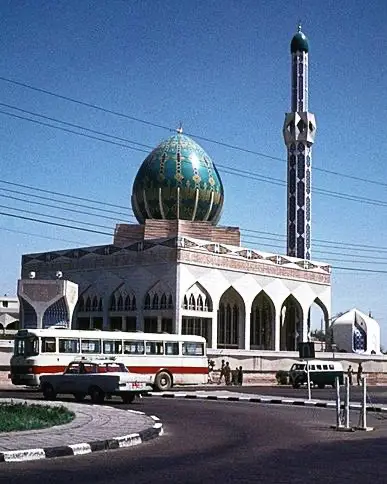
Al Bunniyah Mosque
Al Bunniyah Mosque is located in the heart of Baghdad, directly across from the Baghdad Central Railway Station. It was founded by Hajj Mahmoud Abdul Wahhab Al Bunniyah, a notable figure from the well-known Al Bunniyah family.
Driven by a lifelong dream to build a mosque that bore his name, Hajj Mahmoud embarked on a journey across Iraq and the Islamic world, studying mosque architecture. He was particularly inspired by the Mosque of Salah Al Din in Cairo, and with the help of Iraq’s ambassador to Egypt and the Egyptian Ministry of Awqaf, he obtained detailed blueprints of that mosque. However, the Iraqi government later decided to use the design for the construction of Umm Al Tabul Mosque, as a tribute to local martyrs. Hajj Mahmoud graciously supported this decision, considering his contribution a noble act of public service.
He then resumed the search for a new design and location. The current site was chosen due to its central position in Baghdad and the lack of a major mosque in the area. The goal was to build a mosque large enough to accommodate 1,000 worshippers, along with a public library, religious school, gathering hall, and residences for the imam and preacher.
Architect Qahtan Al Madfai was commissioned to design the mosque, and construction began in 1971. Sadly, Hajj Mahmoud passed away in December of that same year, and was buried in a private chamber outside the prayer hall. His sons completed the project, and the mosque was officially inaugurated on Friday, May 31, 1974.
•Total area: 5,000 square meters
•Central prayer hall: 36×36 meters, with a height of 14 meters
•Crowned with a unique dome supported by four octagonal columns, each 1 meter in diameter
•Dome height: 36 meters total, with 18.5 meters visible above the rooftop
Instead of traditional Kashani tile decoration, the dome features ornamental Kufic calligraphy, repeating the phrase “La ilaha illa Allah” (There is no god but God) sixteen times. The basmala is inscribed in stylized script along the upper edge.
The mosque’s interior is adorned with calligraphic panels of Qur’anic verses, skillfully executed by the legendary Iraqi calligrapher Hashim Muhammad Al Baghdadi, making the mosque a landmark of Islamic architecture and Arabic calligraphy in Baghdad.
The mosque includes:
•A main mihrab
•A spacious men’s prayer hall
•A designated women’s prayer area
•Residential quarters for the imam
•A hall for events and funeral gatherings
•Administrative and service rooms
•A library rich in Islamic and historical books
•Surrounding gardens and an outdoor plaza
The first preacher to ascend the pulpit of Al Bunniyah Mosque was Egyptian scholar and da’iyah Mahmoud Muhammad Gharib, who played an active role in engaging Baghdad’s youth. He was later arrested by the authorities and subsequently relocated to the United Arab Emirates, where he worked at the Sultan Qaboos Center for Islamic Culture. He passed away in Salalah, Oman.
Following the bombing of the al-Askari Shrine in Samarra in 2006, the mosque was subjected to acts of violence and vandalism, which led to its closure. However, in April 2007, it was officially reopened by the Sunni Endowment Office after undergoing significant repairs and restoration.
The Dream That Became Stone and Prayer
4 Min · Arabic · English
Frequently asked questions
What are the opening hours of Al Bunniyah Mosque?
Al Bunniyah Mosque is open 24 hours.
How much does it cost to visit Al Bunniyah Mosque?
Admission to Al Bunniyah Mosque is free.
How long should I spend at Al Bunniyah Mosque?
Plan about ~ 30 min for Al Bunniyah Mosque.
When is the best time to visit Al Bunniyah Mosque?
Outside prayer times — mid-morning (after sunrise prayer settles) or mid-afternoon. Avoid Friday noon prayer.
Does Al Bunniyah Mosque have an audio guide?
Yes — a narrated audio guide for Al Bunniyah Mosque is available in the Travel Tale app.
Where is Al Bunniyah Mosque located?
Al Bunniyah Mosque is in Baghdad.

Hear the full audio story — free in the app
Get app