
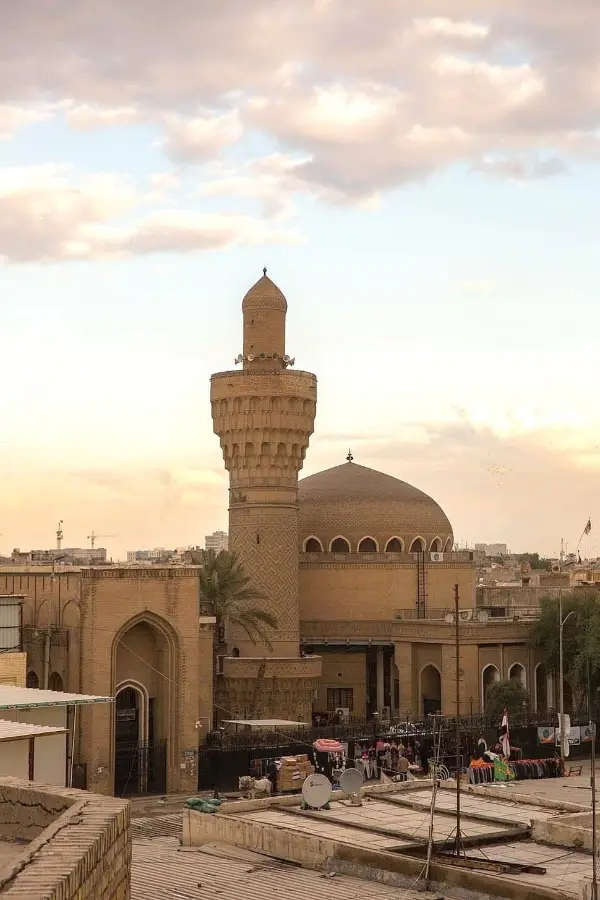
Al Khulafa Mosque
Al Khulafa Mosque (The Caliphs' Mosque) is one of Baghdad's heritage archaeological mosques, built by Caliph Al Muktafi Billah Al Abbasi between (289-295 AH / 902-908 CE) to be the congregational mosque for Friday prayers east of the Hasani Palace. It was initially known as the Palace Mosque, then called the Caliph's Mosque, and was named the Caliphs' Mosque in the recent period.
In 479 AH/1086 CE, a minaret was built for this mosque in the month of Rabi' Al Akhir. It appears that the minaret's construction came later after the mosque's construction, or the call to prayer was raised from another minaret that had collapsed and this one was built in its place, as it is unlikely that the mosque continued without a minaret for more than a century, especially since it was the ruling Caliph's mosque and the main Abbasid state mosque in Baghdad.
In 670 AH/1271 CE, the minaret fell and the mosque was demolished. The book "Al Hawadith Al Jami'a" mentions that Ala Al Din Al Juwayni (head of the bureau during the reign of King Abaqa ibn Hulagu the Ilkhanid) ordered the minaret's reconstruction, which was completed in the month of Sha'ban, then fell in the month of Ramadan after people finished Tarawih prayers, and none of those who were in the mosque during prayer were harmed.
In 678 AH/1279 CE, the minaret was rebuilt again.
Many travelers mentioned the mosque, including Ibn Battuta during his visit to Baghdad in 727 AH/1327 CE. The German traveler Niebuhr, who visited Iraq in the eighteenth century, also mentioned it, saying he saw near the Suq Al Ghazl (Yarn Market) minaret various parts of the old mosque wall and remains of two beautiful entrances, one decorated with ornamental writing.
Between (1193-1196 AH)/(1779-1802 CE), Governor Sulayman Pasha the Great rebuilt the mosque and constructed a congregational mosque west of the minaret known as Suq Al Ghazl Mosque, which remained standing until 1957, when it was demolished to open Queen Aliya Street, later renamed Republic Street, which passes through Shorja Market.
Governor Sulayman Pasha the Great also established in the mosque a scholarly school teaching intellectual and transmitted sciences, where Baghdad's scholars and notables taught, including Sheikh Yahya Al Watari and Sheikh Abdullah Al Mawsili, then his son Muhammad Afandi Al Mawsili. The school was later demolished and its features disappeared when Republic Street was built and opened.
The Palace Mosque or Caliph's Mosque was considered one of three major mosques in Baghdad (the other two being Al Mansur Mosque and Al Rasafa Mosque), and Friday prayers were held there and elsewhere during the last four centuries of the Abbasid Caliphate.
It was the official mosque of the Abbasid state, where judges' appointments were read, funerals of notables and scholars were held, and circles of learning for jurists, hadith scholars, and debaters convened. In its courtyard, social and commercial life flourished for the people of Baghdad.
Scholar Mahmud Shukri Al Alusi mentioned in his book (History of Baghdad's Mosques and Their Monuments) that this mosque was established during the reign of Abbasid Caliph Al-Mahdi in 159 AH, which contradicts reality and history, because Caliph Al Mahdi actually established the mosque known as Al Rasafa Mosque located south of Abu Hanifa Al Nu'man's cemetery (Al Khayzuran Cemetery), and urban development had not reached this area where the Palace Mosque was built during Al Mahdi's era.
The minaret is considered the tallest from which Baghdad can be seen from its summit. Its height was thirty-five meters, and currently it stands at twenty-six meters. It expresses the majesty of the Abbasid Caliphate's palace construction, and was named the Suq Al Ghazl Minaret because the mosque's land was divided and a yarn market was established on one of its eastern sides.
The minaret is distinguished by rare architectural engineering, containing two staircases reaching the minaret basin that do not meet, with two doors at the bottom and two others at the top of the minaret.
The minaret currently leans eastward due to groundwater seepage beneath its base.
At the bottom of the minaret are four layers of muqarnas (stalactite decorations) supporting the minaret's base consisting of twelve sections, topped by five layers of muqarnas that highlight its beauty.
In 1961, the Iraqi Awqaf Directorate commissioned architect Muhammad Salih Makiya to redesign and rebuild the Caliphs' Mosque in Baghdad in accordance with Abbasid-era architecture.
Muhammad Makiya based his mosque design on Islamic architecture during Abbasid times, but maintained its current architectural formation while preserving the mosque's archaeological minaret.
Muhammad Makiya integrated the minaret building with the modern mosque design to make the mosque appear as if it had never been demolished before.
The modern Caliphs' Mosque building contains an octagonal prayer sanctuary topped by a dome decorated with Kufic Arabic calligraphy. The dome's height is approximately seven meters in addition to the basic building height of about 14 meters. There are also three arcades leading to the prayer hall, and the dome's exterior surface was painted wheat-yellow to match the minaret's color, in addition to covering the sanctuary hall with gradations of yellow arranged in various geometric shapes.
Construction of the modern mosque was completed in 1964, and the mosque was opened for Friday prayer on June 6, 1966, after its reconstruction.
After the invasion of Iraq in 2003, the minaret's eastward lean was noticed. Due to lack of maintenance for the mosque's minaret, the Sunni Endowment in Iraq commissioned the Engineering Department to perform maintenance work on the mosque in agreement with UNESCO to preserve its archaeological value.
Among the scholars who held the position of imam and preacher in the mosque was Sheikh Jalal Al Din Al Hanafi, who was the mosque's imam for several decades and helped maintain and preserve the mosque. He placed in the mosque a huge library on the second floor of the sanctuary containing books and manuscripts in law, literature, jurisprudence, and sharia. This library is divided into eight corners, each containing five wooden cabinets.
Around the mosque is a beautifully crafted iron fence considered a masterpiece of art and creativity in this field. Sheikh Jalal Al Din Al Hanafi requested from the master of blacksmiths in Baghdad, Hajj Abd Al Amir Al Haddad, to make a fence befitting this mosque. The master blacksmith completed this fence in 1964, decorated with Diwani script.
Remarkably, the blacksmith Abd Al Amir Al Haddad was illiterate and could not read or write.
Visitors to this mosque can see with their own eyes the extent of this blacksmith's creativity in shaping iron into this magnificent form that has no parallel in any mosque in the Islamic world.
A Thousand Years and Still Standing
5 Min · Arabic · English
Frequently asked questions
What are the opening hours of Al Khulafa Mosque?
Al Khulafa Mosque is open 24 hours.
How much does it cost to visit Al Khulafa Mosque?
Admission to Al Khulafa Mosque is free.
How long should I spend at Al Khulafa Mosque?
Plan about ~ 30 min for Al Khulafa Mosque.
When is the best time to visit Al Khulafa Mosque?
Outside prayer times — mid-morning (after sunrise prayer settles) or mid-afternoon. Avoid Friday noon prayer.
Does Al Khulafa Mosque have an audio guide?
Yes — a narrated audio guide for Al Khulafa Mosque is available in the Travel Tale app.
Where is Al Khulafa Mosque located?
Al Khulafa Mosque is in Baghdad.

Hear the full audio story — free in the app
Get app