Al Mutanabi Street
Al Mutanabi Street is located in the center of the Iraqi capital, Baghdad, near the Al Maidan area and Al Rasheed Street.
It is considered the most important cultural market for the people of Baghdad.
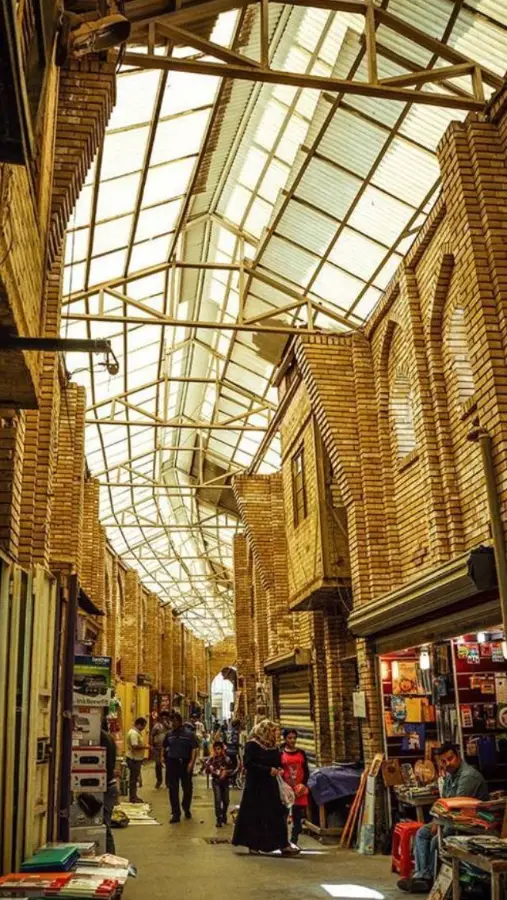
The street is famous for its book trade across all types and fields, and it is usually crowded on Fridays as readers, writers, and artists flock to it.
The street contains printing presses dating back to the nineteenth century, along with several historic bookstores that house rare books and manuscripts.
Facing the street is the Baghdad Cultural Center overlooking the Tigris River.
The center includes halls for seminars and lectures, and its courtyard serves as a gathering place for artists and intellectuals every Friday, in addition to being a platform for media coverage and television interviews.
At the end of Al Mutanabi Street lies the historic Shabandar Café, one of Baghdad’s oldest cafes and one of the most deeply rooted in the city’s cultural memory.
Today, Al Mutanabi Street is a vibrant market for selling old and new books and magazines, as well as a central hub for intellectual and cultural activity in Baghdad.
Like many areas of Baghdad, Al Mutanabi Street was subjected to a series of bombings after 2003 during periods of security instability.
On March 5, 2007, the street was hit by a car bombing that killed at least 30 people and wounded dozens. Many bookstores and buildings were destroyed, including the Modern Library (established in 1908) and the historic Shabandar Café, along with major losses to printing presses and old Baghdadi buildings.
Despite this, the street was restored and revived, and it was reopened in December 2021 after a comprehensive reconstruction and development project.
A Street of Paper… and Blood and Memory
2 Min · Arabic · English
4 stops to discover
- 1Premium
Al Shabandar Cafe
Al Shabandar Café is one of the most famous old cafés in Baghdad. The café building was previously the 'Al-Shabandar Press' which was established in 1907 and owned by Musa Al-Shabandar, who became Foreign Minister during the monarchy in 1941 in Rashid Ali Al-Gaylani's government. It has now become one of the important social clubs in Baghdad, and is considered one of the important cultural landmarks in Iraq, where discussions about culture, art, poetry, and politics take place. It is frequented by ordinary people, merchants, employees, and writers, and Iraqi politicians and intellectuals used to gather there. The café is distinguished by its authentic Baghdadi architectural style, built from brick and plaster, and retains its old wooden furniture and traditional tea samovars. Its walls are adorned with historical photographs of prominent figures such as King Faisal I, Khalil Pasha, and Umm Kulthum, making it resemble a living museum of Baghdad's memory. In March 2007, the café was subjected to a terrorist bombing that killed more than 100 people, including four of the café owner's sons, Haji Mohammad Al-Khashali, and his grandson. Despite this tragedy, the café was rebuilt with support from the state and community, and was given the title 'Martyrs' Café' in honor of the victims.
- 2Premium
Al Mutanabi Statue
The Al Mutanabi statue was created in 2009 by the Iraqi sculptor Saad Al Rubaie as part of the project to rehabilitate Al Mutanabi Street after the terrorist bombing that targeted it in 2007. Today, the statue stands at the heart of the street as a symbol of Arab culture and a prominent landmark in the literary memory of Baghdad. Abu Al Tayyib Al Mutanabi (303–354 AH / 915–965 CE) He is considered one of the greatest Arab poets of all time so highly esteemed that he was called “The Poet of the Arabs” and “He Who Filled the World and Preoccupied the People,” due to the power, depth, and influence of his poetic talent. He was born in 915 CE, and his poetic gift appeared early; he composed poetry at the age of nine. He was known for his intelligence, sharpness, and diligence. Al Mutanabi was a wise, prolific, and innovative poet, known for his maxims, aphorisms, and original meanings. His poetic legacy amounts to around 326 poems that vividly depicted the political and social life of the fourth Islamic century. His poetry is distinguished by its powerful expressions, eloquent language, and rich imagination. He left an exceptional impact on Arabic literature, and he is regarded as one of the greatest glories of Arabic poetry. Al Mutanabi grew up during a turbulent era marked by the fragmentation of the Abbasid state and the rise of competing principalities and emirates amid conflicts, wars, and invasions. Poets of that time often moved between the courts of princes, offering praise and participating in intellectual and political life. In this unstable world, Al Mutanabi’s talent matured and his ambition took shape, and he lived his most productive years in the court of Sayf Al Dawla Al Hamdani in Aleppo. The turmoil of his era was reflected in his poetry; he wrote about battles, ambition, wisdom, the philosophy of life, human nature, and the qualities of the human soul. His poetry expressed pride in the self and in Arab identity, mastery of style, and the power of imagination, to the extent that his work is considered a historical record of an entire era. Al Mutanabi harshly satirized Dabba ibn Yazid Al Asadi, which caused Dabba’s clan to harbor hostility toward him. On his way back to Kufa, he was intercepted by Fatak ibn Abi Jahl Al Asadi (Dabba’s maternal uncle) and his group near Al Numaniyah, close to Dayr Al ‘Aqool southwest of Baghdad. Fighting broke out, and Al-Mutanabbi, his son Muhammad, and his servant Muflih were all killed.
- 3
The Friday Book Market
Every Friday the booksellers of Al-Mutanabbi Street spread their stock across the lane and pavements, and readers, poets and collectors pour in to browse, haggle and talk. It is the living ritual of Baghdad's literary culture, the soul of a city that famously 'reads.'
- 4
Al-Mutanabbi Street Starts Here
On 5 March 2007 a car bomb ripped through this street of booksellers, killing more than 26 people and gutting its historic shops. The atrocity inspired the international 'Al-Mutanabbi Street Starts Here' coalition of artists and writers, and the rebuilt street now carries that defiant memory alongside its books.
Near Baghdad
Hear the full audio story — free in the app
Get app


%2520-%2520Irak%2520-%2520Bagdad%2520-%2520Mosqu%25C3%25A9e%2520al-Mur%25C3%25A2diyah%2520(M%25C3%25A9diHAL%25204934377).jpg&w=3840&q=75)