
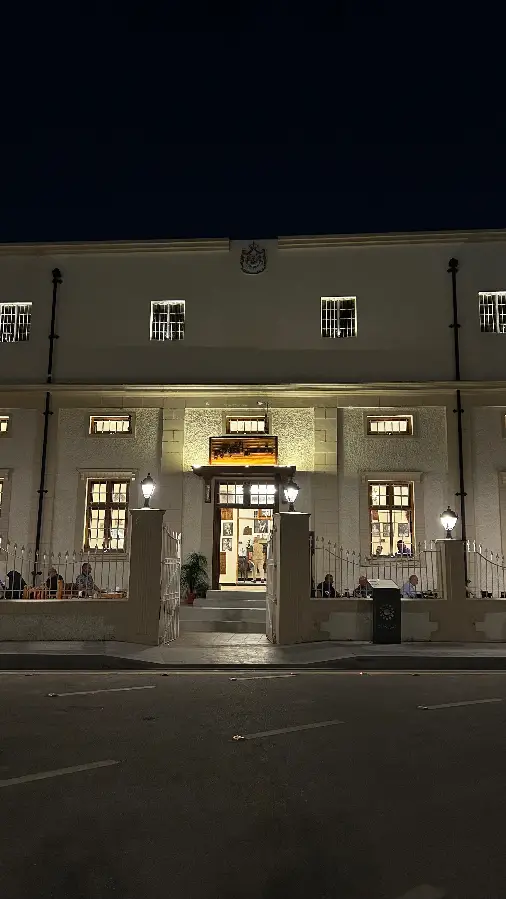
Al Qubbanji Cafe
The General Directorate of Awqaf in Baghdad was built in 1929 to serve as one of the most important religious and administrative institutions in Iraq, and as a center for managing Islamic endowments and organizing mosques, husseiniyas, and religious libraries. The building stood as a symbol of dignity and reverence, housing a large archive of manuscripts and documents within its walls, and featuring a Baghdadi architectural style that blended Ottoman art with local identity.
Before the building was constructed, this piece of land was a garden attached to Al Saray Mosque, surrounded by a low wall. It remained so until the late 1920s, when the first floor of the directorate was built during the monarchy as the headquarters of the General Directorate of Awqaf.
The building is characterized by an eclectic style, where various architectural and artistic elements were incorporated into its structure. This is clearly visible in the outer wall, which combines interlaced motifs inspired by classical art with printed Greek Corinthian columns.
The façade also displays the historical plaque bearing the name of the building, in addition to a reproduction of the royal emblem placed above the entrance as a replacement for the older original emblem.
After decades as an official institution, the building was transformed into a café called “Al Qubbanji Café” after being leased to a private investment company, as part of a trend in Baghdad to convert heritage buildings into commercial projects under the theme of “tourism activation.”
The word Qubbanji is derived from al qubbān, meaning “the long-armed scale,” and refers to “the weigher.” It is said that the term has Greek origins, meaning “scale” or “bell.”
The name may have been chosen as a symbol of balancing past and present in one place, where royal-era memory meets modern usage.
Despite the change in function, many of the building’s original elements remain, such as the old wooden doors, arched ceilings, and tiles decorated with Islamic motifs.
The sounds of visitors and café utensils have now replaced the voices of clerks and the stamping of documents, yet the architectural details continue to narrate the history of the building.
Inside the café, photographs of figures from the royal era are displayed, such as King Faisal I, King Ghazi, and King Faisal II,
alongside images from the republican era such as Abd Al Karim Qasim and Abd Al Salam…
The Balance Between Two Eras
4 Min · Arabic · English
Frequently asked questions
What are the opening hours of Al Qubbanji Cafe?
Open until 02:00
How much does it cost to visit Al Qubbanji Cafe?
Admission to Al Qubbanji Cafe is free.
How long should I spend at Al Qubbanji Cafe?
Plan about ~ 30 min for Al Qubbanji Cafe.
When is the best time to visit Al Qubbanji Cafe?
Mid-morning or late afternoon — softer light and lighter foot traffic.
Does Al Qubbanji Cafe have an audio guide?
Yes — a narrated audio guide for Al Qubbanji Cafe is available in the Travel Tale app.
Where is Al Qubbanji Cafe located?
Al Qubbanji Cafe is in Baghdad.

Hear the full audio story — free in the app
Get app