Al Rasheed Street
HistoricalMust visit Audio guide

Al Rasheed Street

Rusafa / Saray-Mutanabbi
About

Al-Rasheed Street stands as one of the oldest and most iconic avenues in Baghdad a timeless symbol of the city’s diverse history and a stage for its cultural, political, and social events.

It was named after the Abbasid Caliph Harun Al Rasheed, whose era marked the golden age of Baghdad. However, the street’s history predates its name.

Its origins trace back to the Ottoman era, when Khalil Pasha the Ottoman governor of Baghdad and military commander carved a strategic road extending from Bab Al Sharqi to Bab Al Mu'azzam. It was initially called "Khalil Pasha Caddesi" (Khalil Pasha Avenue), a military project aimed at facilitating the movement of Ottoman troops and carriages. The road was hastily completed in 1910 despite facing legal, social, and financial obstacles, which led to adjustments in its path often at the expense of properties owned by the poor, the absent, or those without heirs.

With the British occupation of Baghdad in 1917, the name of the street changed first to “Hindenburg Street”, then to “Victory Street”, before it finally settled during the monarchy on “Al Rasheed Street” a name that would become a national icon etched into memory and maps alike. Al Rasheed is more than a geographic label; it is a cultural artery pulsing with collective memory.

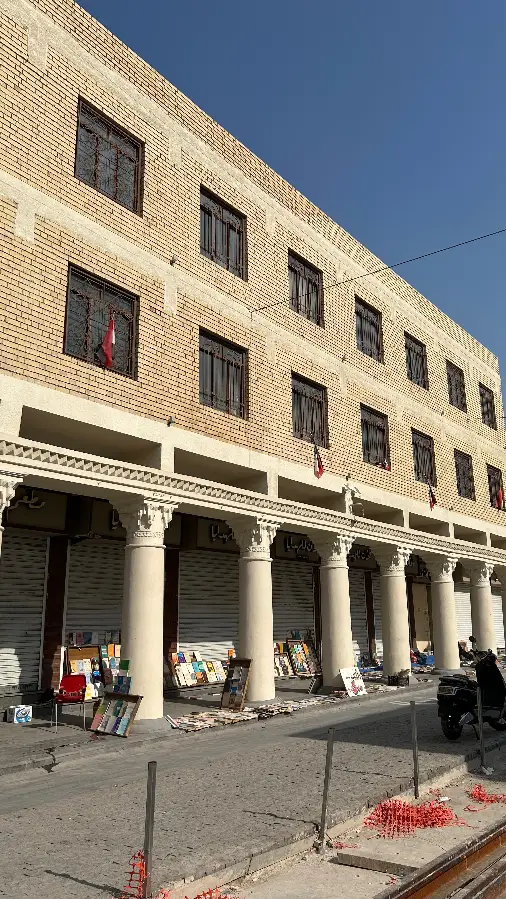
The street stretches from Al Maidan Square near Bab Al Mu'azzam, through the old markets like Al Shorja, all the way to Bab Al Sharqi forming a bridge between commerce and spirit, religion and culture, past and present. It was once home to literary cafés, poetry readings, newly opened cinemas, and the bustling world of newspapers and political discourse. The street housed major landmarks such as the Haidar Khana Mosque and Al Saray Market, and became a stage for Baghdad’s public life from national parades to popular uprisings, including the attempted assassination of Prime Minister Abd Al Karim Qasim following the July 14 Revolution in 1958.

One of the most notable cultural landmarks born on this street was the Jaqmaqji Phonograph Company, established in 1918. It became a sonic and cultural beacon, recording the voices of Iraqi musical legends such as Mohammed Al Qubbanji, Nazem Al Ghazali, Dakhil Hassan, Hadheri Abu Aziz, and Salima Pasha. The company even recorded Arab icons like Umm Kulthum, Abdel Halim Hafez, and Farid Al Atrash, creating a musical archive that later became a national treasure.

Al Rasheed Street also witnessed a historic visit by Umm Kulthum in 1932, when she performed a series of concerts at the Al Hilal Cabaret. The ticket prices were unprecedented for the time. The Al Istiqlal newspaper covered the event with an article titled “The Magic of Babylon and Pharaoh in Al Hilal Cabaret”, noting that the “Star of the East” gave twelve performances starting October 18, 1932 a moment that captured the city’s awe before a living legend.

On both sides of the street, cinemas once flourished such as Royal, Central, Al Rasheed, Al Zawraa, and the open-air Rafidain Cinema. Some later transformed into theaters or commercial centers, like Al Zawraa Cinema and Roxy Cinema, now known as “Al Najah Theater”. Each transformation added a new layer to the street’s evolving narrative.

But with the wars and turmoil that Iraq experienced in recent decades, Al Rasheed Street fell into a period of stagnation and neglect. That began to change in 2023 with the launch of the “Pulse of Baghdad” initiative a government-led project to revive the old city, starting with Al Mutanabbi Street, which was renovated and reactivated as a lively cultural hub. This was followed by the restoration of Al Saray Street, preserving its historic architectural character. Today, Al Rasheed Street stands in the final stages of its rehabilitation, awaiting the official announcement of its reopening a cultural and touristic gateway aiming to restore Baghdad as we knew it: a city that resists oblivion and reclaims its glory through the dew of memory.

Audio story

One Hundred Years of Iraqi Transformations

5 Min · Arabic · English

Listen in the app
Audio experiences

10 stops to discover

  1. 1

    Al Rasheed Tram

    The Al Rasheed Tram is one of the standout initiatives by the "Nabdh Baghdad" (Baghdad’s Pulse) project, aimed at reviving Al Rasheed Street and restoring its former glory while preserving its authentic heritage. The tram takes you on a tour starting from Al Midan Square to the Ma'ruf Al Rusafi Statue, passing through pillars of history. You will glide past "Hajji Zbala Refreshments," which has stood firm for over a century, and the cafes built to honor "Umm Kulthum" during her historic visit decades ago. The journey also takes you by the Haydar Khana Mosque, from whose pulpit the most powerful speeches against the British occupation once echoed. Riding the tram on Al Rashid Street is not just a passing trip; it is a short commute that leaves a long-lasting impression of warmth and nostalgia in the heart.

    Premium
  2. 2

    Haji Zbala Refreshments

    On Al-Rasheed Street, where the scent of history mingles with the aroma of raisin syrup, stands Haj Zbala one of the oldest and most renowned traditional juice shops in Iraq. A living heritage landmark, it has witnessed the passage of time and the succession of rulers. This iconic shop was first established in 1900 in the Karkh district, before moving to its current location in 1912. Since then, it has become a cultural and spiritual symbol of Baghdad maintaining its simple character and traditional method of preparing sharbat al zabeeb (raisin syrup), which has become a hallmark of the Baghdadi palate and a favorite among locals and visitors alike. Over more than a century, the shop has gained fame for serving natural raisin syrup, made from premium-quality raisins specially sourced from northern Iraq, particularly from regions such as Khushnaw, Dukan, and Duhok. The raisins are soaked, pressed, and fermented using a traditional, inherited manual process without any artificial flavors giving the drink its authentic taste, rich texture, and refreshing character. It has come to represent the generosity of Baghdad and the spirit of its traditional craftsmanship. Throughout its long history, the shop has welcomed customers from all walks of life from humble passersby to kings and heads of state. Among the notable figures who have visited or tasted its famous drink are: King Faisal I, King Ghazi, King Faisal II, Nuri al-Said, Abd al-Karim Qasim, Abd al-Salam Arif, Saddam Hussein, King Hussein of Jordan, Hosni Mubarak, and Yasser Arafat. This has made the shop a rare place where the everyday meets the historic, and where popular taste intersects with political presence a unique image that cannot be replicated. As for the man behind the name that became associated with Baghdadi popular taste his real name was Haj Abd Al Ghafoor. But people know him by the nickname “Zbala” (meaning “trash”), a name his mother gave him according to an old folk tradition. This practice was based on the belief that children who had lost siblings were given odd or undesirable names such as "Zbala" to ward off envy or bad luck, in hopes that the child would survive. The name grew to become a symbol, tied to a unique popular product. Many Iraqis even believe that “Zbala” is a brand name rather than a real person. But the story carries within it a deep cultural narrative that blends folklore, belief, and family memory. Thus, Haj Zbala’s shop was never just a place to serve raisin syrup. It became a meeting point of classes, eras, and symbols a place that, in its simplicity, embodies the deep-rooted identity of Baghdad. Here, a humble name can become a legend told at a street corner, its taste engraved in the memory of an entire city.

    Premium
  3. 3

    Al Zuhawi Cafe

    Al-Zahawi Café is considered one of the oldest cultural and historical cafés in Baghdad, as it was established in 1917 in the Haydar Khana area, near Al-Mutanabbi Street, the stronghold of books, readers, and intellectuals. The café was built on endowed land belonging to a scholarly family from the Al-Khatib household, and originally contained a small mosque attributed to Asmaa Khatoun. Later, the place turned into what was then known as “Ameen Café”, before a small hotel was built above it. The poet Jamil Sidqi Al-Zahawi used to frequent this café regularly, sitting with writers and intellectuals to exchange stories, jokes, and literary gatherings. Upon his death on February 20, 1936, the Baghdad Municipality decided to honor his name by renaming the café to “Al-Zahawi Café,” in recognition of his intellectual and literary stature in Iraq. For many years, the café served as a rare meeting point for Iraq’s cultural elite — including parliamentarians, sheikhs, poets, writers, and journalists. Among its frequent visitors were the folk poet Mulla Aboud Al-Karkhi, the satirical writer Nouri Thabet (Habezbouz), as well as lovers of Arabic heritage, who exchanged verses by Al-Mutanabbi, Ahmed Shawqi, Hafiz Ibrahim, and other giants of poetry. The place also hosted musical sessions with leading artists like Mohammed Al-Qubanchi and Yusuf Omar, making it a space that united art and intellect. In the 1980s, the current building of the café was constructed. After the death of its tenant, Salman Al-Kandir, it was inherited by an elderly woman — opening the door for competition over the location, given its high commercial value, being situated at the intersection of Hassan Bin Thabit Street on one side and Al-Rasheed Street on the other. Attempts began to seize the café and transform it into a different commercial activity, and the issue quickly became one of public concern thanks to a campaign led by writers and journalists against the erasure of this cultural landmark. Despite threats and financial temptations, these individuals continued their struggle and managed to meet with the head of state and the Mayor of Baghdad, to explain the importance of the place as a symbol of Baghdad’s cultural identity. Their efforts were crowned with a government decision to preserve the café under the name Al-Zahawi, and to restore its original function as a heritage café and a venue for literary gatherings. Although it was renovated and rebuilt, it lost many of its original patrons, who had shifted to Al-Shahbandar Café after Al-Zahawi’s temporary closure. As a result, its usual traditions faded and its old character changed. Al-Zahawi Café still stands to this day, retaining its name and location, as a silent witness to a full century of Baghdadi memory, where religion, thought, art, politics, poetry, and music once blended in a single cup of coffee.

    Premium
  4. 4

    Planet of the East Cafe

    Planet of the East — Kawkab Al Sharq in Arabic — is one of a handful of small Baghdad coffeehouses opened by fans of the Egyptian singer Umm Kulthum after her two legendary visits to Iraq. The cafe sits on Al Rasheed Street, in the dense run of heritage venues between Maydan Square and the Mutanabbi quarter. Inside, framed photographs of Umm Kulthum cover almost every inch of wall space; her recordings play on a continuous loop; and the regulars — a mix of old men who remember her concerts firsthand and younger Baghdadis curious about the city's twentieth-century cultural memory — sit with strong black tea and dominos. A short stop, but a vivid one if you want to understand why a single Egyptian voice still defines so much of Baghdad's emotional landscape.

    Premium
  5. 5

    Umm Kulthum Cafe

    In an alleyway of old Baghdad, where the scent of tea mingles with the warm tones of authentic music, Umm Kulthum Café stands tall as one of the most prominent cultural landmarks that still retains the glow of the past amid the bustle of the present. The café, according to the most common accounts, was established in 1970 as a gathering place for lovers of the “Star of the East,” Umm Kulthum. However, other narratives indicate that the place originally dates back to the monarchical era, and carried a different name before it was renamed in honor of the immortal voice, who visited Baghdad on two historic occasions: in 1932 and 1946. Inside the café, the walls whisper stories of longing; they are adorned with dozens of rare photos of Umm Kulthum, while her music plays throughout the day, making the place feel like a small museum for lovers of classical Arabic music. But Umm Kulthum Café is not merely a place to drink tea or coffee—it is a living cultural space, where poets, artists, writers, and intellectuals gather to exchange memories and recall a time when songs were crafted with words, melody, and soul. Despite the changes the city has undergone, and the emergence of modern cafés with a contemporary spirit, this café continues to resist oblivion, clinging to its traditional identity, preserving its original character as a bridge between Baghdad and Cairo, between memory and nostalgia, and between the voice of El-Sitt and the heart of those who loved her.

    Premium
  6. 6

    Legend Cultural Forum

    In the heart of Al-Rasheed Street, where the footsteps of history blend with the breath of the present, stands the “Legend Cultural Café” — a heritage café whose name clearly nods to the legendary Arab singer Umm Kulthum. Yet in reality, it is far more than a café. It is a living space for Baghdad’s cultural memory — a meeting point for generations, voices, and ideas. Established in 1968 by Haj Abdul-Mu'in Al-Mawsili, the café was, from its inception, a place devoted to lovers of classical music, literature, and open dialogue. Poets, journalists, and artists from Baghdad and beyond gathered here, transforming it into an informal platform for sharing poetry, ideas, and memories. Located in the old city of Baghdad, specifically on Al-Rasheed Street — one of the capital’s most historically significant thoroughfares — the café has, over time, evolved into a prominent landmark. Not only for lovers of coffee and music, but for those in search of the warmth of memory and a connection to place. When a visitor steps into this space, they are greeted by walls adorned with rare photographs of Umm Kulthum, while her timeless songs flow from the speakers — melodies still sung on lips and hearts — creating a full sensory experience that takes one back to an era when words were weighed like gold, and voices were counted among a nation’s treasures. The café’s role extends beyond the artistic scene. It is also a cultural and folkloric symbol at the heart of Baghdad, evoking a time when cafés were hubs of cultural and intellectual radiance — safe spaces for conversation and openness. Today, it offers its patrons a rare opportunity to sit quietly amidst the city’s noise, whether to read a newspaper or a book, or simply to enjoy a moment of mental stillness so lacking in the modern world. It has become an ideal place for casual, friendly meetings among the city’s intellectuals — like a poet’s rest stop or an artist’s harbor amid a river of stories. Thanks to its symbolism and location, the café has become one of the most prominent spaces embodying the cultural memory of modern Iraq — not only because it honors the name of Umm Kulthum, but because it reimagines the popular urban space as a domain for art, knowledge, and identity. It stands as a testament that culture does not die — it merely changes form and continues to live on, in coffee cups, in the sounds of the oud, and in the tales of visitors who never grow tired of returning.

    Premium
  7. 7

    Abdul Karim Qasim Statue

    In the heart of Baghdad, and along the historic Al-Rasheed Street, stands the statue of Abd al-Karim Qasim as one of the modern commemorative landmarks that bear a blend of national symbolism and artistic expression. This monument was erected in 2005 in honor of Brigadier Abd al-Karim Qasim, the leader of the 14 July 1958 Revolution, which ended the monarchy in Iraq and declared the establishment of the Republic of Iraq. The statue was crafted by the prominent Iraqi sculptor Khalid al-Rahal, using bronze, to embody in the features of the face and the posture of the body a focused image of the leader who carried on his shoulders the dreams of his people for change, and who represented a profound historical turning point that redrew the map of power and state in modern Iraq. The statue was placed in Abd al-Karim Qasim Square, which was specially created to commemorate his legacy, in a central location in the city, where the daily movement of citizens intersects with the national memory. Over time, the statue became a visible symbol of a pivotal transitional phase in Iraq’s history, especially as Abd al-Karim Qasim was the first republican ruler of Iraq after the fall of the monarchy, holding senior positions that combined Prime Minister, Minister of Defense, and Commander of the Armed Forces. Abd al-Karim Qasim was born on Saturday, November 21, 1914, in Al-Mahdiya district, one of Baghdad’s popular neighborhoods, to a poor family—a Sunni father who worked as a carpenter, and a Shiite mother from the Banu Tamim tribe. His family later moved to the Al-Suwaira district in search of livelihood, where he began his elementary studies, before returning to Baghdad to complete his education. He worked briefly as a teacher, then joined the military, entering the Military College in 1932, and graduated with distinction in 1934 as a second lieutenant. He rose through the ranks until he became a brigadier, participating in several wars and military movements, including the Palestine War, the Euphrates uprisings, and the May 1941 movement. He received numerous medals and was described in military reports as an excellent and ethical officer, qualified to be among the major leaders. Qasim was one of the founders of a secret organization known as "Mansuriyah al-Jabal", then joined the Free Officers Movement and became a member of its higher committee. He took part in planning and executing the 14 July 1958 Revolution alongside Abd al-Salam Arif, which overthrew the monarchy through a republican declaration broadcast from Iraqi Radio, accompanied by bloody events, most notably the execution of the royal family, marking the start of a new rule that sparked widespread internal and external controversy. During his rule, Qasim carried out a wide range of political, social, and economic reforms: he abolished the feudal system, enacted agricultural reform laws, distributed state lands to peasants, passed the 1959 Personal Status Law granting Iraqi women unprecedented rights, established residential districts for employees and low-income citizens, linked rural areas with cities through road projects, built hospitals and schools, and armed the Iraqi army through agreements with the Soviet Union. He directed Iraq toward a policy of positive neutrality instead of alignment with the Western bloc, ended British influence in the country, withdrew from the Arab Union with Jordan, and provided financial and military support to liberation movements in the Gulf, Jordan, and Palestine. He also sought to establish a Palestinian Liberation Army, making him a controversial figure—a mix between a popular reformist leader and a decisive head of state. Despite his achievements, his rule witnessed political unrest and internal conflicts between nationalist and leftist forces. He faced multiple coup attempts, until the decisive day came on February 8, 1963, when he was overthrown in a bloody coup led by Ba’athists and Arab nationalists, arrested, and executed the next day, February 9, thus ending a fierce chapter of Iraq’s history and beginning another with a different vision and approach. In the end, this statue serves as a memorial icon for a figure who captivated the nation and embodied broad hopes and great ambitions for a people longing for justice, dignity, and sovereignty. It reminds everyone who passes through Abd al-Karim Qasim Square of a turbulent history rich in transformations, and of a leader who never left the conscience of Iraqis, no matter how differing opinions about him may be. His statue remains standing in the heart of Baghdad—just as he stood one July morning and declared to the people that Iraq had entered a new era.

    Premium
  8. 8

    Marouf Al Rusafi Statue

    In the heart of Al-Rasheed Street, specifically at Al-Ameen Square near Al-Saray Market and the historic Al-Mustansiriya School, stands the statue of the great Iraqi poet Ma’ruf al-Rusafi, considered one of the most prominent cultural and artistic landmarks in the Iraqi capital, Baghdad. The statue was unveiled in 1970, as a memorial commemorating a poet who represented the conscience of his era, and the voice of the people in moments of transformation and protest. This enduring statue was designed by artist and sculptor Ismail Fattah al-Turk, using bronze, and it rises tall with its precise details, expressing al-Rusafi’s contemplative stance and confident gaze — in a rare blend of artistic realism and symbolic depth — making the statue a lasting witness to al-Rusafi’s literary stature and his enlightened spirit that left a deep imprint on Iraqi memory. The statue represents the figure of Ma’ruf Abd al-Ghani al-Jabari al-Husseini, born in Baghdad in 1875, to a Kurdish father who worked in the Ottoman administration, and an Arab mother from the Qaraghol tribe. He grew up in a poor environment in the Al-Mahdiya district, and received his early education in kuttab schools and religious schools, then studied under some of Baghdad’s senior scholars, such as Abdul Wahhab al-Na’ib, Qasim al-Qaisi, Qasim al-Bayati, and Mahmoud Shukri al-Alusi, whom he accompanied for twelve years and graduated under his tutelage. Al-Alusi gave him the name “al-Rusafi”, to match in nobility and reputation a Sufi sheikh known as Ma’ruf al-Karkhi. Al-Rusafi began his career as a teacher at Al-Rashidiya School, then moved to teach at the secondary school in Baghdad, and traveled to Istanbul where he taught at the Shahaniyya College, and worked in journalism, including for Sabīl al-Rashād newspaper. He was elected to the Ottoman parliament (Majlis al-Mab'uthan) in 1912 and 1914, then appointed to the Teachers' House in Jerusalem in 1920, before returning to Baghdad where he founded Al-Amal newspaper, was elected a member of the Arabic Language Academy in Damascus, and held various educational positions such as inspector in the Directorate of Education and professor at the Higher Teachers' House (Dar al-Muallimeen al-‘Aliyah). His travels between Istanbul, Jerusalem, Baghdad, Constantinople, and Damascus shaped his literary and intellectual personality, which combined Arab identity, social awareness, and influence from religious and political reform. Al-Rusafi’s style was marked by strong language, rigorous expression, and firm logic, and he held bold critical views on politics, religion, authority, and society. His poetry was compiled in the famous “Diwan al-Rusafi”, which was divided into eleven chapters addressing topics such as the universe, religion, philosophy, politics, society, war, elegy, descriptions, women’s world, and more. In it, he tackled national issues, expressed the misery of the poor, resisted colonialism, exposed tyranny, and called for social and political revolution for justice and freedom. Al-Rusafi was a contemporary of poet Jamil Sidqi al-Zahawi, and they both advocated for women’s liberation and the removal of the traditional cloak (abaya). However, their relationship was not without literary rivalry and sharp competition, and several debates and clashes were recorded between them, reflecting the intellectual vitality of Iraq’s early 20th-century renaissance. Thus, the al-Rusafi statue is not just a sculpture by the roadside, but a visual representation of a rebellious poet, a defiant mind, and a resilient national spirit, which remained present in literature, politics, and social consciousness. And so, the statue of Ma’ruf al-Rusafi stands today at the crossroads of time and pavement, reminding passersby that when a word is sincere, it remains stronger than the sword, and more enduring than any passing power.

    Premium
  9. 9

    The Literary Coffeehouses

    Along Al-Rasheed Street stood storied cafes, the Brazilian Cafe, Hassan Ajmi and al-Zahawi among them, that nurtured modern Iraqi literature and hosted poets such as al-Jawahiri, al-Rusafi and al-Zahawi. To sit here is to share a table, in spirit, with the giants of 20th-century Iraqi verse.

  10. 10

    Front Line of the 1920 Revolt

    This avenue was a front line in the 1920 Iraqi revolt against British rule, with anti-British protests centred on its Haydar-Khana Mosque. Walking beneath its colonnades, you follow a street that has carried Baghdad's political passions for over a century.

Hear the full audio story — free in the app

Get app