
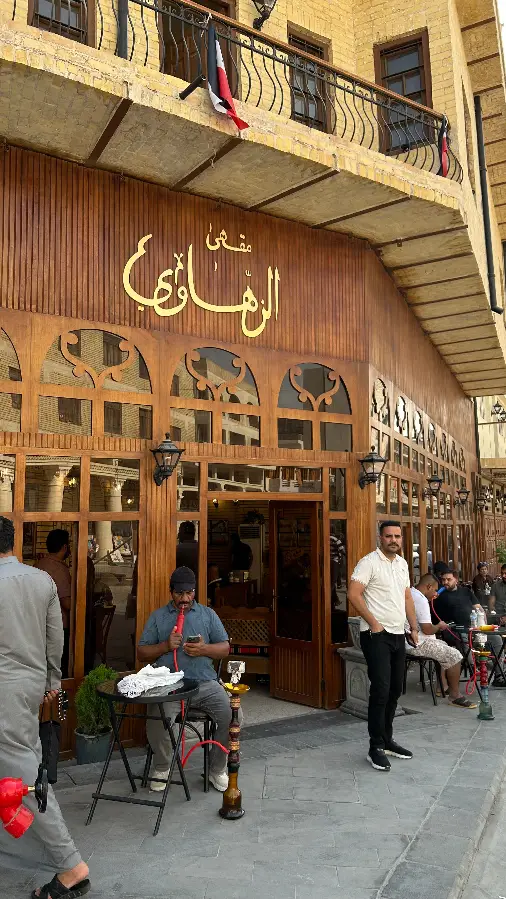
Al Zuhawi Cafe
Al Zahawi Café is considered one of the oldest cultural and historical cafés in Baghdad, as it was established in 1917 in the Haydar Khana area, near A Mutanabbi Street, the stronghold of books, readers, and intellectuals.
The café was built on endowed land belonging to a scholarly family from the Al Khatib household, and originally contained a small mosque attributed to Asmaa Khatoun. Later, the place turned into what was then known as “Ameen Café”, before a small hotel was built above it.
The poet Jamil Sidqi Al Zahawi used to frequent this café regularly, sitting with writers and intellectuals to exchange stories, jokes, and literary gatherings.
Upon his death on February 20, 1936, the Baghdad Municipality decided to honor his name by renaming the café to “Al Zahawi Café,” in recognition of his intellectual and literary stature in Iraq.
For many years, the café served as a rare meeting point for Iraq’s cultural elite including parliamentarians, sheikhs, poets, writers, and journalists.
Among its frequent visitors were the folk poet Mulla Aboud Al Karkhi, the satirical writer Nouri Thabet (Habezbouz), as well as lovers of Arabic heritage, who exchanged verses by Al Mutanabbi, Ahmed Shawqi, Hafiz Ibrahim, and other giants of poetry.
The place also hosted musical sessions with leading artists like Mohammed Al Qubanchi and Yusuf Omar, making it a space that united art and intellect.
In the 1980s, the current building of the café was constructed. After the death of its tenant, Salman Al Kandir, it was inherited by an elderly woman opening the door for competition over the location, given its high commercial value, being situated at the intersection of Hassan Bin Thabit Street on one side and Al Rasheed Street on the other.
Attempts began to seize the café and transform it into a different commercial activity, and the issue quickly became one of public concern thanks to a campaign led by writers and journalists against the erasure of this cultural landmark.
Despite threats and financial temptations, these individuals continued their struggle and managed to meet with the head of state and the Mayor of Baghdad, to explain the importance of the place as a symbol of Baghdad’s cultural identity.
Their efforts were crowned with a government decision to preserve the café under the name Al Zahawi, and to restore its original function as a heritage café and a venue for literary gatherings.
Although it was renovated and rebuilt, it lost many of its original patrons, who had shifted to Al Shahbandar Café after Al Zahawi’s temporary closure. As a result, its usual traditions faded and its old character changed.
Al Zahawi Café still stands to this day, retaining its name and location, as a silent witness to a full century of Baghdadi memory, where religion, thought, art, politics, poetry, and music once blended in a single cup of coffee.
A Cup of Memories
3 Min · Arabic · English
Frequently asked questions
What are the opening hours of Al Zuhawi Cafe?
Al Zuhawi Cafe is open 24 hours.
How much does it cost to visit Al Zuhawi Cafe?
Admission to Al Zuhawi Cafe is free.
How long should I spend at Al Zuhawi Cafe?
Plan about ~ 30 min for Al Zuhawi Cafe.
When is the best time to visit Al Zuhawi Cafe?
Mid-morning or late afternoon — softer light and lighter foot traffic.
Does Al Zuhawi Cafe have an audio guide?
Yes — a narrated audio guide for Al Zuhawi Cafe is available in the Travel Tale app.
Where is Al Zuhawi Cafe located?
Al Zuhawi Cafe is in Baghdad.

Hear the full audio story — free in the app
Get app