
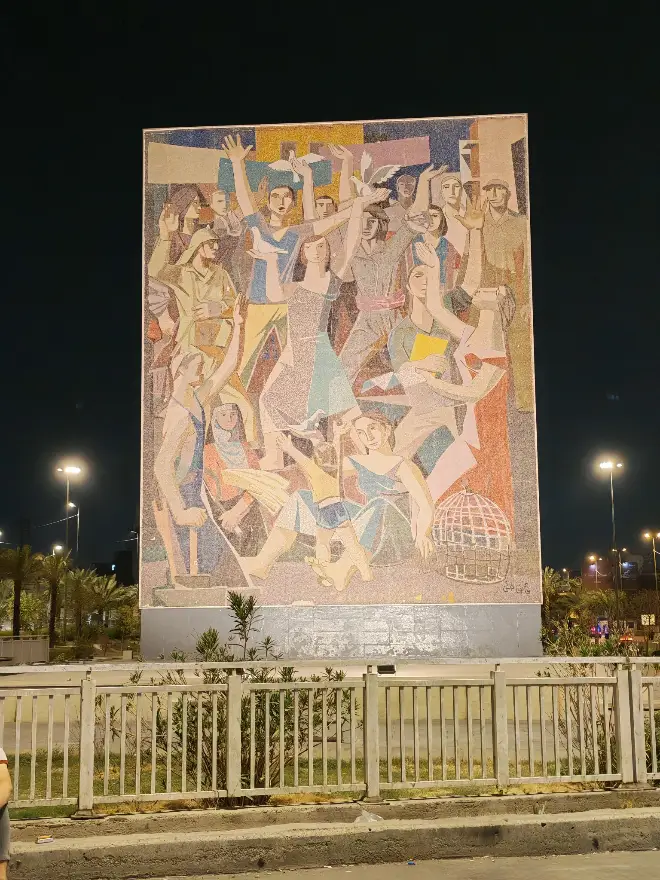
Faeq Hassan Mural
At the end of 1958, Iraqi Prime Minister Abd Al Karim Qasim commissioned the architect Rifat Chadirji to design three monuments commemorating the July 14 Revolution. Among them was the Monument of Freedom, designed by Chadirji and executed in bronze reliefs by Jawad Salim; the Monument to the Unknown Soldier, later demolished by order of Saddam Hussein; and the third monument, designed by Faeq Hassan, which would later become known as the Faeq Hassan Mural, after it inspired the renowned poet Saadi Youssef to write his famous poem “Beneath the Faeq Hassan Mural.”
The Faeq Hassan Mural, composed of thousands of small, colorful ceramic tiles, was executed in a Cubist style that combines structural solidity with dynamic composition. Mosaic was chosen for its resilience against Baghdad’s harsh climate, and the colors pulse with life. Faeq Hassan, known as the Master of Color, gave hue a symbolic force even greater than line transforming the artwork into a kinetic field of visual beauty and emotive energy.
The mural depicts symbolic scenes from the Iraqi people’s struggle against colonialism a visual narrative of their fight for liberation and peace. A unified procession of people from different social backgrounds appears in harmonious composition: a soldier, a laborer, a female farmer, a woman, a child, a student. Many of their hands are raised to the sky, some releasing white doves a clear emblem of freedom.
At the center of the mural stands a young woman with raised arms, releasing two doves into the sky. Around her, colors and bodies radiate in visual harmony, spreading joy and dignity. At the bottom of the mural, a child is seen turning his back beside an open, empty cage, as if to symbolize the lifting of constraints and the birth of a newfound freedom that swept across the nation after the revolution.
It is said that real doves were released in the square during the mural’s inauguration. Five years later, after the execution of Abd Al Karim Qasim, gunmen reportedly climbed ladders and painted the white doves on the mural black in a symbolic attempt to erase the icon of freedom, to obscure a historical moment that had once embodied the Iraqi dream.
Faeq Hassan’s influence in this mural extended beyond folkloric inspiration. He offered a modernist vision that reflected the evolution of Iraqi society and its yearning for equality and justice. The work blends symbolic expressionism, European composition, and a profound humanist message, making the mural an enduring symbol in Iraq’s visual memory.
Today, the Faeq Hassan Mural stands as a testament to the greatness of Iraqi art and its impact on the global artistic stage proof of how art can vividly portray the national spirit and collective soul, and how, through the power of color and symbol, it can eternalize revolution and freedom.
The Day the Doves Flew Away
3 Min · Arabic · English
Frequently asked questions
What are the opening hours of Faeq Hassan Mural?
Faeq Hassan Mural is open 24 hours.
How much does it cost to visit Faeq Hassan Mural?
Admission to Faeq Hassan Mural is free.
How long should I spend at Faeq Hassan Mural?
Plan about ~ 30 min for Faeq Hassan Mural.
When is the best time to visit Faeq Hassan Mural?
Late afternoon to evening — when the cultural events and street life come alive.
Does Faeq Hassan Mural have an audio guide?
Yes — a narrated audio guide for Faeq Hassan Mural is available in the Travel Tale app.
Where is Faeq Hassan Mural located?
Faeq Hassan Mural is in Baghdad.

Hear the full audio story — free in the app
Get app