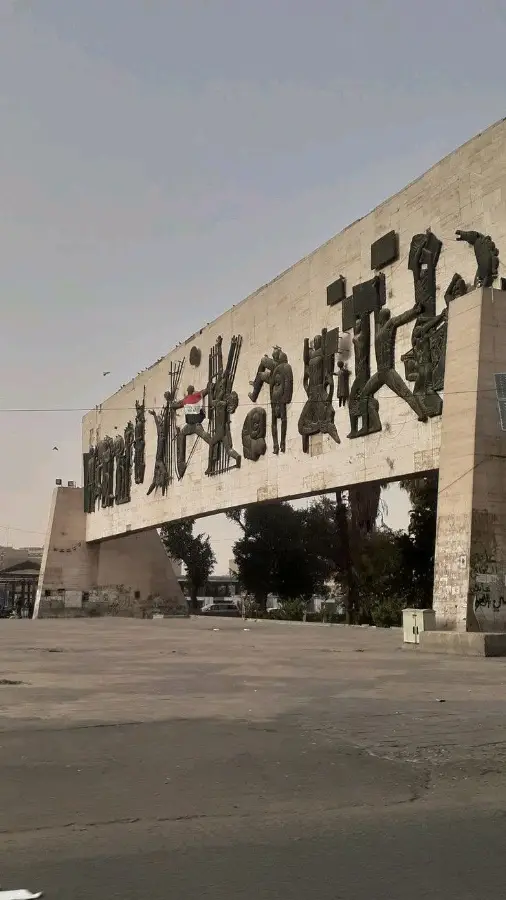
Freedom Monument
The Monument of Freedom is the point where the heartbeat of the city converges from old markets and cafés, to protesters, passersby, and the endless stories it holds.
The monument was designed by the renowned Iraqi artist Jawad Saleem (1920–1961), one of the pioneers of modern art in Iraq. The architectural structure and base were designed by Rifat Chadirji, the Iraqi architect. Work on the monument began in 1959 and was completed after Jawad Saleem’s death in 1961, following the 14 July 1958 Revolution, which ended the monarchy in Iraq.
Jawad Saleem intended the monument to immortalize the spirit of revolution and freedom, not merely its political event.
The “Monument of Freedom” (Nasb Al Hurriyah) was erected to commemorate the 14 July 1958 Revolution, led by Abdul Karim Qasim, which overthrew the monarchy and declared the Republic of Iraq.
Jawad Saleem did not aim to glorify authority through the monument, but rather to present an artistic expression of the Iraqi people, their struggle, and their triumph over oppression just as stories are told across a wall of bronze and light.
The monument is a massive bronze relief mounted on an elevated concrete base, measuring approximately 50 meters in length and 10 meters in height.
It consists of 14 sculptures and connected carvings, arranged by the artist to appear as sequential scenes from one story the story of the Iraqi people, from suffering to liberation.
Each figure represents a social class or group in Iraqi society: workers, farmers, mothers, soldiers, and students. The flowing lines and realistic proportions, inspired by Sumerian and Babylonian art, give the monument a genuinely Iraqi character.
There are no names or kings depicted in the monument only the people because Jawad Saleem believed the true hero is the people themselves.
The name “Freedom” refers not just to political liberation, but to the liberation of the human spirit from fear and injustice.
Over time, the Monument of Freedom became a national and human symbol. In recent years, Tahrir Square, where the monument is located, has become a central site for public movements and protests, especially during the October 2019 demonstrations.
During those protests, the monument served as a backdrop to demands for freedom and reform, and many artists and youth painted its image on walls, T-shirts, and flags as if it were the voice of a free Iraq.
Jawad Saleem did not live to see the monument completed, as he died shortly before its inauguration.
“Art does not change the world with weapons, but with symbols.”
In this spirit, the Monument of Freedom continues to remind Iraqis that freedom is a responsibility, art is testimony, and the people are the makers of history.
The People's Wall and the Voice of the Dream
3 Min · Arabic · English
Frequently asked questions
What are the opening hours of Freedom Monument?
Freedom Monument is open 24 hours.
How much does it cost to visit Freedom Monument?
Admission to Freedom Monument is free.
How long should I spend at Freedom Monument?
Plan about ~ 30 min for Freedom Monument.
When is the best time to visit Freedom Monument?
Late afternoon to evening — when the cultural events and street life come alive.
Does Freedom Monument have an audio guide?
Yes — a narrated audio guide for Freedom Monument is available in the Travel Tale app.
Where is Freedom Monument located?
Freedom Monument is in Baghdad.

Hear the full audio story — free in the app
Get app