
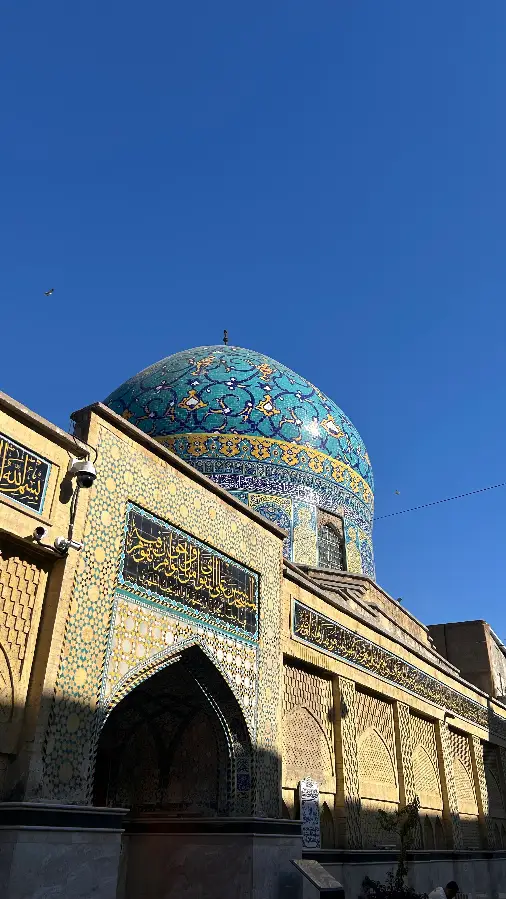
Haydar Khana Mosque
One of the oldest surviving mosques in Baghdad to this day, combining architectural beauty and national symbolism.
The mosque was built during the Ottoman era, around the year 1826, by order of Abdul Ghani Al-Jameel, one of the prominent notables of Baghdad at the time.
However, it later became known as Haydar Khana Mosque, named after one of the scholars and notables who supervised its affairs in later periods.
The mosque underwent several renovation and restoration efforts over time, most notably during the monarchical era and then throughout the late 20th century, while preserving its distinct traditional character that reflects Ottoman architecture in Baghdad.
The mosque is characterized by its decorated dome and slender minaret, which form landmarks on Al-Rasheed Street, the oldest street in the capital.
Haydar Khana Mosque was once a center for religious learning and preaching in Baghdad, and many notable scholars and jurists emerged from it.
Its halls contained a large library with rare books and manuscripts in jurisprudence, language, and history. Weekly religious lessons and gatherings for remembrance and preaching were held there until the mid-20th century.
At that time, the mosque served as a beacon of religious and intellectual culture in old Baghdad.
In the early 20th century, especially during the 1920 Iraqi revolt against the British occupation, the mosque became a center for national mobilization.
In 1920, sermons calling for resistance against the occupation were delivered from its pulpit, and the mosque served as a platform for the revolution in Baghdad.
In 1921, the first nationalist sermon against British colonialism was delivered there by Sheikh Muhammad Mahdi Al-Khalisi, one of Iraq's most prominent anti-occupation scholars.
Since then, Haydar Khana Mosque has become a symbol of Baghdadi national spirit and a free voice among the voices of Iraq.
Over the past decades, the mosque suffered from neglect and structural damage due to its age and the circumstances Baghdad went through.
However, it was later included in restoration projects supervised by the Sunni Endowment Office and the Baghdad Municipality.
Its dome and minaret were rehabilitated in the past two decades to preserve its authentic heritage character.
Haydar Khana Mosque still stands today, hosting prayers and Friday sermons, and is frequented by visitors and historians as one of the most important religious and historical landmarks in the heart of Al-Rasheed Street, where the scent of the past meets the spirit of the present.
The Platform That Spoke of Revolution
4 Min · Arabic · English
Frequently asked questions
What are the opening hours of Haydar Khana Mosque?
Haydar Khana Mosque is open 24 hours.
How much does it cost to visit Haydar Khana Mosque?
Admission to Haydar Khana Mosque is free.
How long should I spend at Haydar Khana Mosque?
Plan about ~ 30 min for Haydar Khana Mosque.
When is the best time to visit Haydar Khana Mosque?
Outside prayer times — mid-morning (after sunrise prayer settles) or mid-afternoon. Avoid Friday noon prayer.
Does Haydar Khana Mosque have an audio guide?
Yes — a narrated audio guide for Haydar Khana Mosque is available in the Travel Tale app.
Where is Haydar Khana Mosque located?
Haydar Khana Mosque is in Baghdad.

Hear the full audio story — free in the app
Get app