
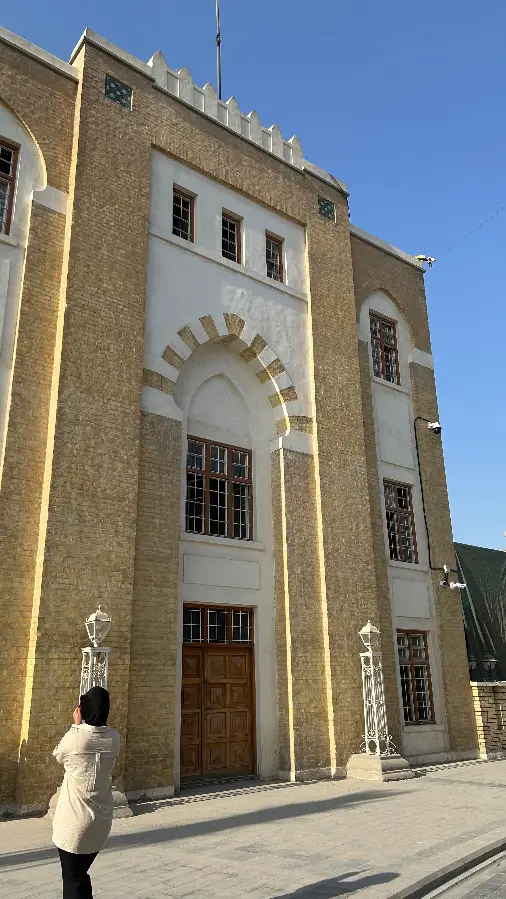
Ministry of Interior In the Royal Era
With the beginning of the Iraqi monarchy, several buildings that had been part of the old Saray administrative complex were removed, and in their place the present complex was constructed beside Al Qishla. It consists of two main buildings:
The Council of Ministers building during the monarchy, overlooking the Tigris River with an internal courtyard.
The Ministry of Interior building during the monarchy, which stands today on Al Saray Street directly in front of us.
The Ministry of Interior was established in 1921, coinciding with the founding of the Kingdom of Iraq and the enthronement of King Faisal I.
The ministry was responsible for maintaining internal security in Iraq and supervising the General Directorate of Security, which was established in the same year.
In 1924, the ministry issued the first version of the Police Instructions, prior to the issuance of the Police Service Law.
The Ministry of Interior was one of the state’s most important ministries, as it carried out security, administrative, and public service tasks that placed it in direct contact with society and tied it to the political and military events that the country passed through particularly during the periods of:
The death of King Ghazi (1939)
The Regency of Abd Al Ilah
World War II
The ministry was not a traditional administrative institution, but rather an active apparatus interacting with local and regional transformations.
During the 1940s and 1950s, the ministry established several vital departments, including:
The General Directorate of Security
The Higher Police School
The Water Supply Authority
The Radio Department
Prisons
Sewage services
The number of police personnel exceeded 24,000 in 1945, reflecting the massive expansion of the security apparatus.
The ministry played a central role in political life, as it supervised elections and became involved in:
Manipulating election results
Supporting government-aligned candidates
The minister enjoyed exceptional influence, and his salary was the highest among cabinet ministers, making the position a focal point of intense competition among prime ministers.
Despite its administrative and service expansion, the ministry faced widespread accusations of:
Administrative corruption
Cronyism
Mismanagement
Bribery
It was heavily criticized in both the Chamber of Deputies and the Senate for its management of elections and issues related to appointments and transfers.
Yet the ministry also had clear national positions, such as:
Collecting donations for Palestine
Supporting Arab causes such as Libya
The participation of some of its officers in the 1948 war
On the other hand, the ministry was extremely harsh in dealing with demonstrations and relied on the army to suppress the 1952 and 1956 protests, resulting in deaths and injuries.
It also exercised strict control over the press and political parties and often failed to distinguish between political opposition and subversive activity, which led to repeated clashes with public opinion.
The ministry worked to manage tribal conflicts and mediate disputes, but it frequently sided with feudal leaders, deepening the gap between peasants and tribal sheikhs.
It oversaw projects related to rural stability, such as:
Rural housing
Irrigation
Well-digging
particularly toward the end of the monarchy.
The ministry’s expenses increased as security and service projects expanded, while revenues remained limited, leading to a persistent budget deficit.
The security apparatus also suffered from waves of violence, disorder, and embezzlement especially in the 1940s before its performance gradually improved after World War II.
The Ministry of Interior during the monarchy was an institution with two faces:
A reformist face that built an important part of the foundations of the modern Iraqi state.
A authoritarian face associated with suppressing freedoms and restricting political life.
For this reason, its legacy remains contested between those who see it as a cornerstone of state-building and those who hold it responsible for entrenching authoritarianism and corruption.
The Ministry That Was a State
4 Min · Arabic · English
Frequently asked questions
What are the opening hours of Ministry of Interior In the Royal Era?
Open until 16:00
How much does it cost to visit Ministry of Interior In the Royal Era?
Admission to Ministry of Interior In the Royal Era is free.
How long should I spend at Ministry of Interior In the Royal Era?
Plan about ~ 30 min for Ministry of Interior In the Royal Era.
When is the best time to visit Ministry of Interior In the Royal Era?
Mid-morning to early afternoon, ideally on a weekday for fewer crowds. Photogenic in early evening light.
Does Ministry of Interior In the Royal Era have an audio guide?
Yes — a narrated audio guide for Ministry of Interior In the Royal Era is available in the Travel Tale app.
Where is Ministry of Interior In the Royal Era located?
Ministry of Interior In the Royal Era is in Baghdad.

Hear the full audio story — free in the app
Get app