
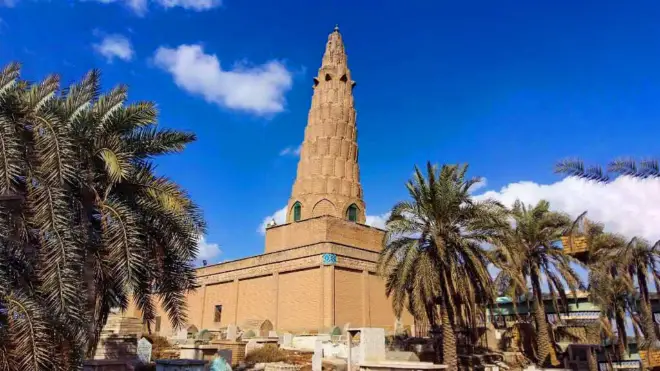
Mosque and the Shrine of Sheikh Omar Suhrawardi
The construction of the mosque dates back to the seventh Hijri century (twelfth century CE), and its name was attributed to Sheikh Omar Al Suhrawardi, who was buried in the Wardiya Cemetery.
Its architecture was renewed by Ismail Pasha, then renovated again in 1320 AH/1902 CE, and also in 1345 AH/1926 CE. The most important reconstruction and renovation was in 1384 AH/1964 CE by the Ministry of Awqaf.
He is Shihab Al Din Abu Hafs Omar ibn Muhammad Al Suhrawardi Al Baghdadi Al Shafi'i (539-632 AH), one of the scholars of Ahl Al Sunna wa'l-Jama'a and among the luminaries of Sufism in the seventh Hijri century, founder of the Suhrawardi Sufi order, and author of the book "Awarif Al Ma'arif" (The Gifts of Divine Knowledge).
He was born in 539 AH/1144 CE in Suhraward, a village in the Zanjan mountains of Iran.
When he reached sixteen, he left his village for Baghdad in the company of his uncle Sheikh Abu Al Najib Al Suhrawardi and Sheikh Abd Al Qadir Al Jilani, and learned from them and other scholars the sciences of his era.
He became famous for holding preaching assemblies, then assumed leadership of several Sufi lodges (ribats) such as Ribat Al Zuzuni and Ribat Al Ma'muniyya. The Abbasid Caliph Al Nasir Li Din Allah brought him close and he became his ambassador to kings and princes.
Imam Al Dhahabi described him as the Sheikh, the Imam, the knowledgeable scholar, the exemplar, the ascetic, the gnostic, the hadith scholar, the Sheikh of Islam, the unique one among Sufis.
Ibn Al Najjar said of him that he was the sheikh of his time in the science of reality (haqiqa), and leadership in training disciples and calling people to God and spiritual guidance ended with him.
He died in Baghdad on the first night of 632 AH/1234 CE, and was buried in the Wardiya Cemetery. A dome in the shape of a conical minaret was built over his grave in the Seljuk dome style, and a large mosque was built beside it named after him.
The mosque and shrine of Sheikh Omar Al Suhrawardi is considered one of Baghdad's ancient archaeological mosques.
This mosque is considered the third most important mosque in Baghdad after the Mosque of Imam Al A'dham Abu Hanifa Al Nu'man and the Mosque of Sheikh Abd Al Qadir Al Kilani.
The mosque contains a wide sanctuary prayer hall covering an area of 600 square meters, centered by a dome supported by ten pillars and surrounded by thick walls.
The mihrab dome is clad with marble, and inside the sanctuary prayer hall is a door overlooking the shrine of Sheikh Omar al-Suhrawardi.
A conical dome in Seljuk style rises above the shrine. It has undergone maintenance and reconstruction several times, but these did not respect the archaeological heritage aspect.
The mosque has a spacious summer prayer hall and is surrounded by an old cemetery. Five daily prayers are held there, and it accommodates more than 400 worshippers.
From the inside, at a height of six meters, a row of arches runs around the four walls, numbering twelve arches, with three arches on each wall; the middle one crowned by a scalloped arch carried on two merged plaster columns, while the other two are crowned by pointed arches.
The mosque's conical dome is considered one of the most prominent Islamic historical monuments and a model of architectural art in the Abbasid era.
It was located in a cemetery called the Wardiya Cemetery in Baghdad, which later changed its name to Sheikh Omar Cemetery after Sheikh Omar Al Suhrawardi was buried there.
It is said that beside Sheikh Omar’s shrine is a tomb or shrine attributed to the Abbasid Caliph Al Musta'sim Billah, but some doubt this because Al Musta'sim Billah's grave was found in Rabi'a Mosque in the Adhamiyah area.
This mosque thus represents an ancient Islamic architectural masterpiece combining religious and heritage value, and its conical dome remains a witness to Seljuk and Abbasid architecture in Baghdad.
During Ottoman times, the mosque had a canal opened by Baghdad's governor Hussein Pasha to bring water to the area from the Tigris River, passing through the Maidan area, then Al Fadl and Al Juba until reaching the mosque.
Many from the Suhrawardi family served the mosque, the last of whom was Sheikh Kamal Al Din Al Suhrawardi, who died in 1979 CE.
On the First Night of a New Year
5 Min · Arabic · English
Frequently asked questions
What are the opening hours of Mosque and the Shrine of Sheikh Omar Suhrawardi?
Mosque and the Shrine of Sheikh Omar Suhrawardi is open 24 hours.
How long should I spend at Mosque and the Shrine of Sheikh Omar Suhrawardi?
Plan about ~ 25 min for Mosque and the Shrine of Sheikh Omar Suhrawardi.
When is the best time to visit Mosque and the Shrine of Sheikh Omar Suhrawardi?
Outside prayer times — mid-morning (after sunrise prayer settles) or mid-afternoon. Avoid Friday noon prayer.
Does Mosque and the Shrine of Sheikh Omar Suhrawardi have an audio guide?
Yes — a narrated audio guide for Mosque and the Shrine of Sheikh Omar Suhrawardi is available in the Travel Tale app.
Where is Mosque and the Shrine of Sheikh Omar Suhrawardi located?
Mosque and the Shrine of Sheikh Omar Suhrawardi is in Baghdad.

Hear the full audio story — free in the app
Get app