
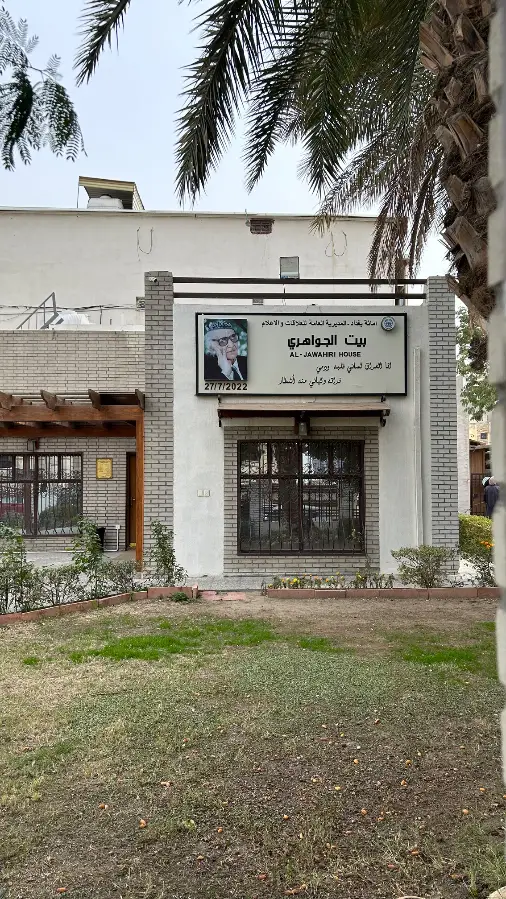
Muhammad Mahdi Al Jawahiri House
“Bayt Al Jawahiri” (The House of Al Jawahiri) is the only home ever owned by the iconic Iraqi poet Muhammad Mahdi Al Jawahiri within Iraq. He built it himself after receiving a 540-square-meter plot in the Al Qadisiyyah district, south of Baghdad, as part of a land distribution initiative for journalists. The house was completed at the end of 1971, but Al Jawahiri left it in the early 1980s, going into exile in Prague due to his opposition to the ruling regime after having spent most of his life renting homes across Baghdad.
During the 1970s, the house became a hub for Iraq’s cultural and political elite, hosting literary gatherings, debates, and discussions that brought together intellectuals from various ideological and artistic backgrounds.
However, the house later fell into neglect, deteriorating into near ruin. Despite more than a decade of appeals from Al Jawahiri’s family and Iraqi intellectuals, Baghdad Municipality did not take serious steps toward restoration until it officially took ownership of the property in 2013. The project remained on hold until August 2022, when the municipality announced the completion of renovations and the opening of the museum and cultural center, coinciding with the 25th anniversary of the poet’s death.
Today, the house has been transformed into a living museum that includes a library, an exhibition of personal belongings, and photographs chronicling his long literary journey preserving the legacy of the man often called “The Poet of the Republic.”
Al Jawahiri is regarded as one of the towering pillars of modern Arabic poetry. Known for his classical form, eloquent language, and unwavering ability to express the emotions and struggles of the people, he carved a unique place in 20th-century Arab literature.
Born in Najaf into a religious scholarly family, he studied classical Arabic sciences and memorized the works of major poets, especially Al Mutanabbi. His career spanned both education and journalism he founded several newspapers including Al Furat, Al Inqilab (The Revolution), and Al Ra’i Al ‘ Aam (Public Opinion). His poetic debut came in 1923 with his collection Hilbat Al Adab (The Literary Arena), followed by many more volumes that reflected the sorrows and upheavals of his era.
Al Jawahiri was known for his bold political stances. After a brief stint at the royal palace, he resigned following the controversy of his poem “Jarribini” (Try Me), and turned his pen against injustice leading to censorship, arrests, and exile. He founded Al Inqilab newspaper in 1936, was imprisoned for three months, and relaunched it as Al Ra’i Al ‘Aam, which was repeatedly shut down, forcing him to flee to Iran.
He helped found the National Party and was elected to parliament in 1947, but resigned in protest against the Portsmouth Treaty, especially after his brother was killed during demonstrations opposing it. In 1949, he participated in the World Peace Congress in Poland as the only Arab delegate, and was later elected to the World Peace Council.
Following the 1958 revolution, he earned the title “Poet of the Republic” and became the first president of the Iraqi Journalists Syndicate, inaugurated in the presence of Prime Minister Abdul Karim Qasim. Yet, political rifts eventually forced him into exile first to Lebanon, then Czechoslovakia, where he sought political asylum in 1961.
Al Jawahiri was also known for his trademark velvet hat, which he adopted after catching a cold in the Soviet Union and, as his daughter Khayal Al Jawahiri recalled, he never took it off, not even when sleeping.
Al Jawahiri passed away on Sunday, July 27, 1997, in Damascus at the age of 98. He was buried beside his wife in the “Maqbarat Al Ghuraba” (Cemetery of Strangers), near Sayyida Zainab.
On his tombstone, the following words are engraved his own heart-wrenching farewell to the homeland he never stopped longing for:
“Here lies a man, far from Dijla Al Khayr”
Where Poetry Resided and Became a Stranger
3 Min · Arabic · English
Frequently asked questions
What are the opening hours of Muhammad Mahdi Al Jawahiri House?
Closed
How much does it cost to visit Muhammad Mahdi Al Jawahiri House?
Admission to Muhammad Mahdi Al Jawahiri House is free.
How long should I spend at Muhammad Mahdi Al Jawahiri House?
Plan about ~ 1 Hour for Muhammad Mahdi Al Jawahiri House.
When is the best time to visit Muhammad Mahdi Al Jawahiri House?
Mid-morning to early afternoon, ideally on a weekday for fewer crowds. Photogenic in early evening light.
Does Muhammad Mahdi Al Jawahiri House have an audio guide?
Yes — a narrated audio guide for Muhammad Mahdi Al Jawahiri House is available in the Travel Tale app.
Where is Muhammad Mahdi Al Jawahiri House located?
Muhammad Mahdi Al Jawahiri House is in Baghdad.

Hear the full audio story — free in the app
Get app