
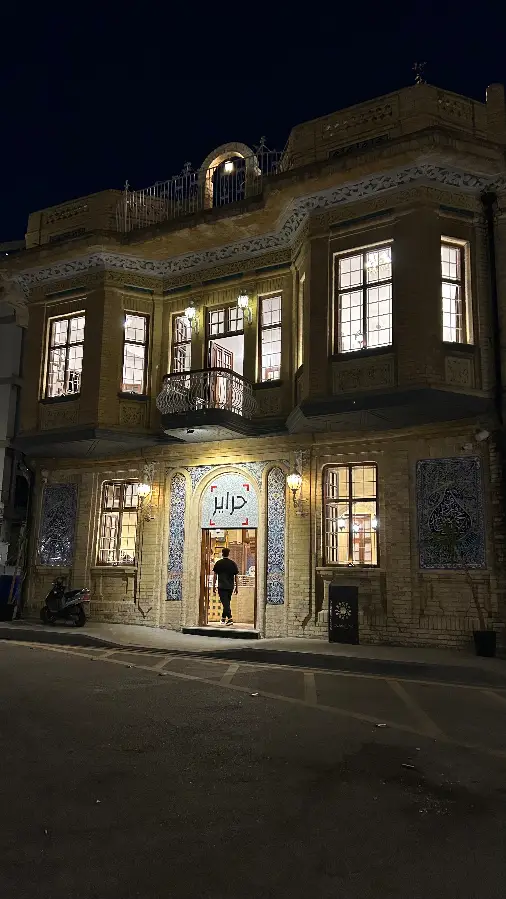
Munkhul Cafe (Regina Murad Pasha’s House)
Regina Murad Pasha (or Regina Mardkhai) was an Iraqi Jewish woman, a businesswoman, a social and artistic mediator, and one of the most influential and powerful figures in Baghdad during the 1920s and 1930s.
Her father was of Iranian origin, a Jewish merchant who had migrated to Baghdad from Istanbul after fleeing a crime for which he had been convicted. Her exact date of birth is not known.
Regina married twice:
Her first husband: Muhammad Al Bambeli, an Indian businessman residing in Baghdad.
Her second husband: Abd Al Karim Al Muhandis, with whom she had her daughter Najiyya, earning her the nickname “Umm Naji.”
She had three sisters who were well-known in the Jewish Baghdadi artistic scene: Mas‘ouda, Rosa, and Salima Murad Pasha (the wife of the singer Nazem Al Ghazali).
The fame of Salima Murad eventually overshadowed Regina’s own name in Iraq’s artistic memory.
Unlike her sisters, who were singers, Regina realized early on that singing would not grant her the influence she desired, so she chose a different path. She acquired a large amount of money from unknown sources and purchased a spacious house in Baghdad an event that marked a turning point in her life.
In her home, she established a private salon that welcomed businessmen and government officials.
Literary, musical, and political evenings were held there, in addition to other activities that formed part of Baghdad’s social and entertainment scene at the time.
Regina’s house was one of the most prominent brothels in Baghdad, and perhaps the first of its kind in the modern era.
It was said to host the most beautiful adult activity workers in the city, making it a daily destination for dignitaries and influential figures.
Regina was also a primary patron of many rising performers and dancers, such as: Banat Taha, Banat Numa, Lilo, and Khazna,
in addition to Baghdad’s famous dancers like Hanina. Their shows were held at the Metropole Hotel Theatre on Al Rasheed Street, where Regina and her sister Salima resided.
Regina’s influence expanded to include high-ranking officials of the Iraqi monarchy.
It was said that:
Cabinets were sometimes formed in her house.
Nuri Al Said borrowed money from her to build his home.
Other politicians regularly borrowed money from her with interest.
Her wealth grew to the point where she owned a car identical to King Ghazi’s automobile, and people reportedly could not distinguish between the two cars when they passed through Al Rasheed Street.
She is credited with inspiring a draft law to regulate sex work, which included provisions for:
Minimum age,
Price ranges,
Taxes,
Social insurance,
Regular medical examinations,
Licensing procedures.
This remains one of the strangest aspects of her social influence.
Regina’s activities affected the reputation of her sisters, especially Salima Murad. In Salima’s memoirs, she wrote that she avoided romantic relationships in order to preserve her public image, which had already been impacted by her sister’s lifestyle.
Regina left an indirect mark on Iraqi culture; it is believed that the famous children's rhyme:
“Majina ya Majina… ḥīli il-jīs wa’nṭīna”
was inspired by Regina’s generosity toward children who knocked on her door asking for sweets.
Regina was killed in 1933 at her home in Al-Karrada, Baghdad, by her second husband Abd Al Karim, who shot her and then committed suicide.
Accounts differ regarding the reason: some say he killed her after catching her in an affair, while others claim her first husband incited him to kill her.
Regina converted to Islam a few years before her death, likely to avoid legal pressures faced by Jews during that period.
The house of Regina Murad Pasha remained a testament to a woman who had a wide influence on various aspects of society and the state. Following restoration campaigns in parts of old Baghdad, Regina’s house was rebuilt and transformed into a café visited by families and tourists from across the capital.
Today, the house is an open space for the public to discover traditional Baghdadi architecture and experience the atmosphere of the home as it once was, filled with historical features and intertwined stories that reflect a part of Baghdad’s social memory.
The House of Unwritten Laws
5 Min · Arabic · English
Frequently asked questions
What are the opening hours of Munkhul Cafe (Regina Murad Pasha’s House)?
Open until 01:00
How much does it cost to visit Munkhul Cafe (Regina Murad Pasha’s House)?
Admission to Munkhul Cafe (Regina Murad Pasha’s House) is free.
How long should I spend at Munkhul Cafe (Regina Murad Pasha’s House)?
Plan about ~ 30 min for Munkhul Cafe (Regina Murad Pasha’s House).
When is the best time to visit Munkhul Cafe (Regina Murad Pasha’s House)?
Mid-morning or late afternoon — softer light and lighter foot traffic.
Does Munkhul Cafe (Regina Murad Pasha’s House) have an audio guide?
Yes — a narrated audio guide for Munkhul Cafe (Regina Murad Pasha’s House) is available in the Travel Tale app.
Where is Munkhul Cafe (Regina Murad Pasha’s House) located?
Munkhul Cafe (Regina Murad Pasha’s House) is in Baghdad.

Hear the full audio story — free in the app
Get app