
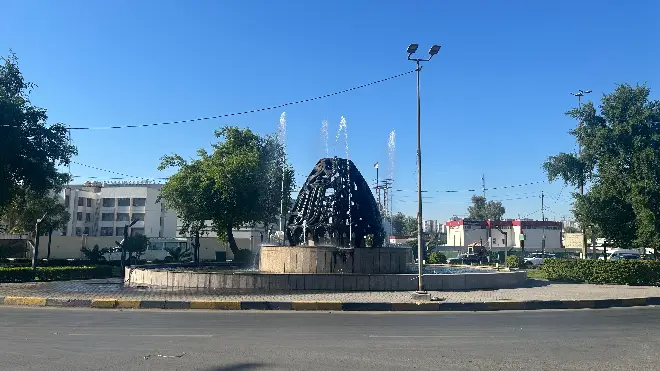
Mustafa Jamal Al Din Square
Mustafa Jaafar ‘Inayat Allah Jamal Al Din (1926 – 22 October 1996) was a prominent Iraqi Shi’a scholar, poet, and writer. He was born in the village of Al Mu’minin, part of the Suq Al Shuyukh district in Dhi Qar province, and grew up in a scholarly religious family one of the most renowned Najafi families that produced many scholars and intellectuals inside Iraq and abroad.
He began his education in the village kuttab schools, then moved to Karmat Bani Sa‘id to complete primary school up to the fourth grade. Afterward, he migrated to Najaf to study religious sciences, where he completed the stages of muqaddimāt and sutooh, then advanced to the bahth Al khārij level. He distinguished himself among his peers with his sharp intellect and early brilliance, to the extent that he wrote the lecture notes (taqrirāt) of his teachers in jurisprudence and legal theory.
In 1962, he was appointed a teaching assistant at the College of Jurisprudence in Najaf after placing first among the students.
In 1969, he enrolled in the master’s program at the University of Baghdad.
In 1972, he earned his Master’s degree with a grade of “very good.”
After 1972, he was appointed professor at the College of Arts – University of Baghdad, where his reputation spread throughout Iraq and the Arab world. In 1979, he earned a PhD with an “excellent” grade in Arabic language studies.
Mustafa Jamal al-Din had been a naturally gifted poet since his middle school years. He refined his talent through religious study and a deep passion for literature. Throughout his career he became acquainted with some of Iraq’s great modern poets, including Badr Shakir Al Sayyab, Abdul Wahab Al Bayati, Muhammad Mahdi Al Jawahiri, and Nazik Al Malaika.
His poetry is characterized by a blend of patriotism and love themes, and by a strong human emotional voice toward daily experiences and social concerns—qualities that gave his poems a powerful presence.
Poet Falih Al Hujja, in his book Literature and Art, describes him as:
“A giant of modern Najafi poetry.”
Among his most famous sayings reflecting his independence and literary integrity is:
“I lived among the kings, rulers, presidents, and influential men of Iraq… yet I never praised any of them.”
Mustafa Jamal Al Din died in Damascus in 1996 after a long life of scholarship, poetry, and literature, leaving behind an indelible mark on Iraqi and Arab culture.
From his famous poem about Baghdad:
Baghdad, whenever the ages clashed upon you,
they withered while the leaf of your life stayed green.
The world passed you by, your mornings radiant…
and when darkness fell, the face of your night was moonlit.
Hard were the events that struck you, and harsher still…
for your endurance of their harm was always greater.
The Man Who Never Praised a King... Was Praised by Baghdad.
3 Min · Arabic · English
1 stops to discover
Frequently asked questions
What are the opening hours of Mustafa Jamal Al Din Square?
Mustafa Jamal Al Din Square is open 24 hours.
How much does it cost to visit Mustafa Jamal Al Din Square?
Admission to Mustafa Jamal Al Din Square is free.
How long should I spend at Mustafa Jamal Al Din Square?
Plan about ~ 30 min for Mustafa Jamal Al Din Square.
When is the best time to visit Mustafa Jamal Al Din Square?
Late afternoon to evening — when the cultural events and street life come alive.
Does Mustafa Jamal Al Din Square have an audio guide?
Yes — a narrated audio guide for Mustafa Jamal Al Din Square is available in the Travel Tale app.
Where is Mustafa Jamal Al Din Square located?
Mustafa Jamal Al Din Square is in Baghdad.

Hear the full audio story — free in the app
Get app