
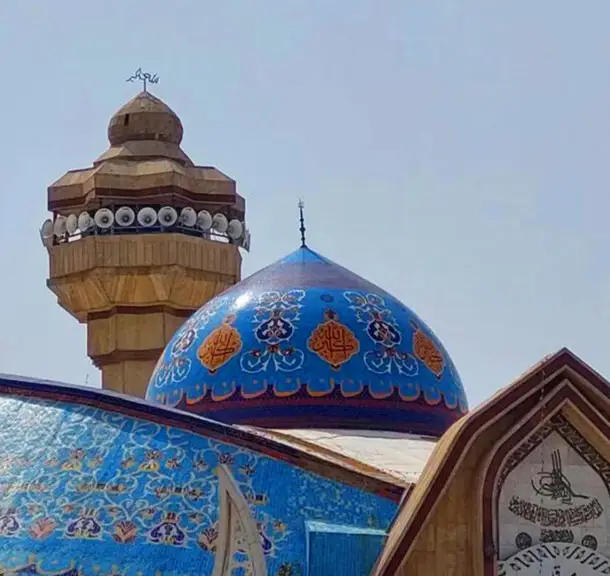
Sheikh Marouf Al Karkhi Mosque
Sheikh Ma'ruf Al Karkhi is Maaruf Ibn Fayruz Al Karkhi, one of the scholars of his time in the second Hijri century, and among the most prominent figures of Sufism in Baghdad. He was renowned for his asceticism, piety, and devotion, and was considered one of the leading figures of asceticism and Sufism in his era. Al Karkhi was born Christian, but embraced Islam in his youth, and was also the reason for his parents' conversion to Islam. Sheikh Ma'ruf died in Baghdad in 200 AH / 815 CE.
Sheikh Ma'ruf Al Karkhi was nicknamed (Abu Mahfuz), and he was one of the masters of Sufism in Baghdad, and among the famous sheikhs known for asceticism, piety, and devotion. He was called Al Karkhi in reference to the Karkh district of Baghdad where he lived. It is said of him that he was of noble character and tolerance, and they also described him as the blessing of his age.
Sheikh Ma'ruf Al Karkhi is connected to a Sufi chain that he received from Imam Ali Al Rida ibn Imam Musa Al Kadhim (peace be upon them), at whose hands he converted to Islam. He is also connected to another chain of knowledge that he received from his teacher Dawud Al Ta'i, from Habib Al Ajami, from Al Hasan Al Basri, from Imam Ali ibn Abi Talib. Among his students who accompanied him and excelled in knowledge and Sufism, the most prominent was Sheikh Al Sari Al Saqati, also buried in the mosque cemetery.
The Mosque of Sheikh Ma'ruf Al Karkhi is distinguished by its simple and beautiful architectural design, combining classical Islamic style with special touches reflecting the cultural and religious environment of that era. The mosque is also distinguished by two distinctive domes adorning its roof, in addition to its minaret that rises overlooking the Karkh area.
The mosque was developed and renovated in 622 AH by the Abbasid Caliph Al Nasir li Din Allah.
The mosque's minaret was built, still standing tall today, reaching approximately 15 meters in height, and adorned with very beautiful Islamic decorations. This minaret has remained a historical monument in the center of the mosque to this day. Beside the new mosque, a minaret 43 meters high was built, which now towers over the mosque.
The Mosque of Sheikh Ma'ruf Al Karkhi is considered a place of worship and spirituality, and throughout the ages has witnessed visitors from all parts of Iraq and the Islamic world. It is also considered a symbol of Islamic Sufism and a religious reference for all researchers in this field.
The shrine of Sheikh Ma'ruf Al Karkhi is considered a magnificent architectural masterpiece and a unique architectural monument, reflecting the beauty of Islamic architecture and splendid design.
It contains the strangest minaret in the Muslim world, where there is a minaret inside with a dome placed above it. It is said to have been built when the current shrine was constructed. This minaret was originally outside and not inside, but when reconstruction took place in the late 1990s to early 2000s through the Antiquities Authority and UNESCO, it was agreed that this minaret must be preserved because it is considered one of the oldest minarets in Baghdad, and the sanctuary was designed and arranged around the minaret to be inside the building.
It is written on the minaret that its construction was completed in 612 AH, ten years before the Abbasid Caliph Al Nasir li Din Allah, but there is not enough information to confirm whether the minaret was built at the same time as the complete construction of the mosque or not.
Inside the prayer hall, there is a deep underground cellar containing a deep well of water that people seek blessing from, with a long history over a thousand years old, and water still springs from it to this day. Imam Ali Al Rida drank from this well, as did Sheikh Ma'ruf Al Karkhi, Al Sari Al Saqati, and Sheikh Abd Al Qadir Al Kilani. The well water is tested and clean, containing some salts, but is suitable for drinking.
Al Karkhi's grave is located 15 meters below ground level, and the shrine grille was constructed after the order of Suleiman the Magnificent (the tenth sultan of the Ottoman Empire). Below are two other graves besides Al Karkhi's: one belongs to his brother Musa, and the other is of the great scholar Al Daraqutni, who mentioned in his will that he wanted to be buried at the feet of Sheikh Ma'ruf Al Karkhi.
There was a cave near the graves, but it was closed during restoration. Al Karkhi used to enter this cave to go learn from Ali Al Rida ibn Musa Al Kadhim (peace be upon him).
Sheikh Abd Al Qadir Al Jilani would come to seclude himself and worship below, eating and drinking only from the existing well.
This mosque has a cemetery considered one of the oldest in Baghdad. It was previously called Shuwainiziyya Cemetery, then named Bab al-Dayr, and finally called Ma'ruf Al Karkhi Cemetery because he was buried there. In this cemetery are many important figures, scholars, religious and political symbols, and even tribal leaders.
Among them are artist Karim Al Ghazali and his wife Salima Murad.
The architectural creativity of the mosque is manifested when viewing it from several angles; when the mosque is seen from above, it takes the shape of an eye, but when viewed from the front, its shape resembles a falcon preparing to soar.
The Boy Who Embraced Islam, and So His Parents Embraced Islam
4 Min · Arabic · English
Frequently asked questions
What are the opening hours of Sheikh Marouf Al Karkhi Mosque?
Open until 22:00
How much does it cost to visit Sheikh Marouf Al Karkhi Mosque?
Admission to Sheikh Marouf Al Karkhi Mosque is free.
How long should I spend at Sheikh Marouf Al Karkhi Mosque?
Plan about ~ 30 min for Sheikh Marouf Al Karkhi Mosque.
When is the best time to visit Sheikh Marouf Al Karkhi Mosque?
Outside prayer times — mid-morning (after sunrise prayer settles) or mid-afternoon. Avoid Friday noon prayer.
Does Sheikh Marouf Al Karkhi Mosque have an audio guide?
Yes — a narrated audio guide for Sheikh Marouf Al Karkhi Mosque is available in the Travel Tale app.
Where is Sheikh Marouf Al Karkhi Mosque located?
Sheikh Marouf Al Karkhi Mosque is in Baghdad.

Hear the full audio story — free in the app
Get app