
Taq El Kisra or Iwan Al Madain
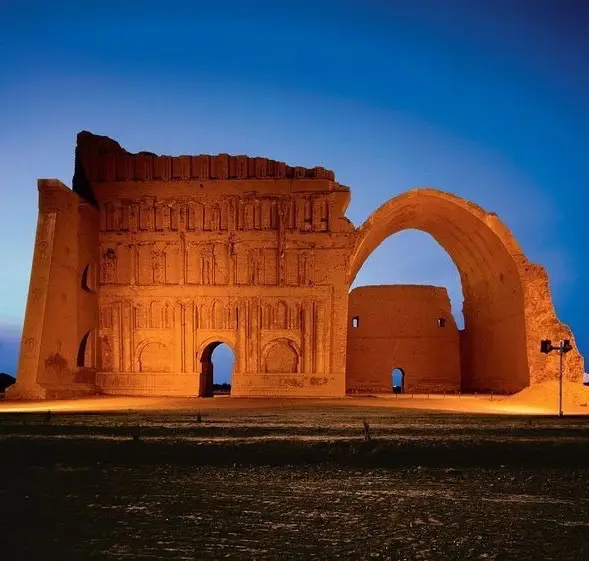
The Arch of Ctesiphon (Arch of Khosrow, or Taq Kasra) (in Persian: Iwan El Khosrow) is the remaining monument of one of the palaces of Khosrow Anushirwan, located south of Baghdad, at the site of the city of Ctesiphon, which lies within the Al Mada'in area administratively belonging to Baghdad Governorate.
Al Mada'in is an ancient Iraqi city built by the Greeks before Christ, then inherited by the Persians, and remained a major center of the country until it was replaced by Baghdad in the eighth century CE. It was the capital of the Sassanians and Parthians.
Construction of the Arch of Khosrow began during the reign of Khosrow I, known as Anushirwan (the Immortal Soul), after his military campaign against the Byzantines in 540 CE. Khosrow I ruled the Sassanian Empire between 531–579 CE, ascending the throne after his father Qobad I. During his reign, foundations were laid for numerous cities and palaces, bridges and dams were erected, arts and sciences flourished in Persia, the Sassanian Empire reached the pinnacle of its glory, and he was one of the most popular emperors in Iranian culture and literature.
The Arch consists of two main parts: the building itself and the massive adjacent vault. The vault reaches approximately 37 meters in height and 26 meters in width, while the total height of the Arch reaches about 50 meters, and is considered one of the greatest buildings of its kind in that era. The throne room, believed to have been located under or behind the vault, reached over 30 meters in height, 24 meters in width, and 84 meters in length.
Muslims took control of the Arch of Khosrow in 637 CE, and it was converted at that time into a mosque.
The king's residence in Persia was known as the "White Palace," and in its center was the "Arch of Khosrow," which was used as the throne hall for the king. Its walls were decorated with paintings depicting the Battle of Antioch between the Persians and Romans. Many Persian poets described the Arch of Khosrow and drew inspiration from its grandeur in their poetry.
Ibn Al Jawzi mentions that the Arch of Khosrow was built by Shapur II ibn Hormizd, known as Dhul Aktaf (of the Shoulders), who died in 370 CE. In Ibn Khaldun's introduction, there is an account of an attempt to demolish the Arch when the Abbasid Caliph Abu Ja'far Al Mansur resolved to build Baghdad and wanted to demolish it. He consulted Khalid ibn Yahya, who said to him: "O Commander of the Faithful, do not do it, and leave it standing as evidence of the great kingdom of your ancestors who seized power from the people of that edifice." Al Mansur accused him of bias toward the Persians and said: "By God, I will demolish it," and began its demolition, gathering workers, taking axes, heating it with fire, and pouring vinegar on it. When he was overcome by inability after all that, and feared disgrace, he sent for Khalid Ibn Yahya to consult him again about abandoning the demolition. He said: "O Commander of the Faithful, do not do it, and continue what you started, lest it be said: The Commander of the Faithful and the Arab king was unable to demolish a structure made by the Persians." Al Mansur understood his intent and ceased demolishing the Arch.
In 1888, floods destroyed about a third of the building. Then a reconstruction attempt was made during Saddam Hussein's era in the 1980s, but it was not completed, and construction work stopped in 1991 during the Gulf War. Currently, the University of Chicago is cooperating with the Iraqi government to restore the Arch as part of what is known as the "Diyala Project."
This monument represents the largest hall of the Arch of Khosrow, a hall roofed with bricks in the form of a massive vault, constructed without the use of supports or any type of reinforcement.
An Arch That Did Not Fall
5 Min · Arabic · English
Frequently asked questions
What are the opening hours of Taq El Kisra or Iwan Al Madain?
Taq El Kisra or Iwan Al Madain is open 24 hours.
How much does it cost to visit Taq El Kisra or Iwan Al Madain?
Admission to Taq El Kisra or Iwan Al Madain is free.
How long should I spend at Taq El Kisra or Iwan Al Madain?
Plan about ~ 1 Hour for Taq El Kisra or Iwan Al Madain.
When is the best time to visit Taq El Kisra or Iwan Al Madain?
Mid-morning to early afternoon, ideally on a weekday for fewer crowds. Photogenic in early evening light.
Does Taq El Kisra or Iwan Al Madain have an audio guide?
Yes — a narrated audio guide for Taq El Kisra or Iwan Al Madain is available in the Travel Tale app.
Where is Taq El Kisra or Iwan Al Madain located?
Taq El Kisra or Iwan Al Madain is in Baghdad.

Hear the full audio story — free in the app
Get app