
Tell Harmal
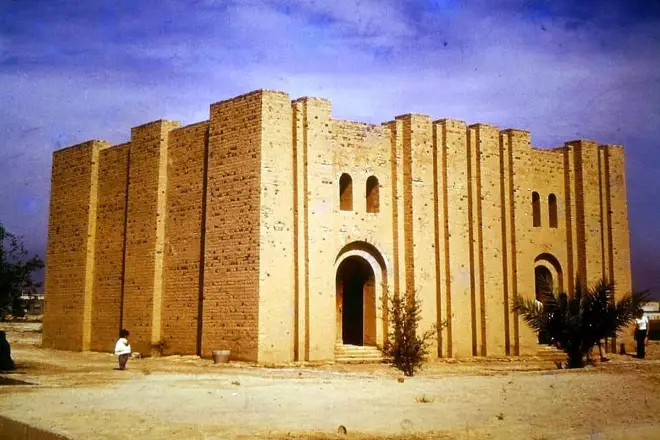
Harmal hill is an archaeological site located in Iraq’s capital, Baghdad. This is its modern name; in antiquity it was known as Shadubum, and it served as an administrative center affiliated with the Kingdom of Eshnunna, one of the city-states of ancient Mesopotamia.
The name Shadubum is believed to mean “the accounting office” or “the treasury,” reflecting the site’s significant administrative and financial role in that era.
The earliest evidence of settlement at Harmal hill dates back to the Akkadian Empire, followed by the period of the Third Dynasty of Ur (2115 – 2004 BCE). However, the city reached its peak of prosperity in the Mid Old Babylonian period, approximately 3,800 years ago.
Archaeological excavations have revealed a complex of buildings constructed from mudbrick and clay, including six temples, the most prominent of which is a large temple built in the southern Babylonian architectural style. At the entrance to its central chamber stood two terracotta lion statues, positioned on either side of the gateway, forming an imposing scene symbolizing authority and protection.
The mound itself has an irregular rectangular shape, measuring 147 meters in length and 98 meters in width. A wide gate opens on its northern façade, while two large towers rise at the northeastern corner.
The most significant architectural discovery at the site is the main temple, alongside two smaller temples that have been restored and recently roofed. Harmal hill was not only a religious center, but also an advanced scientific and intellectual hub. Archaeologists uncovered more than 2,000 clay tablets within its buildings, many of which address complex mathematical and geometrical problems, including the similarity of right-angled triangles a concept the Babylonians understood centuries before the Greek mathematician Euclid.
The tablets also include extensive mathematical tables dealing with multiplication, exponentiation, roots, and reciprocal numbers for division, as well as problems solved using methods resembling what we now recognize as logarithms. Beyond mathematics, the tablets encompass lexical lists, literary texts, and geographical maps, indicating a rich and diverse cultural life.
The sheer number of discovered tablets exceeding 2,000 clay records suggests that Harmal hill functioned as an official state archive or a central repository of documents. These tablets contain:
•Contracts of sale, purchase, marriage, adoption, and inheritance.
•Official correspondence from the kings of Eshnunna.
•Tax records, workers’ wages, and financial revenues.
•Construction contracts and various administrative and economic documents.
Among the most important finds at the site are two clay tablets containing a copy of the Laws of Eshnunna, written in the Babylonian language and dated to between 1900 and 1850 BCE, placing them in the early Old Babylonian period.
These laws predate the Code of Hammurabi issued around 1792 BCE by roughly a century or more.
The Eshnunna code discovered at Harmal hill consists of sixty-one legal articles, addressing matters such as:
•Theft, assault, debts, personal status, wages, and prices.
•Trade, penalties, and compensations.
The Iraqi archaeologist and historian Taha Baqir, who led the first excavations at the site between 1945 and 1963, observed that this code represents the oldest written legal system yet discovered from ancient Iraq. This finding overturned the long-held belief that Hammurabi’s code was the earliest law in human history.
In a significant comparative analysis, Baqir noted that the Laws of Eshnunna closely resemble both the Code of Hammurabi and the earlier Sumerian laws of King Lipit-Ishtar, fragments of which were found at Nippur placing Tell Harmal at a central crossroads in the history of human law.
Shadubum… the Treasury, and the Cradle of Laws
Narrated guide available in the app
Frequently asked questions
What are the opening hours of Tell Harmal?
Tell Harmal is open 24 hours.
How much does it cost to visit Tell Harmal?
Admission to Tell Harmal is free.
How long should I spend at Tell Harmal?
Plan about ~ 30 min for Tell Harmal.
When is the best time to visit Tell Harmal?
Mid-morning to early afternoon, ideally on a weekday for fewer crowds. Photogenic in early evening light.
Does Tell Harmal have an audio guide?
Yes — a narrated audio guide for Tell Harmal is available in the Travel Tale app.
Where is Tell Harmal located?
Tell Harmal is in Baghdad.


Hear the full audio story — free in the app
Get app