
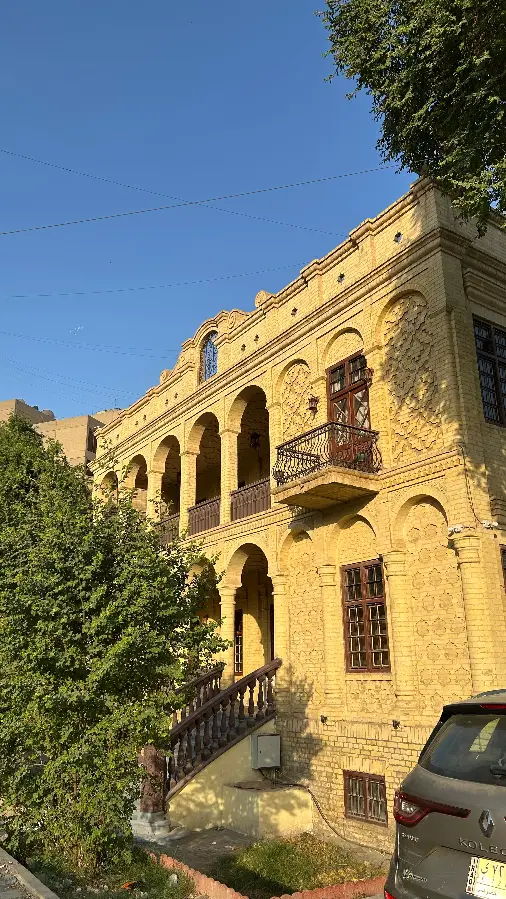
The Dhaher Family Homes
On Haifa Street in Baghdad, along the banks of Iraq’s political and social history, stand the twin houses of the Al Dhaher family among the rare living landmarks that combine the beauty of Baghdadi architecture with the memory of statesmen who passed through here.
These heritage houses belong to the Al Dhaher family, descended from the Al Bu Sultan tribes of Hilla, which are a branch of the Bani Suwayda Al Zubaidi tribe. The family’s patriarch, Sheikh Ahmad Al Dhaher, was one of Baghdad’s notable figures; he participated in the 1920 Revolution, and his majlis (gathering place) in Al Salihiyah was open to visitors until his death in 1932.
The two twin homes were built in 1936 by Baghdadi architect Ibrahim Jasim Al 'Abta, commissioned by Abdul Razzaq Ahmad Al Dhaher, who requested they be built in the style of the Al Mumayyez family homes of that time. Construction took two full years, and Abdul Razzaq personally oversaw all phases of the project. These houses were later designated as heritage sites by official institutions in recognition of the importance of those who lived there.
Abdul Razzaq Ahmad Al Dhaher (1907–2003): An Iraqi lawyer, born in Baghdad. He graduated from the College of Law in 1934, after a brief study period at the American University of Beirut. He held high government positions, most notably as Minister of Economy in Ali Jawdat Al Ayyubi’s cabinet (1949–1950). Known for his bold political stances, he was arrested in 1952 during a crackdown for his harsh criticism of the authorities. After the 1958 revolution, he chose political neutrality, except for his participation in the Agrarian Reform Law Committee.
Abdul Hadi Ahmad Al Dhaher (1898–1978): A prominent judge and administrator with a clear mark on political life during the monarchical era. He was affiliated with several political parties, including: Al Ummah Party (1924), Al Ahrar Party (1946), and Al Jabha Al Sha’abiyyah Party (1951). He held various parliamentary and ministerial posts, and was one of the outstanding voices in Iraq’s political movement during the first half of the 20th century.
Today, the Al Dhaher houses form a meeting point between refined architecture and national memory. They are not merely old buildings, but living pages of Iraq’s political and social history. As one walks through the corridors of the twin homes, they feel they are not just seeing stones and walls, but hearing the echoes of political debates, the talk of old gatherings, and seeing glimpses of monarchical Baghdad before those pages were closed forever.
Voices Behind the Walls
3 Min · Arabic · English
Frequently asked questions
What are the opening hours of The Dhaher Family Homes?
The Dhaher Family Homes is open 24 hours.
How much does it cost to visit The Dhaher Family Homes?
Admission to The Dhaher Family Homes is free.
How long should I spend at The Dhaher Family Homes?
Plan about ~ 30 min for The Dhaher Family Homes.
When is the best time to visit The Dhaher Family Homes?
Mid-morning or late afternoon — softer light and lighter foot traffic.
Does The Dhaher Family Homes have an audio guide?
Yes — a narrated audio guide for The Dhaher Family Homes is available in the Travel Tale app.
Where is The Dhaher Family Homes located?
The Dhaher Family Homes is in Baghdad.

Hear the full audio story — free in the app
Get app