
The March Monument
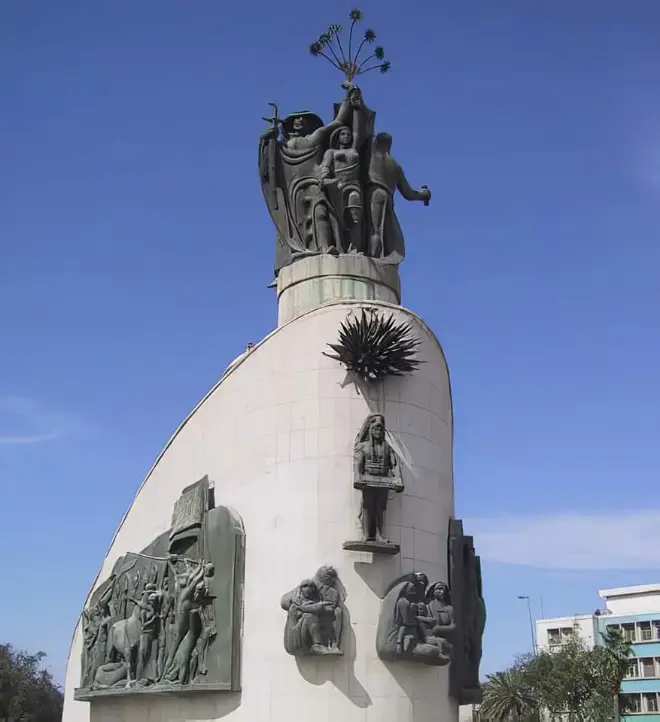
The Monument of Al Maseera (The March) is one of the most remarkable artistic landmarks in Baghdad. It stands tall today in the Al Alawi district as a sculptural masterpiece etched into Iraq’s visual memory. The monument was designed by the renowned Iraqi sculptor Khalid Al Rahal.
Completed in 1978, Al Rahal named the monument “Al Maseera” to represent the journey of the Iraqi people through time from suffering to revival, from poverty to pride, and from stillness to constant movement. Like every great march in history, its heroes are ordinary people: the farmer, the worker, the soldier, the woman, the child, and the intellectual.
Strategically located in Al Alawi Square, the monument lies at the crossroads between modern and historic Baghdad, next to Baghdad Central Railway Station, a hub of movement, travel, and transit. This placement gives the monument a powerful human and spatial dimension a symbol connecting those who arrive and those who depart, the past and the future, memory and motion.
The sculpture flows visually from right to left, forming a rising composition whose sweeping lines evoke a sense of forward momentum and hope. Al Rahal used bronze as the main sculpting material, with stone for the base and structural frame.
The monument reflects a style of expressive realism: while Al Rahal did not neglect anatomical accuracy, he infused the forms with deep dramatic spirit conveying struggle, resilience, and dignity all at once.
Each figure plays a symbolic role in the narrative:
•The woman standing in the center, calm and upright, represents the Iraqi mother a symbol of fertility and sacrifice.
•The child lifted high by one of the men symbolizes hope and future generations.
•The faces, rather than being abstract or hollow, are laden with sorrow, determination, and resolve, each one telling a fragment of Iraq’s long struggle.
Like many of Iraq’s cultural landmarks, the Al Maseera Monument did not escape harm. Following the 2003 invasion of Iraq, the monument was looted, and several pieces were stolen particularly the ones that crowned the upper section.
Years later, restoration efforts were initiated, but many original parts were removed and replaced, altering some of its original features. Today, the monument stands atop a large cylindrical base, engraved with cuneiform script a reference to the heritage of Mesopotamia and Iraq’s ancient role in inventing writing and transmitting civilization to the world.
Al Maseera is more than a sculptural work. It is a national narrative cast in bronze an eternal tribute to the Iraqi spirit: ever striving toward progress while never forgetting its deep-rooted heritage.
When Bronze Told the Story of Iraq
3 Min · Arabic · English
Frequently asked questions
What are the opening hours of The March Monument?
The March Monument is open 24 hours.
How much does it cost to visit The March Monument?
Admission to The March Monument is free.
How long should I spend at The March Monument?
Plan about ~ 20 min for The March Monument.
When is the best time to visit The March Monument?
Mid-morning or late afternoon — softer light and lighter foot traffic.
Does The March Monument have an audio guide?
Yes — a narrated audio guide for The March Monument is available in the Travel Tale app.
Where is The March Monument located?
The March Monument is in Baghdad.

Hear the full audio story — free in the app
Get app