
The Middle Gate of Baghdad
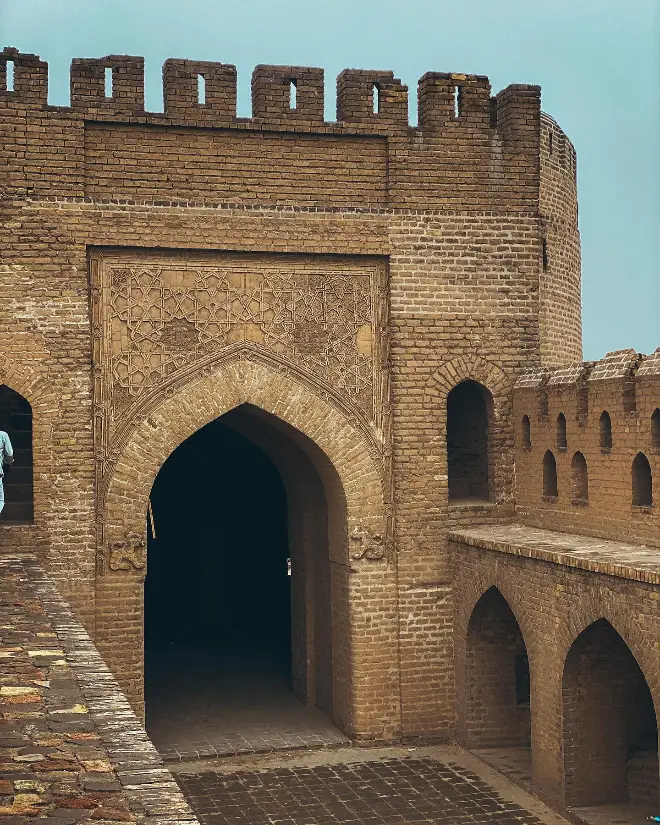
Al Bab Al Wastani (The Middle Gate) is the only remaining standing monument from the eastern wall of Baghdad, which was built during the reign of Abbasid Caliph Al Mustazhir Billah (487–512 AH / 1094–1118 CE), and its construction was completed during the reign of his son Caliph Al Mustarshid Billah (512–529 AH / 1118–1135 CE). It was known in the Abbasid era as Bab Al Zafariyya.
Al Bab Al Wastani consists of a high tower girded with a band of inscriptions executed in Naskh script, and decorated with ornamentations carved on bricks.
A portion of the deep water moat that surrounded the wall used to cut through the gate, and remnants of this moat still remain at the location where the gate passes through.
Brick was used as the primary material in the gate's construction and decoration. This material proved highly durable and greatly resistant to the effects of time, demonstrating the Abbasids' care in using it, even in military and defensive installations.
The gate was named Al Bab Al Wastani (The Middle Gate) because it was midway between Bab Al Mu'azzam and Bab Al Tilsim.
It was also known as Bab Khurasan (Khurasan Gate), as it overlooked the eastern directions, and caravans coming from the east would enter Baghdad through it.
Historians mention that the gate would open from the beginning of the day until the Maghrib call to prayer, then close after that. Caravans that arrived late would spend the night outside the walls, in front of the gate, until the next morning.
It was also called Bab Al Zafariyya, named after the Zafariyya neighborhood that was located west of the gate. "Zafar" was the name of one of the Abbasid Caliphs' Mamluks.
During the Ottoman era, it was called "Aq Qapi," meaning the White Gate.
The area surrounding the gate lost much of its aesthetic features during subsequent decades, due to neglect that lasted until the mid-1930s.
However, the Directorate of Antiquities later restored and maintained the building, then converted it into a museum of ancient weapons.
The museum was officially opened on May 10, 1939, by Sati' Al Husri, Director of Antiquities at the time. Its exhibits were limited to a collection of rifles, cannons, swords, shields, spears, and other ancient weapons.
Al Bab Al Wastani has undergone several maintenance and rehabilitation works since the establishment of the Iraqi state in the 1920s, the most recent of which was completed in 2013, when Baghdad was chosen as the Arab Capital of Culture.
Before 2003, a comprehensive government project was developed to rehabilitate the gate and its surrounding area, including the establishment of parks and gardens, and connecting the site to the open area under the Muhammad Al Qasim Bridge, opposite the Al Suhrawardi Cemetery.
However, the circumstances the country went through prevented the implementation of this project, leaving Al Bab Al Wastani as a silent witness to Baghdad's glorious history, and to the modern care that eluded it.
A portion of Baghdad's circular wall and one of its gates still stands today as a witness to the succession of eras this gate, which was built in the late Abbasid era, to become over time one of the city's most prominent remaining historical landmarks.
A Door That Stands Alone
5 Min · Arabic · English
Frequently asked questions
What are the opening hours of The Middle Gate of Baghdad?
Closed
How much does it cost to visit The Middle Gate of Baghdad?
Admission to The Middle Gate of Baghdad starts at 3,000 IQD.
How long should I spend at The Middle Gate of Baghdad?
Plan about ~ 40 min for The Middle Gate of Baghdad.
When is the best time to visit The Middle Gate of Baghdad?
Mid-morning to early afternoon, ideally on a weekday for fewer crowds. Photogenic in early evening light.
Does The Middle Gate of Baghdad have an audio guide?
Yes — a narrated audio guide for The Middle Gate of Baghdad is available in the Travel Tale app.
Where is The Middle Gate of Baghdad located?
The Middle Gate of Baghdad is in Baghdad.

Hear the full audio story — free in the app
Get app