
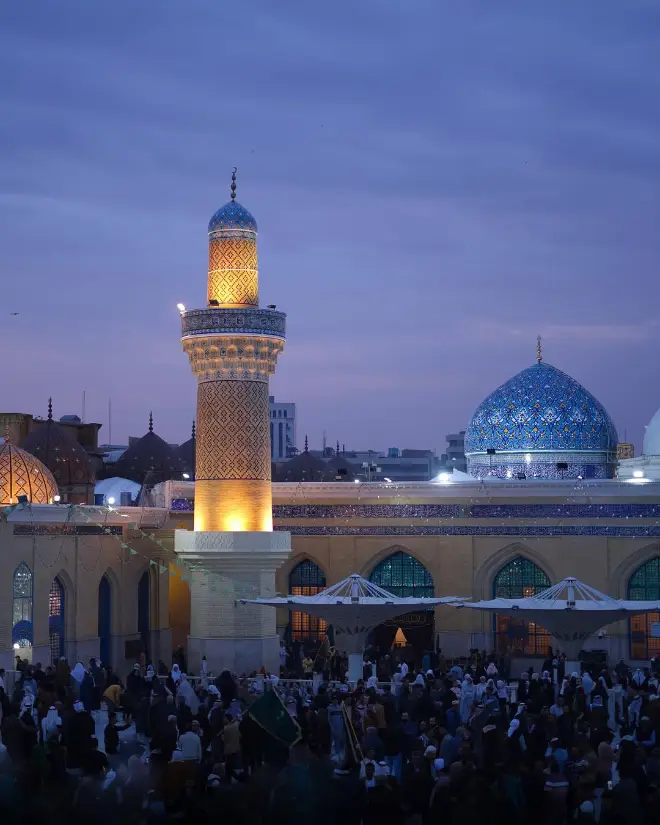
The Qadiriyya Shrine
Sheikh Abdul Qadir Al Gilani was born on the 11th of Rabi’ Al Thani, 470 AH (corresponding to November 6, 1077 CE), in the region of Gilan, north of Tabaristan, according to historical sources. He grew up in a noble family tracing its lineage to the Hashemite clan. In Islamic tradition, he became widely known by titles such as “Sultan of the Saints,” “Reviver of the Faith,” and “The Grey Falcon of God.” He was renowned as a Sufi imam and a scholar of Islamic jurisprudence who mastered religious sciences and was deeply involved in preaching and spiritual guidance. Initially associated with the Shafi’i school, he later taught and issued rulings based on the Hanbali school. His name became widely recognized, and his Sufi order later known as the Qadiriyya was named after him.
His childhood was marked by a deep engagement with knowledge, literature, and Islamic jurisprudence. After receiving the fundamentals of Islamic learning at a young age, he traveled to Baghdad around 488 AH, at the age of eighteen. There, he joined the school of Sheikh Abu Sa’id Al Mukharrami, one of the prominent educational institutions of that era. He delved deeply into various Islamic sciences jurisprudence, hadith, and theology until he became one of the most prominent scholars in Baghdad. For many years, he was at the forefront of preaching, teaching, and issuing legal opinions, gaining widespread recognition in scholarly circles.
Sheikh Al Gilani left a profound spiritual impact on the people, thanks to his strong presence in Sufi practice and preaching. He was renowned for his methods in spiritual education and his Sufi path that emphasized purification of the heart and piety. Around him gathered students, ascetics, and spiritual seekers from various regions, contributing to the growth of the Qadiriyya order, which became one of the most influential Sufi orders in the Islamic world. His name remained inseparable from this path for centuries after his death, continuing to expand and take root in the hearts of believers, becoming a vital part of the spiritual history of Islam.
Al Gilani also had a remarkable influence on intellectual and social relations. He taught and mentored a large number of scholars and students in Baghdad, who benefited from his knowledge. Among his most notable works are Al Ghunya li Talibi Tariq al Haqq (The Riches for Seekers of the Path of Truth), Al Fath Al Rabbani (The Divine Opening), and Futuh Al Ghaib (Revelations of the Unseen) all of which gained popularity among scholars of Sufism, jurisprudence, and theology. It is also reported that he lived a life of simplicity and asceticism, earning a living through his own work, which earned him even greater respect and admiration from both scholars and the public.
Sheikh Abdul Qadir Al Gilani passed away on the 10th of Rabi’ Al Thani, 561 AH (February 19, 1166 CE) in Baghdad, at approximately ninety years of age. He was buried in the Qadiriyya Shrine in Iraq. After his death, his family and students continued to spread his teachings, and the Qadiriyya order remained a major spiritual force throughout the Islamic world into modern times, securing his legacy among the great spiritual scholars and Sufi saints of Islam.
The Qadiriyya Shrine, also known as the Qadiriyya School, was originally established as the Bab Al Azj School by Sheikh Abu Sa’id Al Mukharrami in 541 AH. Sheikh Abdul Qadir Al Gilani later taught there and, upon his death, was buried within its grounds. Over time, the neighborhood of Bab Al Azj came to be known as Bab Al Sheikh in honor of him. The shrine bearing his name was rebuilt after being destroyed by the Mongols and left in ruins. It was later reconstructed by the famed Ottoman architect Mimar Sinan, under the order of Sultan Suleiman the Magnificent during the Ottoman conquest of Baghdad in 1534 CE.
Today, the Qadiriyya Shrine stands as one of the principal centers of Sufism in Baghdad and Iraq. It draws thousands of visitors from across the Islamic and non-Islamic world. The complex includes a mosque, the tomb of Sheikh Al Gilani, and a renowned library known as the Qadiriyya Library. This library houses thousands of rare manuscripts and Islamic texts, making it a significant cultural and scholarly treasure. The nearby square has also been named Kilani Square in honor of Sheikh Abdul Qadir.
Historically and culturally, the Qadiriyya Shrine played an important role in the political and social fabric of Baghdad. During the Ottoman period, it served as a hub for public gatherings and uprisings against oppressive governors. Many renowned Iraqi scholars and preachers delivered sermons at the shrine, including Sheikh Abdul Karim Muhammad A Mudarris, his student Afeef Al Kilani, Mahmoud Al Issawi, and others who left a lasting impact on religious life in Baghdad.
On May 28, 2007, the shrine was targeted by a car bombing, which killed and injured dozens of civilians. The explosion also damaged some of the outer walls and architectural features of the historic mosque. Despite this, the Qadiriyya Shrine has retained its religious and historical significance in Baghdad, remaining a beacon for Sufism and a spiritual destination for believers of all ages and backgrounds.
Between the Cemetery, the School, and the Shrine
4 Min · Arabic · English
Frequently asked questions
What are the opening hours of The Qadiriyya Shrine?
The Qadiriyya Shrine is open 24 hours.
How much does it cost to visit The Qadiriyya Shrine?
Admission to The Qadiriyya Shrine is free.
How long should I spend at The Qadiriyya Shrine?
Plan about ~ 1 Hour for The Qadiriyya Shrine.
When is the best time to visit The Qadiriyya Shrine?
Outside prayer times — mid-morning (after sunrise prayer settles) or mid-afternoon. Avoid Friday noon prayer.
Does The Qadiriyya Shrine have an audio guide?
Yes — a narrated audio guide for The Qadiriyya Shrine is available in the Travel Tale app.
Where is The Qadiriyya Shrine located?
The Qadiriyya Shrine is in Baghdad.


Hear the full audio story — free in the app
Get app