
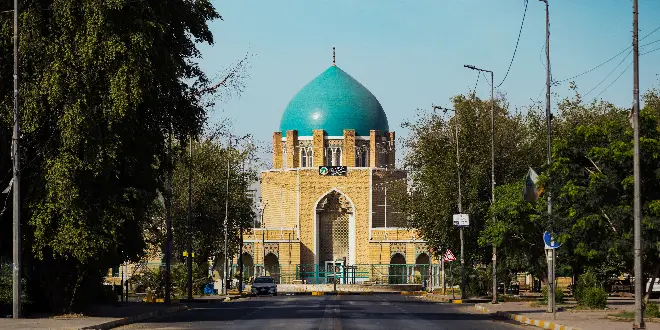
The Royal Cemetery
The Royal Cemetery, also known as the Royal Mausoleum, is the burial site of the Iraqi royal family. Located in the capital city of Baghdad, it is considered one of Iraq’s most significant historical landmarks, preserving the memory of the Hashemite monarchy that once ruled the country. The mausoleum houses the remains of several kings, queens, and princes who shaped the modern history of Iraq.
Among those buried in the cemetery:
•King Faisal I (1883–1933): Founder of modern Iraq.
•King Ghazi (1912–1939): Son of Faisal I.
•King Faisal II (1935–1958): Grandson of Faisal I and the last king of Iraq.
•Queen Huzaima: Wife of King Faisal I.
•Queen Aliya: Mother of King Faisal II.
•King Ali bin Al-Hussein (1879–1935): Former King of Hejaz and brother of Faisal I.
•Princess Jalila: Daughter of King Ali.
•Princess Ra’ifa: Daughter of King Faisal I.
At the other entrance of the mausoleum, the following are also buried:
•Crown Prince ‘Abd Al Ilah: Son of King Ali and regent to King Faisal II.
•Maryam: A young girl adopted by ‘Abd Al Ilah, as he had no biological children.
In the cemetery’s garden, two graves belong to key figures in modern Iraqi history:
•Jafar Al Askari: Iraq’s first Minister of Defense after the formation of the government in 1921. He was buried here in honor following his assassination in Diyala in 1936 on his way to negotiate with coup leader Bakr Sidqi.
•Rustum Haydar: Royal Chief of Protocol and Minister of Finance during the monarchy.
The Royal Cemetery was constructed between 1934 and 1936 by British architect J. B. Cooper. It reflects the style of classical Islamic architecture, with three gracefully domed roofs clad in traditional blue Kashi tiles, adorned with intricate Islamic geometric and floral motifs.
The structure was built using Jalmoud stone, locally known as “shore stone”, with the walls constructed of traditional brick masonry, and the doors and windows made of luxurious teak wood (saj). The result is an architectural composition that evokes the dignity and grandeur of the Hashemite era.
On March 27, 2021, the Royal Cemetery was officially reopened following extensive restoration and rehabilitation efforts. The day before, on March 26, King Abdullah II of Jordan was scheduled to visit the site as part of his official trip to Baghdad, where he attended a trilateral summit with Iraq’s Prime Minister and the President of Egypt.
The Silence of the Crown
3 Min · Arabic · English
Frequently asked questions
What are the opening hours of The Royal Cemetery?
The Royal Cemetery is open 24 hours.
How much does it cost to visit The Royal Cemetery?
Admission to The Royal Cemetery is free.
How long should I spend at The Royal Cemetery?
Plan about ~ 1 Hour for The Royal Cemetery.
When is the best time to visit The Royal Cemetery?
Mid-morning to early afternoon, ideally on a weekday for fewer crowds. Photogenic in early evening light.
Does The Royal Cemetery have an audio guide?
Yes — a narrated audio guide for The Royal Cemetery is available in the Travel Tale app.
Where is The Royal Cemetery located?
The Royal Cemetery is in Baghdad.

Hear the full audio story — free in the app
Get app