
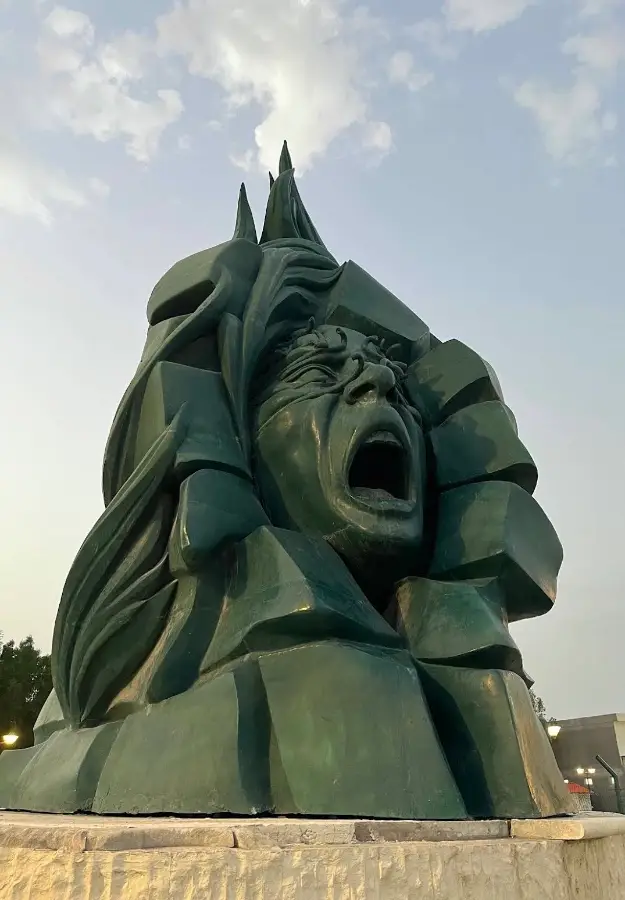
The Scream Monument
Al Amiriyah Shelter, also known as Shelter No. 25, is located in the Al Amiriyah neighborhood in western Baghdad, nestled between residential homes and adjacent to a mosque and a primary school. It was originally built as a fortified shelter designed to withstand non-conventional attacks, such as chemical and biological weapons, and was sealed tightly against atomic radiation and airborne contamination.
The shelter had a capacity of approximately 1,500 people and was equipped with water, food, electricity, and fresh air, allowing civilians to remain safely inside for days without needing to access the outside world. The structure consisted of three floors, each spanning about 500 square meters, with walls over 1.5 meters thick and a reinforced concrete ceiling supported by 4 centimeter-thick steel beams. It also included emergency doors and internal staircases leading to the ground floor.
During the Second Gulf War, Al Amiriyah Shelter was bombed in an American airstrike on the morning of February 13, 1991. Two F-117 fighter jets dropped two laser-guided missiles, specifically designed for this purpose and tested for the first time that day. The first missile penetrated the shelter’s roof and sealed its doors; the second exploded inside the shelter, causing temperatures to rise to thousands of degrees Celsius. The intense heat melted the bodies of civilians men, women, and children inside. Only 11 people survived, having been hurled out of the shelter by the blast wave of the first strike.
There is no precise count of the victims. Some sources confirm the retrieval of around 400 bodies, while others suggest many bodies were entirely vaporized by the extreme heat, implying the true death toll may be higher than the official figures.
A total of 408 people were killed, including 261 women and 52 infants, the youngest only seven days old. Among the dead were also 26 Arab nationals.
The U.S. administration initially claimed the shelter was a military target. However, the global outcry following the circulation of horrific images of the massacre forced the Pentagon to later admit the bombing was a mistake, citing outdated intelligence that had misclassified the shelter as a military command center.
The shelter doors were sealed no rescuers could enter, and no survivors could escape. Although the walls had been designed to isolate those inside from explosions, they instead trapped them, leaving them to perish in fire.
The shelter was later transformed into a museum and a permanent witness to the crime, documenting one of the most horrific humanitarian tragedies in modern Iraqi history, where entire families were annihilated in moments.
In commemoration of the tragedy, a large sculptural monument was created by artist Alaa Bashir, titled “The Scream.”
The monument depicts a human head trapped between solid stone blocks, with tense features, a strained face, and a mouth open in an eternal scream a terrifying and emotionally charged image that sears into the memory the bitter suffering of the Iraqi people.
The incident was also memorialized through a feature film titled “The Sad Dawn,” ensuring that Al Amiriyah Shelter remains an enduring symbol of an unforgettable humanitarian catastrophe.
A Memory Burned Beneath the Concrete
4 Min · Arabic · English
Frequently asked questions
What are the opening hours of The Scream Monument?
The Scream Monument is open 24 hours.
How much does it cost to visit The Scream Monument?
Admission to The Scream Monument is free.
How long should I spend at The Scream Monument?
Plan about ~ 30 min for The Scream Monument.
When is the best time to visit The Scream Monument?
Mid-morning or late afternoon — softer light and lighter foot traffic.
Does The Scream Monument have an audio guide?
Yes — a narrated audio guide for The Scream Monument is available in the Travel Tale app.
Where is The Scream Monument located?
The Scream Monument is in Baghdad.

Hear the full audio story — free in the app
Get app