
The Victory Arch Monument
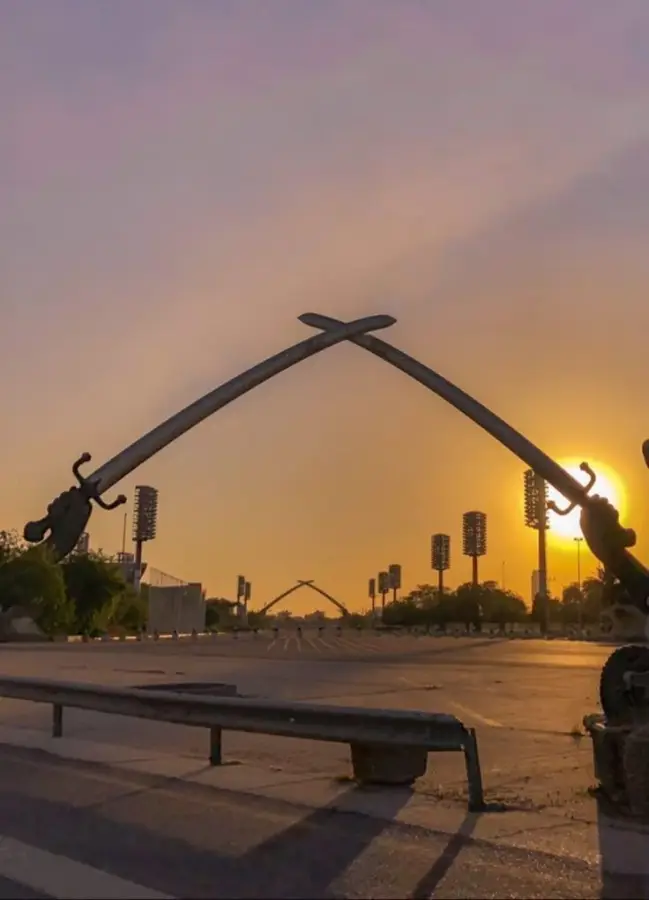
In the heart of the capital Baghdad, stands one of the most symbolic and inspirational landmarks in modern Iraqi history: The Victory Arch, also known as The Swords of Qadisiyyah.
This massive artistic monument, which was officially inaugurated on August 8, 1989, symbolizes victory and resilience. It takes the form of a unique scene: two raised swords held by a pair of hands emerging from the ground, which are said to have been modeled after the hands of former President Saddam Hussein.
The monument was designed to serve as a symbolic gateway for soldiers to march through during official parades, and it is located at the entrance of the Grand Festivities Square in Baghdad.
Beneath the swords lie more than 5,000 real helmets of Iranian soldiers, collected from battlefields during the Iran–Iraq War, and they are displayed as part of the monument.
The materials used in the construction include: stainless steel, bronze, and reinforced concrete.
The concept began with the late sculptor Khalid Al Rahhal, and was later completed after his death by the renowned artist Mohammad Ghani Hikmat.
The monument was part of propaganda projects during the Iran–Iraq War, but it quickly went beyond its political symbolism to become one of the most famous landmarks in Baghdad.
It was named “The Swords of Qadisiyyah” after the historic Battle of Al Qadisiyyah, which represented a major turning point in Arab-Islamic history, and the monument came to symbolize decades of political and social transformation in Iraq.
Despite attempts to remove it after the fall of the former regime, the monument remained standing, and in 2011, it underwent extensive restoration efforts as part of a national campaign to preserve Iraqi heritage.
The Swords That Elevated Baghdad
4 Min · Arabic · English
Frequently asked questions
What are the opening hours of The Victory Arch Monument?
The Victory Arch Monument is open 24 hours.
How much does it cost to visit The Victory Arch Monument?
Admission to The Victory Arch Monument is free.
How long should I spend at The Victory Arch Monument?
Plan about ~ 30 min for The Victory Arch Monument.
When is the best time to visit The Victory Arch Monument?
Mid-morning to early afternoon, ideally on a weekday for fewer crowds. Photogenic in early evening light.
Does The Victory Arch Monument have an audio guide?
Yes — a narrated audio guide for The Victory Arch Monument is available in the Travel Tale app.
Where is The Victory Arch Monument located?
The Victory Arch Monument is in Baghdad.

Hear the full audio story — free in the app
Get app