
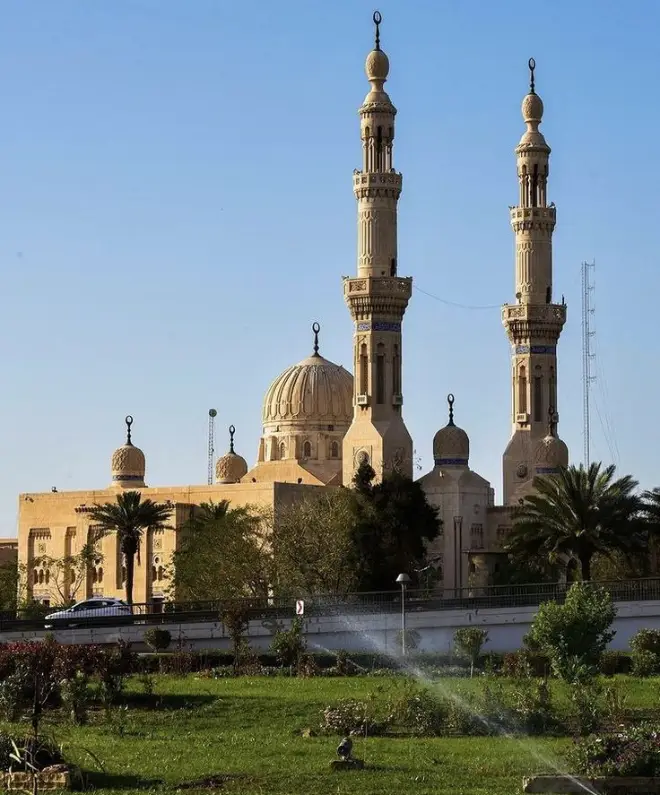
Umm Al Taboul Mosque
The Umm Al Taboul Mosque is one of Baghdad’s most opulent modern mosques, built to commemorate the officers involved in the Shawwaf Coup.
After 2003, it was renamed Ibn Taymiyyah Mosque, but later reverted to its original name. Today, it is officially registered under the Sunni Endowment Office as Jamia Umm Al Taboul, named after the square on which it was built. The mosque was inaugurated in 1388 AH / 1968 CE.
The mosque stands in the Umm Al Taboul district, which was once a military shooting range for the Iraqi Armed Forces. On September 20, 1959, a group of officers accused of involvement in the failed Shawwaf coup against Prime Minister Abd Al Karim Qasim were executed here including Nazim Al Tabqajli and Rifaat Al Haj Serri. Their deaths left a profound impact on Iraqi nationalists.
After the February 8, 1963 coup that overthrew Qasim’s regime, the new Iraqi government decided to erect a grand mosque to honor the memory of those officers. Construction began in 1966 and was completed in 1968. Its architectural design was inspired by the Sultan Hassan and Al Rifaai mosques in Egypt but on a larger scale. The remains of the “Free Officers” were transferred from the Al Ghazali Cemetery to a tomb within the mosque grounds.
In a Cabinet session held on September 1, 1963 (Resolution No. 67), the Minister of Municipalities at the time, Mahmoud Shit Khattab, was granted authority to oversee the mosque’s design in coordination with a committee composed of representatives from the Ministries of Defense, Housing, Health, Education, and Religious Endowments. The Ministry of Endowments funded the project.
Egyptian architect Abdul Salam Ahmed, from the Ministry of Awqaf in Egypt, was commissioned to design the mosque in the style of Salah Al Din’s mosque in Egypt. Architectural drawings were prepared by artist Ersham George. The foundation stone was laid on July 16, 1964, and architect Adnan Yousif Al Qudsi won the bid to carry out the construction.
During a visit to Iraq in 1964, Sheikh Abdullah Al Salim Al Sabah, Emir of Kuwait, donated 100,000 Iraqi dinars to support the families of the fallen officers. This amount was allocated toward the mosque’s construction, and an additional 600,000 dinars completed the funding. The mosque was officially opened on September 20, 1968. Today, it is surrounded by landscaped gardens.
The sanctuary is elevated about 1.5 meters above ground level and accessed via a broad staircase of white marble. In front of the main entrance is a courtyard adorned with marble columns and an elegant chandelier. Verses from Surat Yasin are inscribed on the stone at the entrance, while the interior is embellished with verses from Surat Al Rahman and Ayat Al Kursi, rendered in 1968 (1388 AH) by renowned calligrapher Hashim Muhammad Al Baghdadi.
The prayer hall is rectangular about 100 meters long and 50 meters wide supported by 98 rare white marble columns. Between the columns hangs a massive chandelier. The ceiling is covered with stunning decorations and inscriptions, meticulously crafted by skilled Egyptian artisans.
The mosque houses a beautiful mihrab and a pulpit made of fine teak wood, both crafted in Egypt. The upper floor includes a dedicated women’s prayer area, in addition to several large halls, an outdoor summer prayer space, and rooms for the imam and preacher. The mosque has three external entrances, the main one flanked by two minarets, each standing 40 meters tall. A large white marble dome crowns the central roof, flanked by two smaller domes. At the rear are ablution facilities, restrooms, and three residences for mosque staff alongside the cemetery where the Umm Al Taboul martyrs are buried.
Following the 2003 invasion of Iraq, the mosque was targeted by occupying forces, raided multiple times, and temporarily shut down. It was even converted into a military barracks. During this period, its name was briefly changed to Ibn Taymiyyah Mosque. Eventually, regular prayers resumed, including Friday and Eid congregational prayers.
On February 23, 2006, following the bombing of the al Askariyayn Shrine in Samarra, the mosque was attacked by sectarian militias. Fortunately, the assault did not cause any structural damage..
From the Execution Square to the Dome of Prayer
4 Min · Arabic · English
Frequently asked questions
What are the opening hours of Umm Al Taboul Mosque?
Umm Al Taboul Mosque is open 24 hours.
How much does it cost to visit Umm Al Taboul Mosque?
Admission to Umm Al Taboul Mosque is free.
How long should I spend at Umm Al Taboul Mosque?
Plan about ~ 40 min for Umm Al Taboul Mosque.
When is the best time to visit Umm Al Taboul Mosque?
Outside prayer times — mid-morning (after sunrise prayer settles) or mid-afternoon. Avoid Friday noon prayer.
Does Umm Al Taboul Mosque have an audio guide?
Yes — a narrated audio guide for Umm Al Taboul Mosque is available in the Travel Tale app.
Where is Umm Al Taboul Mosque located?
Umm Al Taboul Mosque is in Baghdad.

Hear the full audio story — free in the app
Get app