
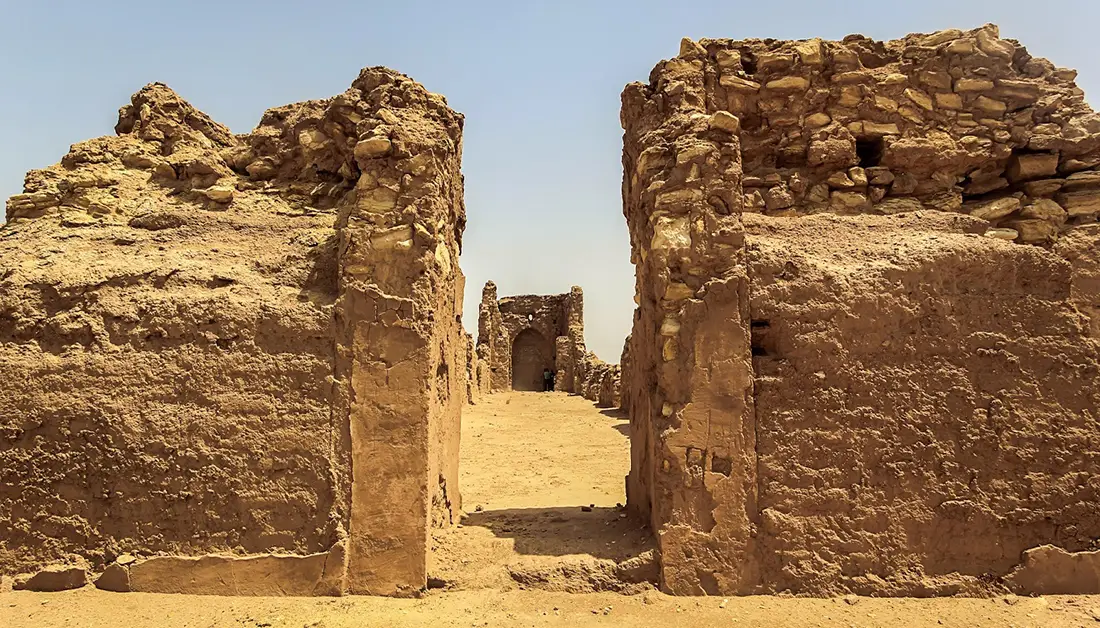
Al Uqaysir Church
The Church of Al Uqaysir is located in the heart of the western desert in the Al Ain Al Tamr district, 70 kilometers southwest of Karbala Governorate and 5 kilometers from the famous Al Ukhaidir Fortress.
It is one of the oldest churches in the Middle East, with studies indicating that its construction dates back to the mid-460s CE approximately one hundred and twenty years before the emergence of Islam.
This church was built by Christian rebels of the Nestorian sect against the Byzantine Church, who found safety and freedom to practice their rituals and worship under the Lakhmid Mundhirid state that extended between 268 and 633 CE, which was subject to the Sassanian state and professed Christianity. Nestorianism flourished in that era, aided by the welcome extended by the Sassanian Persians to this sect, as the Sassanians were waging wars against the Romans who adhered to Orthodoxy.
The church was built on the system known as the "Basilica" in ancient churches, inspired by the ancient Iraqi temples of the Babylonian and Sumerian civilizations, where a main corridor runs through the center of the building with rooms and passages distributed on either side, ending in a prayer apse facing Jerusalem. The church walls consist of a mixture of stone, clay, and ash, built in a defensive manner, in a rectangular shape 75 meters long and 15 meters wide. The total area of the church is approximately four thousand square meters, while the height of its tallest parts reaches about eight meters.
Traces of Aramaic inscriptions still remain on its walls, in addition to the altar facing Jerusalem, elevated above the rest of the church floor. It also contained a school, a washing place for the dead, and a burial ground for church servants.
Outside the church wall lies another church discovered to be dedicated to Christian burial ceremonies, in which dozens of graves facing Jerusalem were found. Many mounds near the two churches suggest the existence of a complete city that once surrounded them.
In the twelfth year of the Hijra, when Khalid ibn Al Walid fought the people of Ain Al Tamr and besieged its fortified castle, he found a group of people in the church and took them captive. Among these captives were figures who later contributed to building Islamic civilization, including Sirin, father of the jurist Muhammad ibn Sirin; Nusayr, father of the famous commander Musa ibn Nusayr; and Yasar, grandfather of Muhammad ibn Ishaq, author of the Prophet's biography.
The site was discovered between 1976 and 1977. Christians would come to visit it annually during Christmas to hold Mass there, despite its roofs having been lost long ago. However, its walls and ruins still stand, narrating the ancient history of Karbala.
Although the church today suffers from neglect and incomplete excavation work, despite forty years having passed since its discovery, calls persist for the inscription of the Church of Al Uqaysir on the UNESCO World Heritage List, with advocates affirming that it belongs not only to Christians, but to the entire world.
A Secret Standing on the Edges of the Desert
4 Min · Arabic · English · Persian · Turkish
Frequently asked questions
What are the opening hours of Al Uqaysir Church?
Al Uqaysir Church is open 24 hours.
How much does it cost to visit Al Uqaysir Church?
Admission to Al Uqaysir Church is free.
How long should I spend at Al Uqaysir Church?
Plan about ~ 30 min for Al Uqaysir Church.
When is the best time to visit Al Uqaysir Church?
Cooler months and the gentler hours of the day; the site is fully exposed. A local guide or driver is the easiest way to find it.
Does Al Uqaysir Church have an audio guide?
Yes — a narrated audio guide for Al Uqaysir Church is available in the Travel Tale app.
Where is Al Uqaysir Church located?
Al Uqaysir Church is in Karbala: Western desert, near Ain Al Tamr, Karbala.
Hear the full audio story — free in the app
Get app