
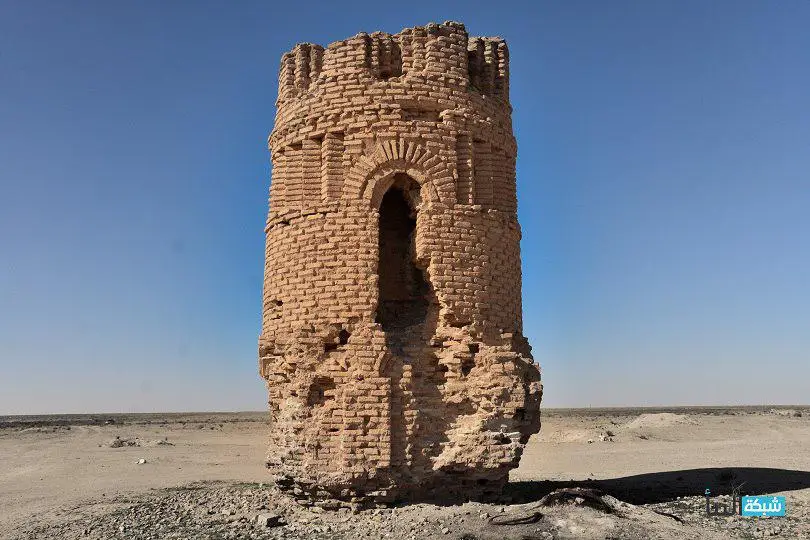
Al Muqada Minaret
Al Manara Al Muqada (The Lit Minaret), or "Manarat Mujada" as the desert people call it, stands alone and towering in the western desert of the sacred city of Karbala, forty kilometers from the governorate center, on the left side of the road connecting Karbala to the Al Ain Al Tamr district.
It occupies a position exactly midway between the famous Al Ukhaidir Fortress to the north, 15 kilometers away, and Khan Al Atshan to the south, 10 kilometers away, making it an archaeological link between these two great monuments.
Researchers believe its construction dates back to the ninth century CE, the same Abbasid era in which Khan Al Atshan was built. Its construction method reflects the ancient Islamic style with its varied ornamentation clearly visible in its upper sections, although some sources suggest it predates Islam and was associated with a palace known as "Qasr Mujada," whose traces have disappeared leaving only this minaret behind.
The minaret derived its name from its function, as fires were lit at its peak at night to guide commercial caravans traveling between Iraq, the Levant, and the Hijaz. It was also used as a lighthouse for ships sailing in the southern sea whose waters receded to what is known today as the Gulf, in addition to the possibility of its use for communication between administrative units through smoke signals and carrier pigeons, and some of its uses may have been for military surveillance.
The minaret was built from ancient square red brick, plaster, and lime, standing on a square base covering 25 square meters. Each side of the base is decorated with three blind niches topped by semicircular arches, then the cylindrical form extends to the top of the minaret decorated with various ornamental bands, until the summit ends with niches and arrow slits terminating in cylindrical arches similar to those at the base. The total height of the minaret is approximately twelve meters, and it can be ascended via an internal staircase on the southern side. It was mentioned in the Iraqi Guide of 1935-1936, which noted that its upper half was demolished while the other half still maintained its structure.
A Flame the Days Lit and Could Not Put Out
3 Min · Arabic · English · Persian · Turkish
Frequently asked questions
What are the opening hours of Al Muqada Minaret?
Al Muqada Minaret is open 24 hours.
How much does it cost to visit Al Muqada Minaret?
Admission to Al Muqada Minaret is free.
How long should I spend at Al Muqada Minaret?
Plan about ~ 35 min for Al Muqada Minaret.
When is the best time to visit Al Muqada Minaret?
Cooler months and daytime hours; mornings are quietest.
Does Al Muqada Minaret have an audio guide?
Yes — a narrated audio guide for Al Muqada Minaret is available in the Travel Tale app.
Where is Al Muqada Minaret located?
Al Muqada Minaret is in Karbala: Western Desert of the Sacred City of Karbala.

Hear the full audio story — free in the app
Get app