
Khan Al Atayshi
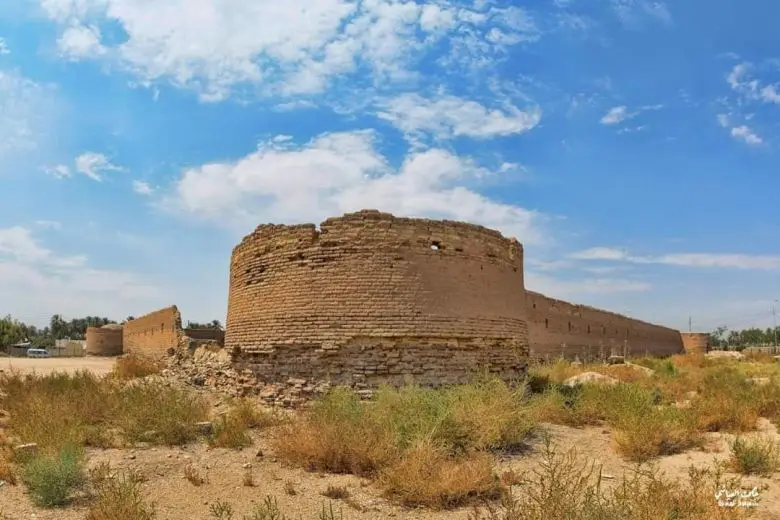
Khan Al Atayshi is considered one of the oldest heritage khans in the sacred city of Karbala, built along with a group of khans on this road during the Ottoman state era. It is one of 99 khans beginning from the Iranian city of Tus and ending in the city of Najaf Al Ashraf at Khan Al Nukhayla.
Khan Al Atayshi was built at the end of the eighteenth century CE, constructed from brick in the Hiri measurement, believed to have been taken from the ruins of the archaeological Tell Al Atayshi located near the khan, which archaeologists believe dates back to the era of the Lakhmid state.
The architectural style of the khan resembles the Hiri style, which relied on facing internal iwans (vaulted halls) roofed in the semicircular arch style, distributed among the four corners of the khan with beautiful geometric symmetry. One of the advantages of this style is allowing sunlight to pass through in winter and air-conditioning the heat in summer.
The khan came in a rectangular shape, 65 meters long and 51 meters wide. Its external walls reach approximately five meters in height and one meter in thickness, with the upper portion equipped with arrow slits used for defense and protection of the khan from thieves. Its external corners are reinforced with four large towers, each with a radius of 4.5 meters. It has an entrance centered on the southwestern facade, protruding from the wall level, three meters high and two meters wide, topped by a large pointed arch decorated with interlocking brick ornamentations resembling the weave of a mat. At its center is an open internal courtyard, 50 meters long and 35 meters wide, surrounded by rooms preceded by iwans of varying dimensions topped by pointed arches, with its towers roofed by hemispherical domes resting on cylindrical necks.
Excavations conducted by the archaeological expedition in 2008 indicated the presence of two archaeological layers belonging to two different eras. The ceramic and glass artifacts discovered showed they belong to the Abbasid era, which flourished around 221-279 AH. A copper coin was also discovered stamped with "There is no god but God" on its face and "Muhammad is the Messenger of God" on its reverse, presented to numismatic experts at the Iraqi Museum, who determined its historical period to be the Abbasid era.
A Station on a Road That Never Ends
4 Min · Arabic · English · Persian · Turkish
Frequently asked questions
What are the opening hours of Khan Al Atayshi?
Khan Al Atayshi is open 24 hours.
How much does it cost to visit Khan Al Atayshi?
Admission to Khan Al Atayshi is free.
How long should I spend at Khan Al Atayshi?
Plan about ~ 35 min for Khan Al Atayshi.
When is the best time to visit Khan Al Atayshi?
Spring and autumn, and the cooler hours of morning or late afternoon; summer middays are punishingly hot. Bring water and sun protection — there is little shade.
Does Khan Al Atayshi have an audio guide?
Yes — a narrated audio guide for Khan Al Atayshi is available in the Travel Tale app.
Where is Khan Al Atayshi located?
Khan Al Atayshi is in Karbala: Al Husseiniyya District, Old Karbala-Baghdad Road, Karbala.

Hear the full audio story — free in the app
Get app