
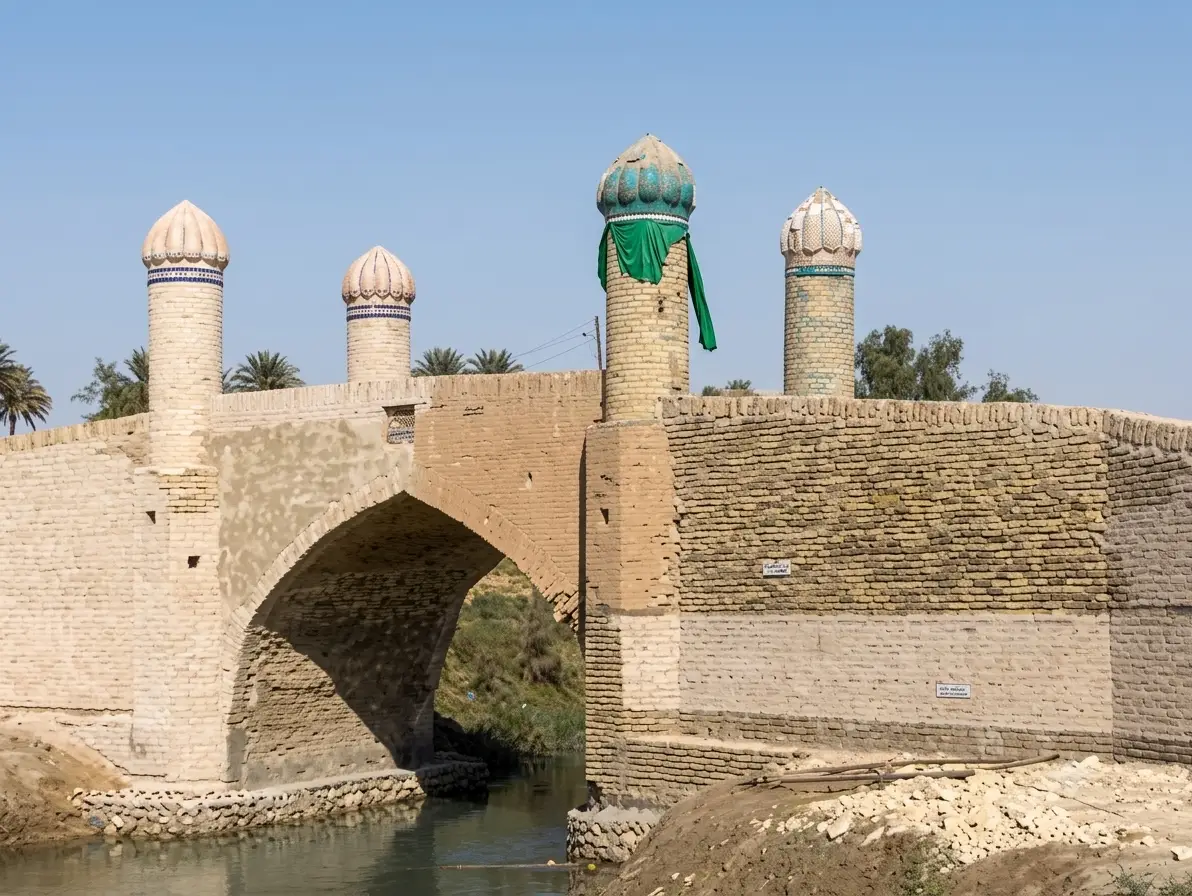
White Al Qantara
White Al Qantara, also known as the White Bridge and the Bridge of Imam Ali, is located on the Husseiniyya River, a branch of the Euphrates, five kilometers east of Karbala city center. It is one of the oldest bridges built by the Ottomans in Iraq, with its construction dating back more than 450 years, becoming since then the water gateway to Karbala, through which ships loaded with goods and foodstuffs would pass after paying a crossing toll.
The site where the bridge was built holds sacred significance, as beside it stands the shrine and prayer site of Imam Ali when he passed through Karbala in 37 AH while heading to the Battle of Siffin via Karbala, then Ain Al Tamr, then Anbar toward the Levant. This sacred trace was the reason for choosing this precise location for the bridge.
Ottoman Sultan Suleiman the Magnificent ordered the digging of the Husseiniyya River during his visit to Karbala in 1550 CE, in response to appeals from the city's residents and the custodian of the Husseini shrine, then commissioned the new Governor of Baghdad, Hasan Pasha, to build bridges over the river.
The bridge's construction follows the pointed arch style, with the arch rising about 5 meters above the riverbed, which allowed boats to pass. The current length of the bridge is 46 meters, its diameter is 1.80 meters, and its supporting walls are distinguished by their massiveness, measuring more than one meter at the base and tapering to 45 centimeters at the top. The bridge includes four columns in the shape of small domed minarets, some appearing in yellow with blue rings surrounding their upper portions.
Key historical milestones:
37 AH: Imam Ali (peace be upon him) passed through the site on his way to the Battle of Siffin and prayed there.
1550 CE: Sultan Suleiman the Magnificent ordered the digging of the Husseiniyya River and the building of the bridge over it.
1803 CE: The Mamluk Governor of Baghdad, Sulayman Pasha the Great, renovated its construction after the Wahhabi invasion.
1824 CE: A national battle known as the "Miraakhur Incident" or "Manakhur Incident" took place around it between the Ottomans and the people of Karbala who had declared rebellion. After a long siege, Governor Dawud Pasha was forced to lead his army to occupy the city, resulting in the collapse of a large part of the bridge.
1850 CE: Sayyid Ali Al Nahri enlisted architect Muhammad ibn Ali ibn Usta Qasim Al Banna Al Asadi to rebuild the collapsed portion.
A decision was made to reconstruct it, and the General Authority for Antiquities and Heritage carried out maintenance works, forming a committee of archaeologists in Karbala who rebuilt the foundations of the supporting walls to the same ancient measurements. It was subsequently inscribed on the World Heritage List for Irrigation, in recognition of its exceptional archaeological and historical value.
Four and a Half Centuries and the River Still Passes Beneath It
4 Min · Arabic · English · Persian · Turkish
Frequently asked questions
What are the opening hours of White Al Qantara?
White Al Qantara is open 24 hours.
How much does it cost to visit White Al Qantara?
Admission to White Al Qantara is free.
How long should I spend at White Al Qantara?
Plan about ~ 20 min for White Al Qantara.
When is the best time to visit White Al Qantara?
Cooler months and daytime hours; mornings are quietest.
Does White Al Qantara have an audio guide?
Yes — a narrated audio guide for White Al Qantara is available in the Travel Tale app.
Where is White Al Qantara located?
White Al Qantara is in Karbala: Husseiniyya River, Karbala.
Hear the full audio story — free in the app
Get app