
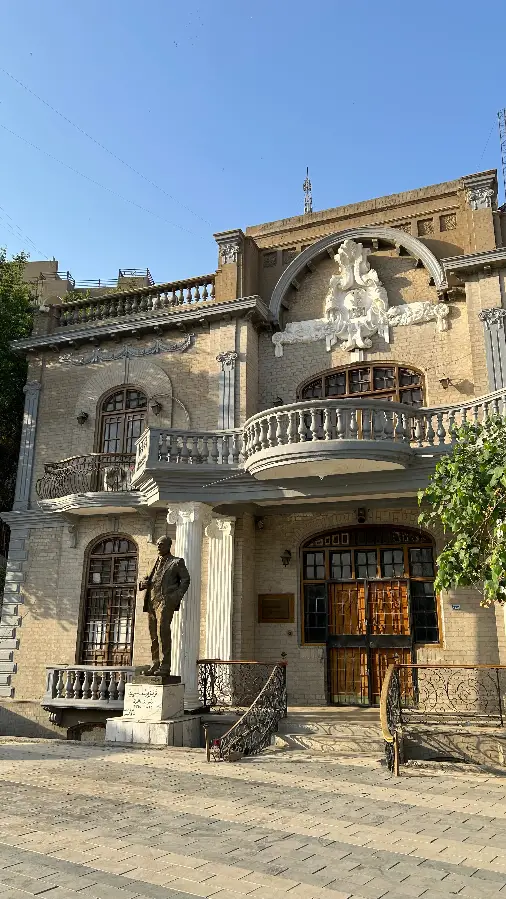
Tawfiq Al Suwaidi's House
On Haifa Street, where the bustle of the modern city blends with the scent of history, Tawfiq Al Suwaidi’s house stands tall as a witness to a turbulent political era and a period of major transformations in Iraq.
This house was not merely the residence of a prominent man, but became a cultural and political symbol, still preserving the details of the life of one of the key figures of the Iraqi monarchy.
Tawfiq Al Suwaidi was born in Baghdad and descends from the Al Bu Mudallal tribe of the Al Dur clans, a branch of the Bani Suwayda Al Zubaidi tribes. His family is known as “Al Suwaidi”, named after his great-grandfather Abdullah Al-Suwaidi, one of Iraq’s religious scholars in the 18th century.
He graduated from the University of Paris Sorbonne, and was among the first judges in Iraq, as well as one of the earliest instructors at the “Law School” in Baghdad, which later became the College of Law.
He held high-ranking government positions, most notably as Prime Minister in four cabinets (1929, 1930, 1946, and 1950), in addition to serving as Foreign Minister during the period of the Hashemite Union between Iraq and Jordan in 1958. He was also among the founders of the Arab Renaissance Society, which called for Arab independence from the Ottoman Empire.
The house was built in 1932 by the architect Nu’man Munib Al Mutawalli in a classical English style, and the construction was executed by one of the pillars of traditional Baghdadi architecture, Al Usta Al Maz.
The initials TS are still visible on the upper façade of the house, referring to the name of its owner.
Tawfiq Al Suwaidi lived in the house until his death on October 15, 1968, after leaving Iraq following his release from prison in 1961, where he had been imprisoned after the July 14, 1958 Revolution.
At that time, the house was raided, and his papers and library were confiscated, including the will of Abdul Muhsin Al Saadoun, which was deposited with him and has since disappeared.
After his death, the house was used for several years by the Cooperative Society of the Ministry of Education until 1981, and in 1988, it was transformed into the headquarters of the Iraqi Manuscripts House, part of the Iraqi Museum, now known as the National Center for Manuscripts. It continues to serve as a living archive of Iraq’s cultural and intellectual memory.
Despite its transformation from a private home into a governmental cultural institution, Tawfiq Al Suwaidi’s house still retains its original identity from the classical architecture and wooden doors, to the fine engravings and the spirit of its owner, which resides in the place with silence and dignity.
It is not merely a house, but a page from Iraq’s political, architectural, and cultural history, open to anyone who wishes to read it.
The House That History Passed Through... And Went Away
4 Min · Arabic · English
Frequently asked questions
What are the opening hours of Tawfiq Al Suwaidi's House?
Tawfiq Al Suwaidi's House is open 24 hours.
How much does it cost to visit Tawfiq Al Suwaidi's House?
Admission to Tawfiq Al Suwaidi's House is free.
How long should I spend at Tawfiq Al Suwaidi's House?
Plan about ~ 30 min for Tawfiq Al Suwaidi's House.
When is the best time to visit Tawfiq Al Suwaidi's House?
Mid-morning or late afternoon — softer light and lighter foot traffic.
Does Tawfiq Al Suwaidi's House have an audio guide?
Yes — a narrated audio guide for Tawfiq Al Suwaidi's House is available in the Travel Tale app.
Where is Tawfiq Al Suwaidi's House located?
Tawfiq Al Suwaidi's House is in Baghdad.

Hear the full audio story — free in the app
Get app