
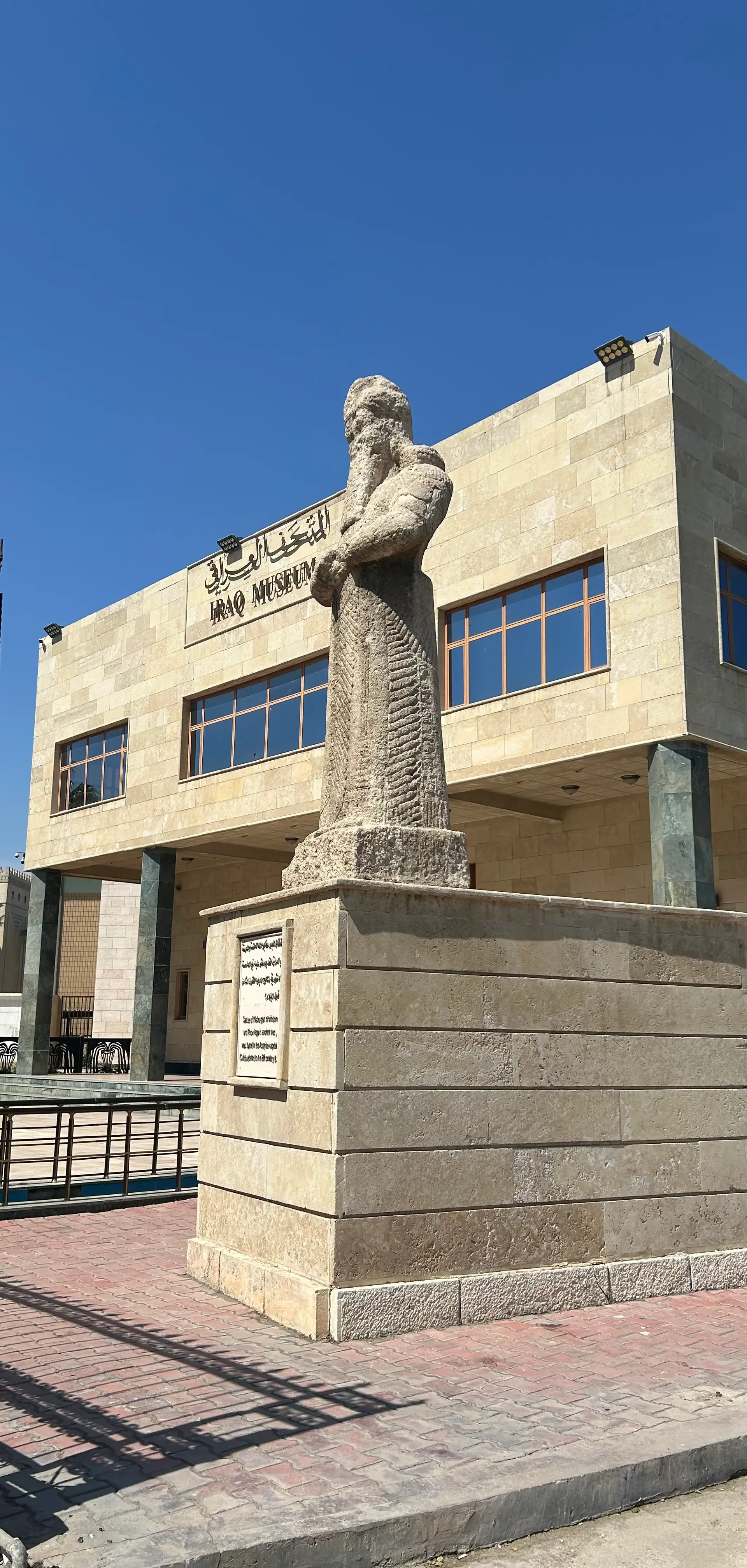
Iraqi National Museum
The Iraqi National Museum rises as one of the oldest and most important cultural and archaeological institutions in the Middle East.
Within its walls, it holds thousands of artifacts that narrate the history of Mesopotamia from the dawn of the earliest civilizations to the Islamic eras. It is more than an architectural landmark; it is a memory shaped by Sumerian clay, Assyrian carvings, Babylonian gold, and Abbasid pottery.
The museum’s beginnings trace back to 1923–1924, when British archaeologist Gertrude Bell began collecting Iraqi antiquities and displaying them in a small space within the Qushla building (the old Ottoman government complex) in the center of the capital.
This marked the first effort to document Iraq’s ancient heritage.
As the collection grew, a new building was opened in 1926 on Al Ma'mun Street to house the expanding artifacts. Bell was appointed the museum’s first director, followed by R. S. Cook.
In 1966, due to the increasing size of the collection and the limitations of the old building, the Iraqi government decided to construct a modern, fully equipped museum that could reflect the immense value of its holdings.
The new facility was built in Al Alawi and renamed the Iraqi National Museum, replacing its former name, Baghdad Museum of Antiquities. This became the permanent home and official guardian of Iraq’s millennia-old legacy.
Today, the museum hosts one of the largest and most significant archaeological collections in the world. It displays rare artifacts from the civilizations of Sumer, Akkad, Babylon, Assyria, and the Islamic era, in addition to objects from the Stone Age, the Ubaid, Uruk, Nabataean, and later historical periods.
The collection includes cuneiform tablets, statues, cylinder seals, pottery, farming tools, wall reliefs, and weapons all of which reflect the ingenuity of early Iraqis in building society, recording language, and founding civilization.
Despite its global stature, the museum did not escape destruction. Following the U.S. invasion of Iraq in 2003, the Iraqi National Museum suffered the largest looting event in its history.
The building was stormed, and thousands of priceless artifacts were stolen, many of them irreplaceable.
That day marked a profound wound in the conscience of the global cultural community. In its aftermath, massive efforts were launched both locally and internationally. The Iraqi government collaborated with UNESCO and major archaeological institutions to recover as many pieces as possible.
These efforts succeeded in retrieving a large number of stolen items some returned from foreign museums, others from international black markets though many artifacts remain missing to this day, as if fragments of memory remain exiled, still waiting to return home.
And yet, the Iraqi National Museum continues to stand as a center of scientific research, preservation, and restoration. It still welcomes visitors, scholars, and historians, offering them a chance to stand face-to-face with a long, rich history a history not written by empires alone, but by the Iraqi people themselves, from the moment they inscribed the first letter, told the first myth, and built the first city.
The Voice of Civilizations in One Place
3 Min · Arabic · English
11 stops to discover
- 1Premium
Statue of the God Nabu
Before you cross the threshold of the museum, Nabu will greet you standing tall as he always was, his hands clasped in a posture exuding wisdom and dignity. As if he never left, but chose to remain a guardian on the threshold of time. Nabu is the god of writing, wisdom, and knowledge in Mesopotamian mythology. His name is derived from the Semitic root meaning "to speak" or "to proclaim," as if the civilization that created him wanted to make the word itself a god. His name was associated with everyone who carries a pen or seeks knowledge, for he was the patron of scribes, scholars, and astrologers alike. He is the son of the great god Marduk (the supreme god of Babylon) and inherited from his father a lofty position among the gods. Indeed, his influence increased in the Neo-Babylonian period until he almost rivaled him in importance. He was assigned the sacred number forty, and was associated with the planet Mercury in the Mesopotamian astronomical tradition. His most prominent symbol was the stylus and writing reed, and sometimes the winged dragon known as "Mushhushshu". His wife was the goddess Tashmetu, also goddess of writing, so the word and knowledge united them in everything. His worship was centered in the city of Borsippa near Babylon, where the temple "Ezida" (meaning "The Eternal House") was built for him, which was a shrine for scholars and priests from throughout Mesopotamia. Nabu was the guardian of the Tablet of Destinies, that cosmic tablet on which the fates and lifespans of humans are recorded. At each Babylonian New Year during the great Akitu celebrations, priests believed that he renewed the writing of human destinies for the coming year, so prayers rose to him in fear and hope. His status was so great that the great royal libraries, such as the Library of Ashurbanipal in Nineveh, were placed under his patronage, and warnings in his name were written on their tablets for anyone who dared to steal or destroy the tablets. Many of the great kings bore compound names containing his name, foremost among them Nebuchadnezzar, the greatest king of Babylon, Nabopolassar, founder of the Neo-Babylonian Empire, and Nabonidus, its last king as if association with Nabu's name granted the king an aura of wisdom and divine legitimacy that no other attribute could provide.
- 2Premium
01 & 02 Behnam Abu Al Suf Hall (Prehistoric)
This hall contains the remains of humans who settled in the northern regions of Mesopotamia and made caves and plateaus their dwelling place, where their stone and bone tools were found in the depths of these caves and on the highlands. These early ages are called the Old Stone Ages (Paleolithic), which is a long period in Iraq spanning between (100,000 years) to (10,000 years). During this time, humans lived as nomadic hunters gathering sustenance from hunting and vegetation. Among the most famous sites of these ages are Barda Balka, Shanidar, Hazar Merd, Zarzi, and many other caves and sites. In the New Stone Age (Neolithic) about (10,000 years ago), humans settled and began to farm and raise livestock, forming the first villages. They began producing their own sustenance and developed social life and religious beliefs. The most famous villages are Jarmo, Tell es-Sawwan, Hassuna, and Samarra. Over thousands of years, the population increased, villages grew and transformed into thriving cities, farms expanded, trade flourished, and city inhabitants invented new industries, including pottery, which was simple at first but then developed. They invented the potter's wheel and colored pottery with bright colors and beautiful geometric shapes. The manufacture of dolls and stone or clay figurines also flourished, most of which represented the mother goddess, the source of fertility, reproduction, and blessing, or represented animals that lived alongside these humans. Then copper entered into manufacturing. As for the art of architecture, it advanced extensively and buildings were constructed with regular mud bricks or stones, so cities, temples, and palaces were built. In this hall are selected samples from the artifacts of these villages, cities, and civilizations from northern and southern Iraq. The time of these civilizations ends in the middle of the fourth millennium BC, which is known as the prehistoric era. The Second Hall: Displayed artifacts from a transitional period between prehistoric and historical ages. This is a period of time famous for the civilizations of Ubaid, Uruk, and Jemdet Nasr, spanning the fourth millennium BC between (4,000 - 3,000). During this period, humans used copper extensively and employed the fast-spinning potter's wheel to manufacture pottery in large quantities. They built extensive cities surrounded by walls and magnificent temples decorated with mosaics and pigments.
- 3Premium
03 & 04 The Civilization of the Sumerian Ages Halls
The Sumerian Hall at the Iraqi National Museum is more than just an archaeological exhibit it is a journey through time to one of the earliest civilizations known to humanity. Between 2900 and 2004 BCE, the first cities of Mesopotamia flourished, laying the foundations of what we now call civilization in its truest sense. In this gallery, the names Uruk, Ur, Lagash, Nippur, and Eridu stand as powerful witnesses to the emergence of the first Sumerian city-states. These were not mere settlements but fully developed urban societies, governed by advanced political, economic, and religious systems. Central to this era is the figure of Gilgamesh, the legendary king of Uruk, who would later inspire one of the world’s oldest and greatest literary epics. Among the Sumerians’ most transformative achievements was the invention of cuneiform writing. These were not just marks pressed into clay they were a complete language used to record laws, treaties, myths, and administrative documents. This invention paved the way for the world’s first known legal code: the Code of Ur-Nammu, which predates even the famous laws of Hammurabi. Scientifically and technologically, the Sumerians were remarkably advanced. They invented the wheel and the plow, developed sophisticated irrigation systems that ensured agricultural stability, and introduced mathematical and temporal concepts that still define our lives today such as dividing the hour into 60 minutes, and the minute into 60 seconds, based on their sexagesimal (base-60) system. They also founded the world’s first formal schools, known as the “House of Tablets”, where young scribes studied writing, mathematics, and engineering. In this gallery, you will encounter basalt stelae carved with religious texts and historical records, stone sculptures and clay and marble figurines depicting religious rituals and daily life scenes, as well as original walls from Uruk temples, once adorned with colorful geometric patterns. One of the most remarkable features of the gallery is its collection of cylinder and stamp seals, used to authenticate documents and contracts. These seals are miniature masterpieces that reveal artistic details of Sumerian life. You will also find original cuneiform tablets, inscribed on sun-dried or kiln-fired clay, offering a direct glimpse into the Sumerian world their administrative practices, spiritual beliefs, notions of justice, divinity, death, love, literature, and language. The Sumerian Gallery is not simply a space for contemplating Iraq’s earliest cultural eras it is a vivid restoration of the human story when people first began to build cities, record thoughts, and seek meaning in their existence.
- 4Premium
05 & 06 The Civilizations of the Akkadian, Babylonian, and Kassite Periods
This Hall of the Iraqi National Museum extends a long timeline covering pivotal eras in the history of Mesopotamia, beginning with the rise of the Akkadians in the twenty-fourth century BC, through the era of the Early Babylonians, and reaching the Kassites and Hurrians, who left their marks in the heart of Iraqi history between 1500 and 1000 BC, in a complete tableau reflecting the transformation of Mesopotamia from Sumerian city-states to powerful kingdoms and empires with cohesive political, economic, and religious organization. The journey begins with the Akkadian Era (2350–2159 BC), where the first unified empire in history emerged under the leadership of the famous King Sargon of Akkad, who succeeded in uniting the Sumerian city-states under one banner and imposed the Akkadian language as the official language in temples and government bureaus, paving the way for a new phase of administrative stability and cultural prosperity. The Akkadian state was distinguished by its ability to organize far-flung territories with an effective administrative system, and its commercial networks expanded to connect the Mesopotamian valley with the Arabian Gulf, the Indian subcontinent, and Anatolia. During this period, sculptural art flourished, and the bronze Head of Sargon of Akkad is considered one of the finest legacies of that civilization, serving as a witness to their mastery in metal casting and sculpting the features of power. The historical narrative in the same hall continues with the Old Babylonian Era (2000–1500 BC), a period distinguished by tremendous development in law, administration, astronomy, and literary thought. During the reign of King Hammurabi, Babylon reached the pinnacle of its prosperity, not only as the political and cultural capital of ancient Iraq, but as a center of legal and astronomical enlightenment. The Code of Hammurabi, inscribed on a tall stone stele, is considered one of the oldest known written law codes, and established the concept of justice and accountability in Babylonian society. The Babylonians also knew astronomical tables and divided the day into 24 hours, in a scientific achievement whose echo still extends to the modern era. In terms of literature, they recorded the Epic of Creation (Enuma Elish) on clay tablets, expressing their vision of the universe, the relationship between humans and gods, and the question of order and chaos. Under Hammurabi's rule, the legend of the Tower of Babel was built, and news spread of the Hanging Gardens, which were considered one of the Seven Wonders of the World, giving the city an almost mythical character in the global imagination. Displayed in this hall is a rare collection of Akkadian era artifacts, including pieces of inscribed marble stelae, small stone sculptures, clay statues representing the goddess Ishtar, alongside an elegant collection of precise cylinder seals that were used to authenticate contracts and correspondence. The visitor's attention is also drawn to the presence of a plaster copy of the famous Stele of Hammurabi, which contains more than 280 legal articles, a copy identical to the original displayed today in the Louvre Museum in Paris. Alongside the Akkadian and Babylonian artifacts, the visitor finds references to the Kassite and Hurrian civilizations who lived between 1500 and 1000 BC and also left their marks in the military, artistic, and religious fields, thus forming a rich link in the chain of civilizational diversity for which Mesopotamia was known. This hall, with its precise exhibits and deep historical dimensions, embodies the transition of humans in ancient Iraq from local authority to centralized state, from clay symbols to written legislation, from improvisation to organization, in a civilizational narrative reflecting the maturation of human consciousness thousands of years ago.
- 5Premium
08 The Assyrian Sculptures Hall
In this hall of the Iraqi National Museum, there is a living embodiment of the greatness of Assyrian civilization, which arose in northern Mesopotamia and extended its deep roots from the third millennium BC, reaching its zenith between the ninth and seventh centuries BC, before the curtain fell on its great capital Nineveh with its fall in 612 BC. Yet its cultural, artistic, architectural, and military achievements remain etched in human memory, bearing witness to one of the most powerful civilizations of the ancient Near East. The Assyrian state was known for its unparalleled military power, as it was a strictly organized centralized state, based on strict administration, accountability, and precise taxation. It relied on an organized army that conquered lands stretching from the Gulf to the Mediterranean, built its great capitals such as Ashur, Nimrud, and Nineveh, and its kings took care to document their heroic deeds in massive stone inscriptions adorning the walls of palaces and temples, depicting their battles and scenes of lion and ibex hunting, expressing power, control, and the integration of humans, nature, and the gods. The Winged Bulls (Lamassu) are among the most prominent symbols left by Assyrian art massive stone statues combining the body of a bull or lion, eagle's wings, and a human face with an imposing beard. They were erected at the entrances of royal palaces to guard them spiritually and intimidate enemies, representing symbols of strength, wisdom, and immortality. They were carved with meticulous attention to detail to embody the Assyrian concept of divine authority manifested in the person of the king. The hall also contains massive relief sculptures carved from limestone, depicting a complete panorama of military campaigns led by Assyrian kings such as Ashurnasirpal II and Shalmaneser III. Scenes of civilizations, epics, capturing soldiers, victory processions, and religious rituals appear, making them not only stunning works of art but also pictorial historical records documenting the Assyrian worldview. Among the most prominent exhibits here is the statue of King Ashurnasirpal II, in his royal garments with his steady gaze, and the Stele of Shalmaneser III, on which precise details of his conquests, the alliances he formed, and the kingdoms he subjugated were recorded. This hall embodies both military and artistic spirit, revealing the flourishing of official art associated with the royal court, and highlighting how the Assyrians used art and architecture as a means to establish prestige and immortalize political and religious memory, making Nineveh and their other cities not merely centers of rule, but capitals of culture, sovereignty, and a comprehensive world order ahead of its time.
- 6Premium
09 Middle Assyrian Period hall
This Hall presents the Middle Assyrian period, which spanned approximately from 1365 to 911 BCE. It represents a pivotal turning point in the development of the Assyrian state, following the Old Assyrian period and paving the way for the Neo-Assyrian era, during which the empire would reach the peak of its territorial expansion and political dominance. The Middle Assyrian period was marked by profound transformations in the political, administrative, economic, and social structures of the kingdom. During this time, Assyrian kings began to establish stronger centralized institutions, organize more effective military systems, and expand agriculture and trade networks. These developments helped solidify the concept of an expansionist state one that no longer aimed solely to govern a city, but sought to annex neighboring territories and assert control over them. This period laid the essential foundations for the imperial structure that would later define the Neo-Assyrian Empire, with its centralized authority, military campaigns, and far-reaching influence across the ancient Near East.
- 7Premium
11 Ivory Hall
This Hall highlights one of the most exquisite forms of ancient Mesopotamian art through a rare collection of ivory artifacts. Ivory a precious material typically sourced from elephant tusks or the teeth of hippopotamuses was highly valued in antiquity and was most often associated with the elite and royal classes, due to both its rarity and the intricate craftsmanship it required. The artifacts on display reflect the refined aesthetic and exceptional artistic skill of ancient Iraqi craftsmen, who mastered the delicate art of carving and shaping ivory. It was used to create boxes, ornaments, furniture inlays, and decorative panels that often depicted scenes from daily life, mythology, and symbolic iconography. Most of these pieces originate from the great Assyrian cities, particularly Nimrud in northern Iraq, where extensive artistic treasures were uncovered in the palaces of Assyrian kings clear evidence of the royal opulence and cultural flourishing of that era. Other examples were found at various sites across Mesopotamia, indicating that ivory craftsmanship was widespread and diverse in its production centers across different Mesopotamian civilizations.
- 8Premium
12 Neo-Babylonian Hall (Chaldean Period)
The Chaldean era began in 626 BC when Nabopolassar founded the Chaldean dynasty after expelling the Assyrians from Babylon, heralding a new era of power. This transformation represented a major political and architectural renaissance that restored Babylon's historical status in Mesopotamia. The Neo-Babylonian Empire became one of the most important powers in the ancient East. Babylon reached the height of its greatness during the reign of Nebuchadnezzar II (605–562 BC), who led powerful military campaigns and built massive architectural projects. Under his rule, Babylon was transformed into the jewel of the East thanks to its architecture and arts. His era was the zenith of political and military influence for the Chaldean state. The Hanging Gardens are one of the Seven Wonders of the World, built by Nebuchadnezzar for his wife Amytis to ease her longing for the mountains of Media. They were distinguished by their green terraces and ingenious irrigation systems that historians considered a unique engineering achievement. The gardens remained a global symbol of Babylonian beauty and imagination. The Ishtar Gate was Babylon's greatest entrance, covered with blue glazed bricks and reliefs of lions, bulls, and dragons. The gate reflects the pinnacle of Babylonian architectural art and the splendor of colored decorations. Its replica in the Berlin Museum remains one of the most famous archaeological works in the world. The Tower of Babel (Etemenanki Ziggurat) represented a massive religious symbol rising in graduated levels toward the sky, embodying Babylon's connection to the gods. It was one of the city's most important temples and most influential in religious and historical memory. The tower is associated with the well-known "Tower of Babel" story in global heritage. The Babylonians developed a precise astronomical system that enabled them to observe planetary movements and predict lunar and solar eclipses. Their science had a direct impact on subsequent Greek and Roman civilizations. Babylon was an advanced center for astronomical studies in the ancient world. The Babylonians adopted the sexagesimal system that we still use for time and angles today. They provided mathematical solutions in algebra and geometry demonstrating a high level of advancement. Their cuneiform tablets are among the oldest discovered mathematical models. The Babylonians recorded diseases and their treatments on cuneiform tablets, making Babylon an important medical center. Babylonian medicine mixed practical expertise with spiritual knowledge. Their records became an important source for studying ancient medicine. The Neo-Babylonian Empire extended across Mesopotamia, the Levant, and parts of Asia Minor. Its influence reached the borders of Egypt, making it one of the greatest powers of the Near East. It maintained its status until the mid-sixth century BC. The empire fell in 539 BC when Cyrus the Great entered Babylon without significant resistance. This event marked the end of the last independent state in ancient Mesopotamia. With Babylon's fall, a page was turned on a civilization that had lasted thousands of years.
- 9Premium
13 & 15 Hatra Period Halls
The period of the Kingdom of Hatra extends from around 100 BCE to 241 CE, and it represents one of the most significant historical eras in northern Mesopotamia. The city arose in northwestern Iraq and was a flourishing cultural and civilizational center. It was distinguished by its urban development and the strength of its religious and political institutions. Hatra prospered thanks to its strategic location along the trade routes between the Roman and Persian empires. This position made it a major stop for caravans and an influential commercial hub in the region. Its archaeological remains combine Eastern and Western artistic styles, giving its art a unique and distinctive character. Hatra was famous for its massive walls, which withstood attacks from powerful armies. The city contained numerous temples reflecting its religious diversity and rich cultural identity. Its architectural elements are considered among the most important remnants left by Mesopotamian civilizations in the north. The Kingdom of Hatra collapsed in 241 CE after a long siege by the Sasanian king Shapur I. Its fall marked the end of one of the strongest fortified cities of the ancient Near East. Despite its disappearance, its ruins have stood as a testament to its greatness for centuries. Today, the ruins of Hatra are among the most important archaeological sites in Iraq. UNESCO has listed them as a World Heritage Site in recognition of their historical and architectural value. They remain a witness to a distinguished period in the history of Mesopotamia.
- 10Premium
14 Abdullah Shukr Al Sarraf Coin Hall
Al Hajj Abdullah Abd Al Rasul Shakir Al Sarraaf was born in the holy city of Najaf on July 7, 1910, and he learned reading and writing at the hands of the city’s mosque scholars. He was passionate about collecting ancient coins and dedicated forty years of his life to this passion. He amassed more than 1,600 gold, silver, and copper pieces of high historical value. On March 18, 1969, Al Sarraaf donated his precious collection to the Iraqi Museum in appreciation of the national heritage. In the same year, the hall dedicated to displaying these coins was inaugurated, and the items were placed in eleven display cabinets. Since then, the hall has been named The Abdullah Shakir Al Sarraaf Hall of Islamic Coins. The Iraqi Museum’s administration celebrated this valuable gift with a major official ceremony. The Department of Antiquities also issued a special edition of The Iraq Museum Journal that presented the entire Al Sarraaf coin collection. Copies of that issue were distributed to museums around the world in recognition of the collection’s importance. The Al Sarraaf family renovated the hall twice: once in 2016 and again in 2019. These updates were carried out to preserve display quality and to better organize the historical information associated with the coins. The hall has remained one of the important spaces within the museum due to its significant cultural and historical value. The hall contains 1,600 coins arranged chronologically according to states, caliphs, sultans, and kings. They include coins in the Sasanian and Byzantine styles, as well as various groups from the Abbasid era, along with gold, silver, and copper coins from different states and periods. Al Sarraaf left Iraq in 1985 for the city of Rabat, then moved to the United States where he lived in the state of Virginia. He passed away in Washington on October 30, 2000, after a life rich in scholarly and cultural contribution. His dedicated hall in the Iraqi Museum remains a lasting testament to his passion and legacy.
- 11Premium
Halls 16 & 17 — Pre-Islamic Galleries
The artifacts in this hall are from the era of the Sassanian state, and the Sassanian civilization in Iraq is an extension of previous civilizations, particularly the Parthian and Seleucid. Traces of these civilizations have been found in the upper layers of many cities in the south, especially in Uruk and Kish.
Frequently asked questions
What are the opening hours of Iraqi National Museum?
Opens at 09:00
How much does it cost to visit Iraqi National Museum?
Admission to Iraqi National Museum starts at 3,000 IQD.
How long should I spend at Iraqi National Museum?
Plan about ~ 3 Hours for Iraqi National Museum.
When is the best time to visit Iraqi National Museum?
Mid-morning to early afternoon, ideally on a weekday for fewer crowds. Photogenic in early evening light.
Does Iraqi National Museum have an audio guide?
Yes — a narrated audio guide for Iraqi National Museum is available in the Travel Tale app.
Where is Iraqi National Museum located?
Iraqi National Museum is in Baghdad.

Hear the full audio story — free in the app
Get app