
Al Hadba Minaret
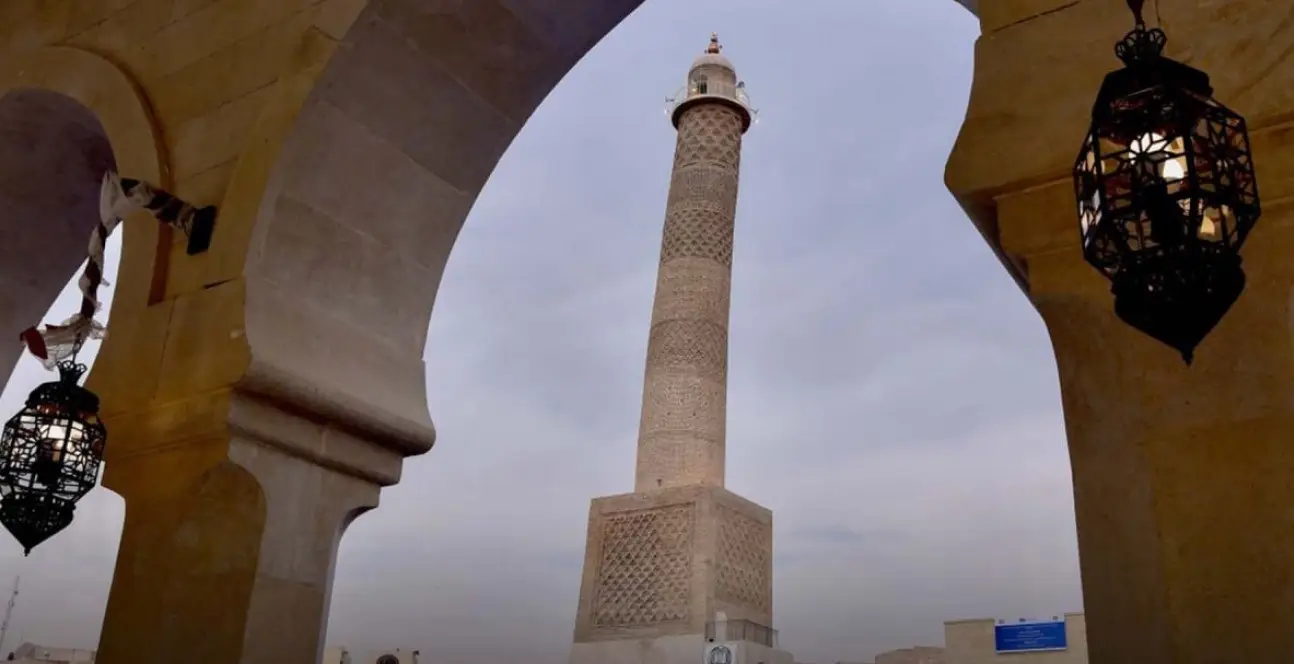
Al Hadba Minaret is considered one of the most prominent historical monuments in the Iraqi city of Mosul, and is part of the Great Nuri Mosque built in the sixth Hijri century. It is located in the northwestern corner of the mosque's sanctuary on the western part of Mosul, on the western bank of the Tigris River. Its image was printed on the Iraqi ten-thousand-dinar banknote, making it a symbol of the city's identity and civilizational face.
Al Hadba Minaret was established in 1170 CE by the Governor of Mosul Imad Al Din Zanki, erected within the second mosque established in Mosul. The task of its construction was entrusted to architect Ibrahim Al Mawsili, who took into consideration construction methods, engineering aspects, and the impact of climatic and environmental factors, along with the harmony of artistic and decorative characteristics and their connection to the religious dimension, making this minaret distinguished by its architecture and beautiful engravings that reflect Islamic architectural art. Its height is 65 meters and its width 17 meters, and it forms one of more than 17 leaning towers in various parts of the world.
The minaret consists of two sections, one cylindrical and one prismatic. The cylindrical section rises above the prismatic section and contains seven decorative brick relief rings. It has two entrances, each leading by staircase to the top. Ibrahim Al Mawsili created two staircases inside the minaret, each separate from the other, meeting at the fortress area at the top, so that one ascending cannot see one descending.
Multiple interpretations exist for the reason of its lean. Among them is that Ibrahim Al Mawsili did it intentionally to reduce casualties if it fell leaning eastward toward the mosque's courtyard rather than westward toward the houses. When traveler Ibn Battuta visited it two centuries after its construction, the minaret had already begun to lean, while traveler Gratien Graty wrote about it in the nineteenth century describing it as appearing "like a man bowing."
In June 2017, the mosque and its Al Hadba Minaret were destroyed by explosives placed by ISIS inside the mosque during battles between Iraqi forces and the organization. The mosque held an inverted symbolism for the organization, as its leader Abu Bakr Al Baghdadi had declared from its pulpit in the summer of 2014 what he called "the Islamic Caliphate." Approximately 80% of Mosul's old city was destroyed, and more than 12,000 tons of rubble were removed from main sites.
Following the city's liberation, UNESCO worked for five years to restore archaeological landmarks, among them the Great Nuri Mosque and its Al Hadba Minaret, which returned as an original replica with its old stones. The minaret's body required 96,000 new bricks on the inside, while 26,000 old bricks were used on the outside to preserve its heritage character. The minaret's lean was preserved exactly as it was in the 1960s, with its foundations reinforced to prevent the lean from gradually increasing. UNESCO Director Audrey Azoulay said upon visiting the site: "Being here is like a return to the city's history and identity."
The Hunchback of Mosul
4 Min · Arabic · English · Persian · Kurdish (Kurmanji)
Frequently asked questions
What are the opening hours of Al Hadba Minaret?
Al Hadba Minaret is open 24 hours.
How much does it cost to visit Al Hadba Minaret?
Admission to Al Hadba Minaret is free.
How long should I spend at Al Hadba Minaret?
Plan about ~ 20 min for Al Hadba Minaret.
When is the best time to visit Al Hadba Minaret?
Cooler months and daytime hours; mornings are quietest.
Does Al Hadba Minaret have an audio guide?
Yes — a narrated audio guide for Al Hadba Minaret is available in the Travel Tale app.
Where is Al Hadba Minaret located?
Al Hadba Minaret is in Mosul: Great Mosque St, Old City, Mosul.
Hear the full audio story — free in the app
Get app