
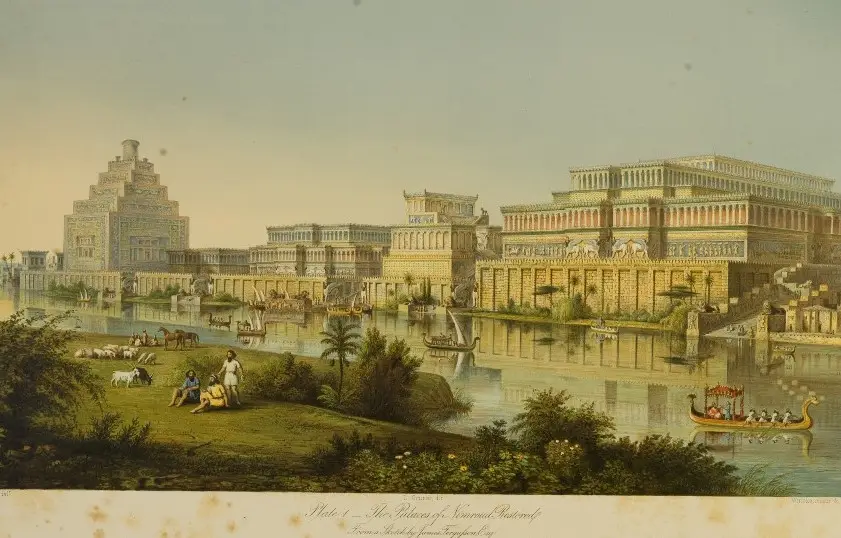
The Ancient City of Nimrud
The archaeological city of Nimrud, known in Assyrian texts as Kalhu and in the Tanakh as Calah, is located in the Nimrud district 30 kilometers south of Mosul, at a strategic site six miles north of the point where the Tigris River meets the Greater Zab. The name Nimrud is most likely a modern designation derived from the biblical figure, with the earliest mention tracing to the German traveler Carsten Niebuhr who visited the site in 1766.
The city was founded in the thirteenth century BC and became in the ninth century BC the capital of the Neo-Assyrian Empire during the reign of King Ashurnasirpal II, flourishing and expanding until it became one of the greatest cities of the ancient world. It was destroyed in 612 BC by the Chaldeans and Medes, leaving its standing ruins as a witness to that golden era across the centuries.
In 1846, the first excavations at the site were conducted under the management of the British diplomat and archaeologist Sir Austen Henry Layard, revealing the remains of a large palace, fortifications, and a rare archaeological wealth of alabaster stone sculptures, ivory works, stelae, and massive statues.
In 1988, Iraqi excavation work was crowned with the discovery of the famous Nimrud Treasure, a collection of extraordinarily rich royal gold jewelry and ornaments. These were preserved in the Central Bank of Iraq and later displayed at the Iraqi Museum in Baghdad, and are considered among the most important archaeological discoveries of the twentieth century.
In mid-2014, ISIS seized control of the area, and on the fifth of March 2015 its members announced the bulldozing and destruction of the site using bulldozers, axes, and explosives, destroying the Temple of Nabu dating back 2,800 years, with their hands reaching the giant Lamassu statues and rare wall inscriptions. Specialists described this as one of the largest deliberate destruction operations of human heritage in modern history.
After the liberation of the area in 2017, rehabilitation work began in 2018 in cooperation with UNESCO, but stopped due to the Covid pandemic, resuming again in 2023, a long journey to recover what could be recovered of what destruction had done to the face of human civilization in this ancient part of Mesopotamia.
Frequently asked questions
What are the opening hours of The Ancient City of Nimrud?
Hours unavailable
How long should I spend at The Ancient City of Nimrud?
Plan about ~ 2 Hours for The Ancient City of Nimrud.
When is the best time to visit The Ancient City of Nimrud?
October–April
Where is The Ancient City of Nimrud located?
The Ancient City of Nimrud is in Mosul: South of Mosul.
Plan your visit — free in the app
Get app