
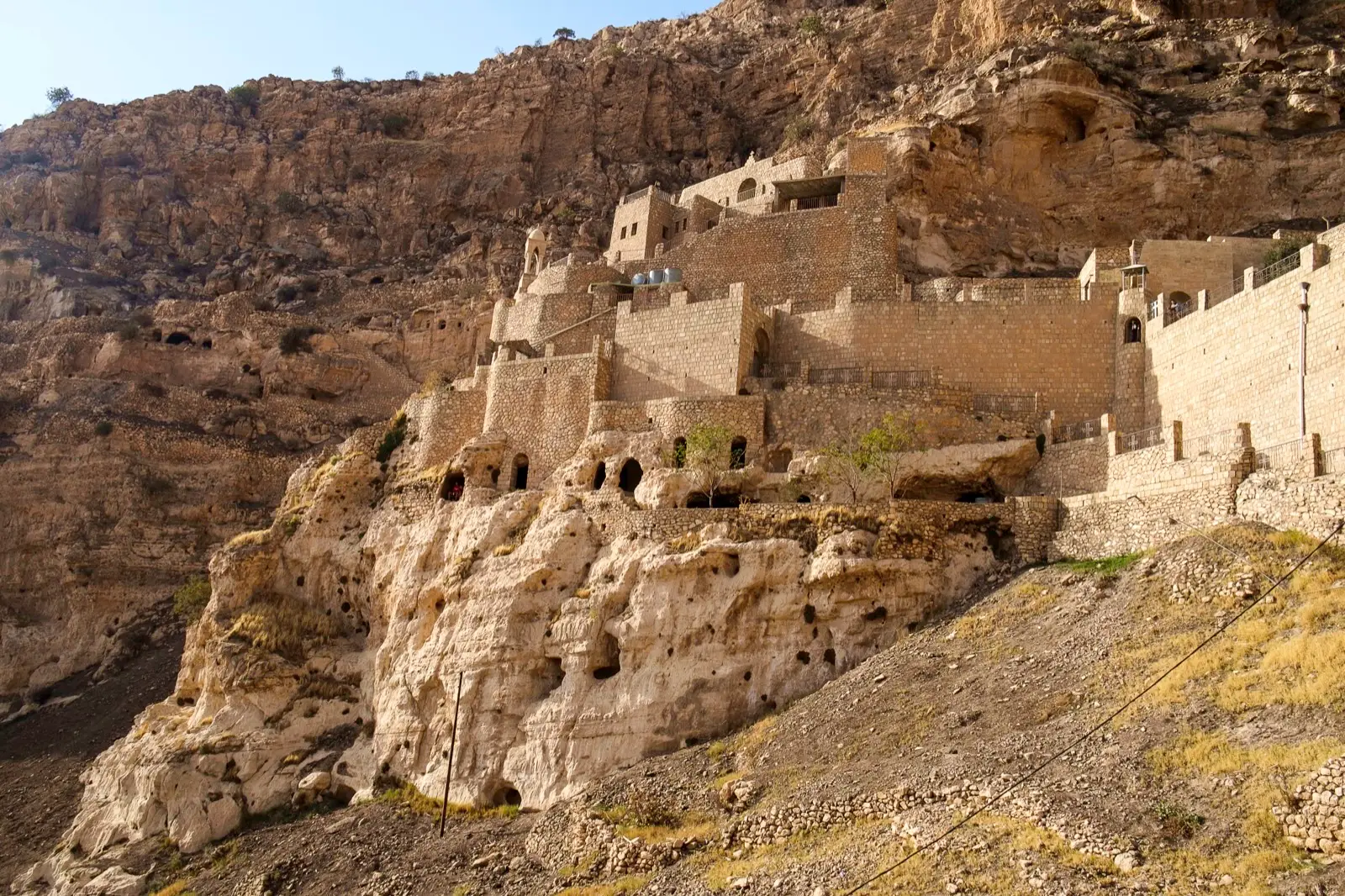
Rabban Hormizd Monastery
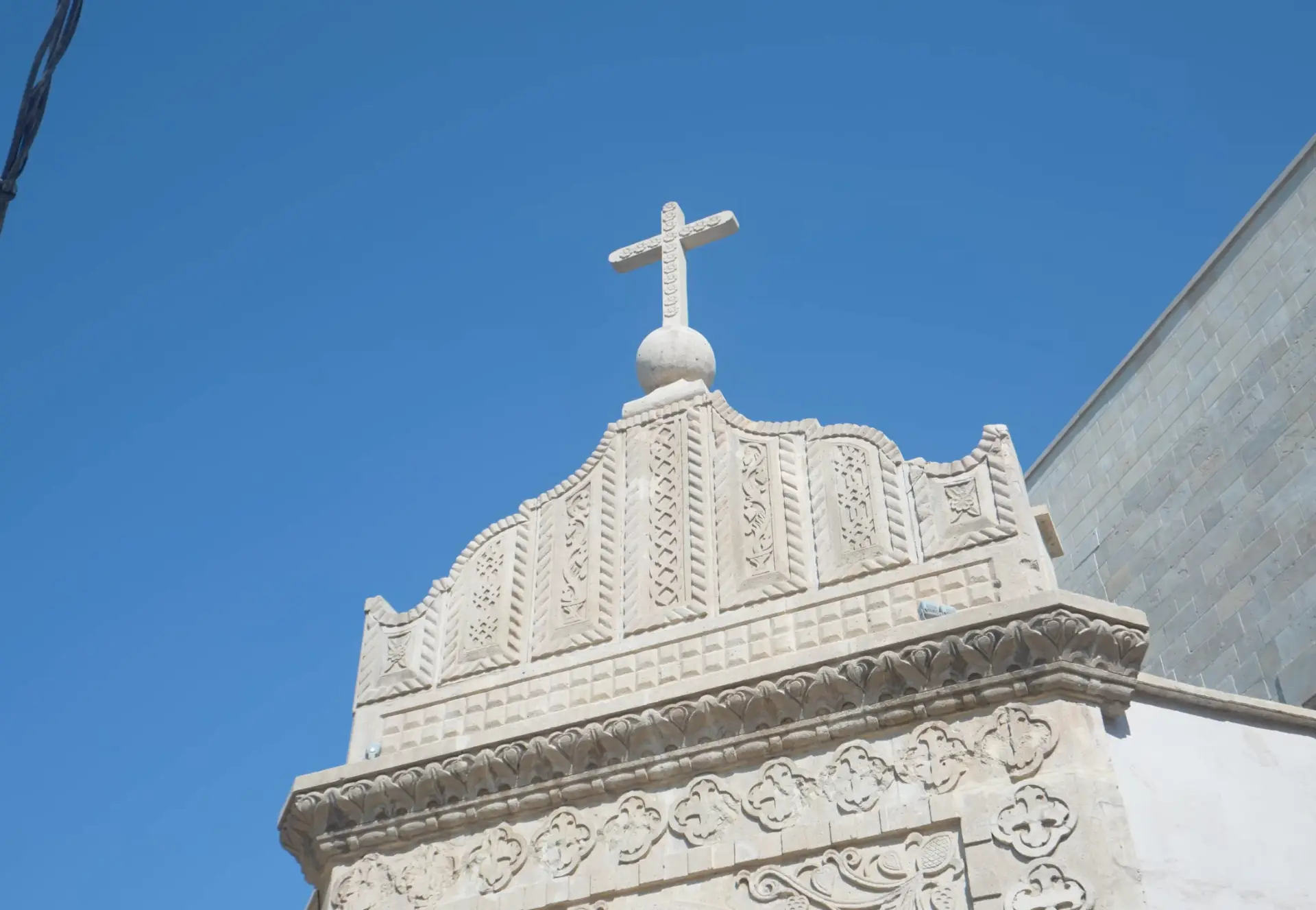
The monastery is considered one of the oldest Christian monasteries in Iraq, with its construction dating back to 640 CE, the seventh century CE during the era of Patriarch Isho'yahb II, in other words, during the years of the Islamic conquest. The monastery held a distinguished position in the Church of the East, particularly in the tenth and eleventh centuries, when it became the center of a church extending eastward to encompass millions in Persia, Central Asia, and China. It is considered the mother monastery of monasticism and an ancient civilizational and historical heritage of the church.
This monastery appears like a pearl placed in a jewelry box. The fourth-century Saint Mar Mikha Al Nuhudri prophesied about it, comparing it to a great eagle soaring in station above the angels, nesting in the crevices of the Alqosh mountain and giving birth to spiritual offspring, and said that all who invoke its name are healed of every pain and illness.
Saint Rabban Hormizd, the monastery's founder, was a Persian monk on his way to pilgrimage in Jerusalem when he met three monks in Mosul who changed the course of his journey eastward, becoming a monk who lived approximately 39 years, 32 of them inside a hermitage cell.
His journey then led him to the valley of Mount Alqosh, where he and his disciple Abraham settled near a spring later known as the Saint's Spring, each taking a cave near the spring. Before Abraham moved to Batnaya to build his own monastery, Hormizd remained in the place alone. People soon sought him for blessing and healing, and many young men and monks joined him, the monastery growing from a simple hermitage to many cells until it became a great expansive monastery housing one hundred monks.
Rabban Hormizd died at ninety years of age and was buried in a simple shrine, later transferred to its current location in the monastery due to earthquakes. His intercession is still sought to this day.
The Rabban Hormizd Monastery sits suspended on the side of a towering rocky slope at an elevation of 815 meters above Mount Alqosh, approximately three kilometers northeast of the city of Alqosh in northern Nineveh Governorate, and ten kilometers from the eastern bank of the Tigris River. From its southern side it overlooks the desert horizon of the Nineveh Plain where Mosul appears forty kilometers away, while from the north it leans against a mountain mass on the borders of ancient Assyria and along the international Iraqi-Turkish-Iranian borders.
The mountain surrounding the monastery is covered by a vast network of approximately four hundred hermitage cells and cave dwellings carved in rock, forty of which still stand. The monks arranged their cells in a six-tiered terrace formation ascended by staircases of up to forty steps, with a small garden in front of each cell, inside it a clay raised platform used as a bed, a niche for keeping spiritual books, and sometimes a stone table for writing and reading. A mountain inhabited by monks, not merely built upon.
The current monastic complex contains several churches, most prominently the Hall of the Holy Trinity, the largest in area with a spacious portico and an oval shaped holy of holies with liturgical lines, and the Hall of the Four Evangelists built in 1820 CE, and the Hall of Mar Antonios considered perhaps the first chapel established in the monastery, in addition to the hermitage of Rabban Hormizd — a cave half carved and half built in stone and plaster.
The monastery houses the shrine of Rabban Hormizd in the form of a carved and colored stone altar topped by a stone arch with Syriac inscription reading: "Here rests our glorious father, the radiant light of the East, the victorious Rabban Hormizd, from the seventh century of Christ." It also contains the Patriarchs' Cemetery with nine marble tablets documenting the lives of nine patriarchs from the House of the Father who administered the Church of the East from 1497 to 1804. Among its most prominent features is the large iwan carved in the rock overlooking the valley and plain, and large cisterns storing rainwater as the only water source in the monastery.
The monastery's history is replete with trials divided into three periods: the ancient period from its founding in the seventh century until the Mongol destruction; the period of the Patriarchs of the House of Our Father from 1497 to 1804; and the period of renewal beginning with Abba Gabriel Dambo.
In the years 958, 964, and 978 CE, Hakkari Kurds launched bloody attacks leading to the scattering of monks and destruction of many monasteries. Then Tamerlane attacked Baghdad and Mosul in 1393 and 1401, bringing looting upon the monastery and dispersing its monks.
On the ninth of April 1553, the monastery gained exceptional historical importance when Pope Julius III appointed Yohannan Sulaqa, the monastery's abbot, as the first Patriarch of the Chaldeans, making the monastery the seat of the Chaldean Patriarchate.
The most devastating attack came in April 1842 when Ismail Pasha, Prince of Amadiya, pillaged it, books were torn and burned, monks were taken captive, and the high priest died in prison. In 1850 tragedy recurred with the loss of more than one thousand valuable manuscripts swept away by floods in 1851. Following these disasters, Chaldean Patriarch Joseph Audo VI established the New Lady of the Harvest Monastery at the gates of Alqosh in 1858, containing today one of the most important Chaldean libraries with what was rescued from Rabban Hormizd.
In 2014, ISIS stood a few kilometers from Alqosh and Chaldean authorities took necessary protective measures for the people and heritage, the monastery that had withstood the Mongols and Tamerlane was not about to fall.
The monastery uniquely possesses three hundred and sixty-five doors, one for each day of the year. Every year, on the second Sunday after Easter, Christians come to the monastery in a celebration known in Syriac as "Shira" (the Vigil), performing prayers and celebrating the commemoration of Mar Hormizd, as if that Persian monk who lost his way to Jerusalem still receives those who come.
From a Hermit's Cell to a Church That Reached China
Kurdish (Kurmanji) · Kurdish (Sorani) · Chinese
Frequently asked questions
What are the opening hours of Rabban Hormizd Monastery?
Rabban Hormizd Monastery is open 24 hours.
How much does it cost to visit Rabban Hormizd Monastery?
Admission to Rabban Hormizd Monastery is free.
How long should I spend at Rabban Hormizd Monastery?
Plan about ~ 1 Hour for Rabban Hormizd Monastery.
When is the best time to visit Rabban Hormizd Monastery?
October–April; spring is especially good for mountain/valley scenery. Visit on weekday mornings for quiet reflection.
Does Rabban Hormizd Monastery have an audio guide?
Yes — a narrated audio guide for Rabban Hormizd Monastery is available in the Travel Tale app.
Where is Rabban Hormizd Monastery located?
Rabban Hormizd Monastery is in Mosul: Northeast of the town of Alqosh, in the north of Nineveh Governorate..
Hear the full audio story — free in the app
Get app