
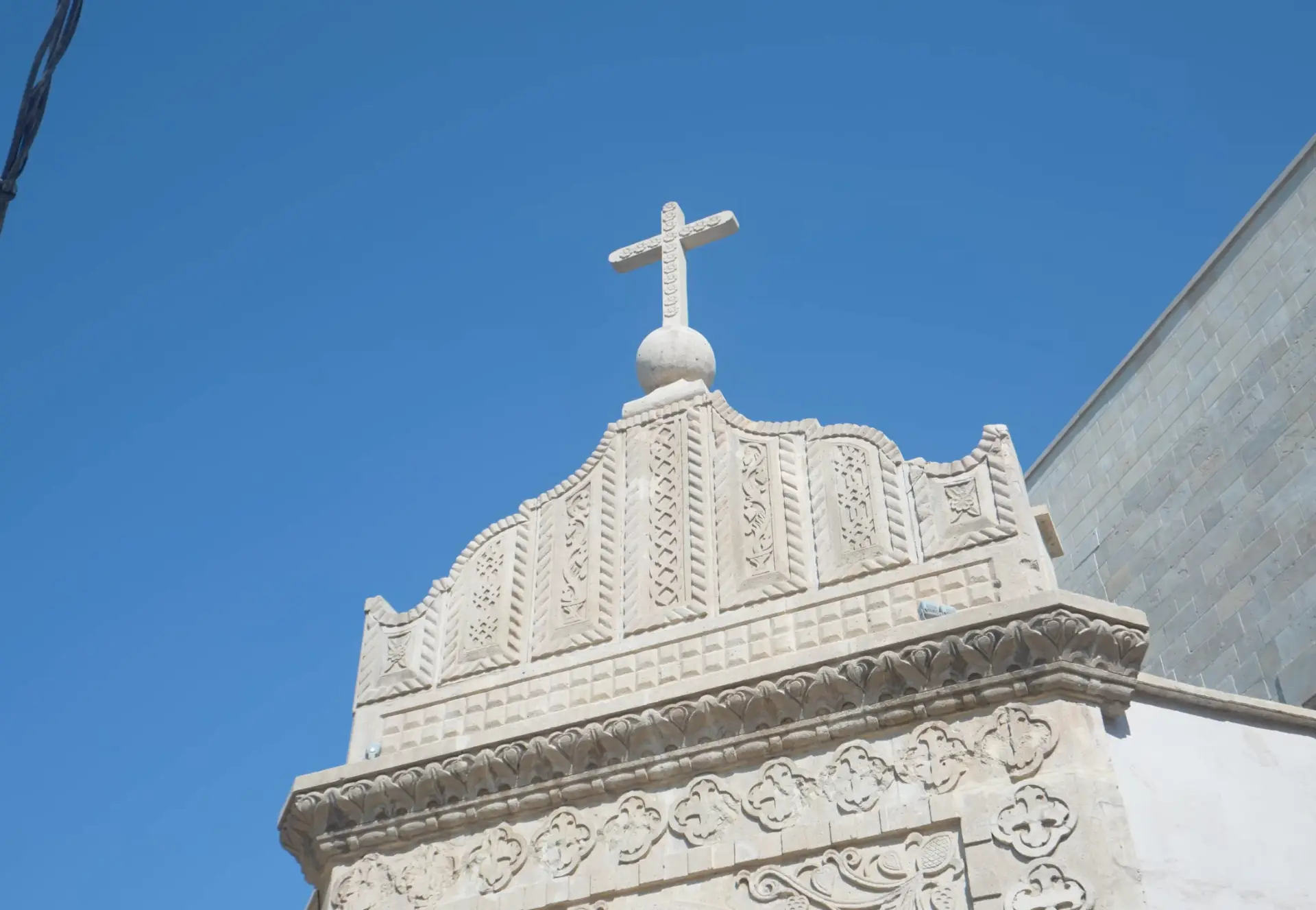
Al Tahira Church
The Church of the Immaculate Conception (Al Tahira) is located in the heart of the city of Qaraqosh, or Bakhdida as its Syriac people call it, a name derived from "Beit Khadadad," meaning the place given by God. The city lies approximately thirty kilometers southeast of Mosul and eighty kilometers west of Erbil. Before ISIS's attack, Qaraqosh was the largest Syriac Catholic city in the world, housing between forty and seventy thousand inhabitants, approximately ninety percent of whom are Syriac Catholics.
The roots of Christianity in Qaraqosh trace back to the end of the fourth or beginning of the fifth century CE. The city was initially Nestorian, then became Monophysite around 615 CE. In the eleventh and twelfth centuries, many Christians from Tikrit who were forced to leave their city took refuge there. In 1743 it was subjected to a siege by Nader Shah's forces who pillaged it and destroyed its churches. At the end of the eighteenth century, the city converted to Catholicism.
The Al Tahira complex consists of two churches, the old and the new. The new church, whose construction began in 1932 and continued for sixteen years with the labor of all the city's inhabitants until its consecration in 1948, is the largest Syriac Catholic church in the Middle East. Two Christian architects from Nineveh designed its plans, and it covers more than three thousand square meters, 54 meters long and 24 meters wide, accommodating approximately four thousand worshippers.
It consists of three aisles resting on 22 magnificent columns of Mosul marble, the main pillar reaching 15 meters in height, topped by an imposing dome visible from afar crowned by a cross. Its square bell tower was a symbol for the city's residents, bearing a large clock with crosses topping its four corners. As for the old Church of Al Tahira, believed to date to the thirteenth century, it consists of three aisles and three altars of modest dimensions, restored several times, most notably in 1745 after Nader Shah's forces burned it, and still preserves today an ancient hexagonal inscribed baptismal font.
On the sixth of August 2014, all the residents of Qaraqosh fled in a single night from ISIS, which occupied the city for twenty-four months. During that time it used the Church of Al Tahira as a command center, weapons processing facility, and firing range, burning the church completely, blackening its magnificent dome and white walls with fire, destroying all statues inside and outside, tearing liturgical books and writing insults on its marble columns, and converting its back courtyard into a shooting training ground, leaving behind widespread devastation.
After the city's liberation in October 2016 and the gradual return of residents in April 2017, the Church of Al Tahira reclaimed its lofty spiritual and communal standing. It has become one of the most famous churches among Iraq's Christians and a firm identity for the city of Qaraqosh, most prominently evidenced by Pope Francis visiting it during his historic tour of Iraq, remaining a living witness to the faith and steadfastness of its people in the face of everything that tried to erase their identity and ancient history in the land of Mesopotamia.
In the Place That God Gave
4 Min · Arabic · English · Persian · Turkish
Frequently asked questions
What are the opening hours of Al Tahira Church?
Opens at 09:00
How much does it cost to visit Al Tahira Church?
Admission to Al Tahira Church is free.
How long should I spend at Al Tahira Church?
Plan about ~ 45 min for Al Tahira Church.
When is the best time to visit Al Tahira Church?
Year-round; October–April. Visit on weekday mornings for quiet reflection
Does Al Tahira Church have an audio guide?
Yes — a narrated audio guide for Al Tahira Church is available in the Travel Tale app.
Where is Al Tahira Church located?
Al Tahira Church is in Mosul: Bakhdida, Mosul.
Hear the full audio story — free in the app
Get app