
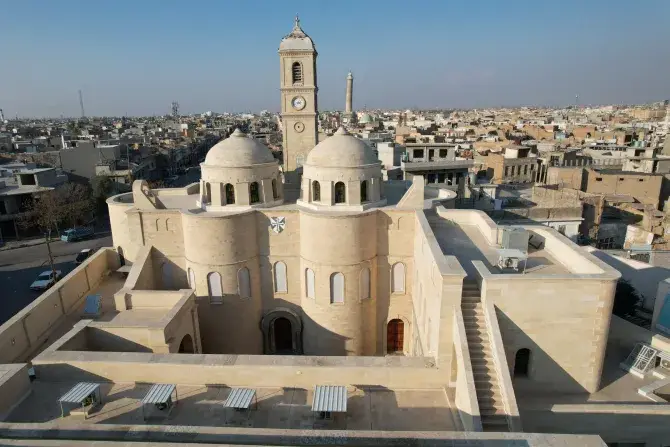
The Lady of Al Saa'a Convent
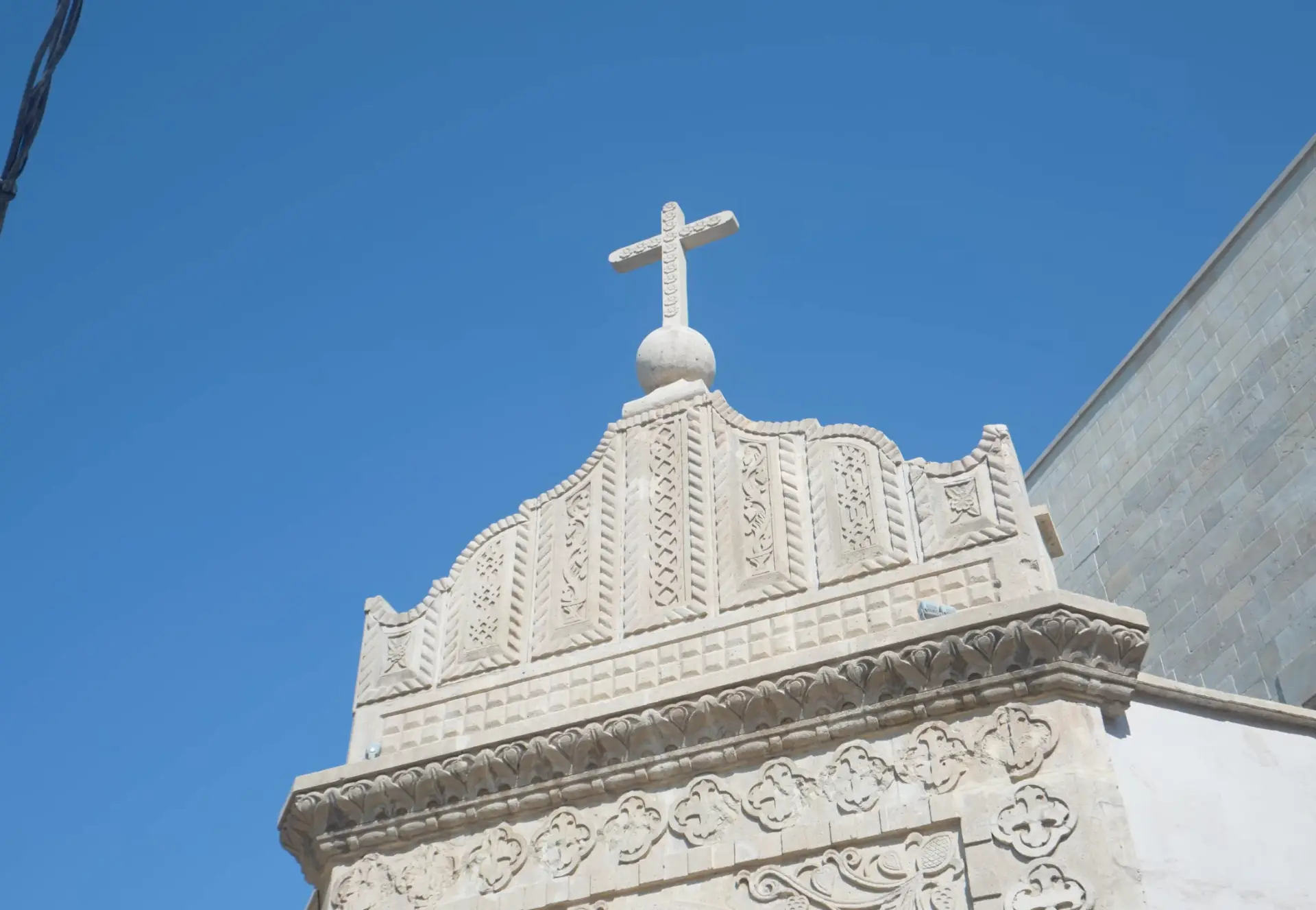
The Latin Church, or the Clock Church of the Dominican Fathers, is located in the southern sector of old Mosul. It carries in the memory of the people of Mosul the name "the Clock Church," because its famous bell granted the entire city its time for decades.
The Dominican presence in Mosul dates back to 1750, when the first mission of Italian Dominican Fathers arrived in Mesopotamia by papal decree, welcomed by the Jalili family, rulers of the city. French Dominicans succeeded them from 1859, and in 1862 they established the first printing press in Iraq, publishing books in Arabic, Kurdish, and Syriac, among its productions was the first Bible in Arabic in Iraq.
The foundation stone of the current main church was laid on the ninth of April 1866, and it was consecrated on the second of August 1873 under the supervision of Father Duval and Father Léon. It is a grand imposing building in the Romano-Byzantine style, with three naves and five sections, its structure resting on four pairs of free-standing cylindrical pillars decorated with acanthus leaves, topped by two hemispherical domes. Its interior walls are clad with Mosul marble and its exterior facade covered with golden-colored stone cladding.
In 1876, Empress Eugénie de Montijo, wife of Napoleon III, provided the necessary funding for the bell tower's construction, and the famous clock was installed in 1880 as a gift from the French government, giving the time to all the people of Mosul. In the church courtyard is an exact replica of the Lourdes Grotto containing a statue of Our Lady of Miracles, visited for prayer and blessing by Christians, Muslims, and Yazidis alike.
The church's surroundings comprised a complete complex including the Fathers' monastery, the Sisters' convent, a boys' school, a hospital, a pharmacy, an orphanage, and classrooms. The building also contains a crypt housing the graves of a number of Dominican Fathers who witnessed the genocide of Armenians and Assyrians between 1915 and 1916 and documented it in their writings.
The monastery was restored in 2000, but ISIS's occupation of Mosul between 2014 and 2017 reduced this architectural masterpiece to rubble. The bell tower supports and clock mechanism were stolen, the church vandalized and its main and side altars crushed, marble panels torn apart or stolen, the Lourdes Grotto and its statue destroyed by explosives on the twenty-fourth of April 2016, and the monastery converted into a torture center. Yet the church did not collapse despite all of this, it remained standing as a lighthouse bearing witness to the pain.
After Mosul's liberation, UNESCO undertook the reconstruction project with French support, and in 2025 the church clock's chimes were heard again in Mosul's sky, returning through them the city's memory and its beloved voice that generations had lived by the rhythm of its strikes.
When the Clock Spoke across Mosul
5 Min · Arabic · English · Persian · Turkish
Frequently asked questions
What are the opening hours of The Lady of Al Saa'a Convent?
The Lady of Al Saa'a Convent is open 24 hours.
How much does it cost to visit The Lady of Al Saa'a Convent?
Admission to The Lady of Al Saa'a Convent is free.
How long should I spend at The Lady of Al Saa'a Convent?
Plan about ~ 45 min for The Lady of Al Saa'a Convent.
When is the best time to visit The Lady of Al Saa'a Convent?
Year-round; October–April. Visit on weekday mornings for quiet reflection
Does The Lady of Al Saa'a Convent have an audio guide?
Yes — a narrated audio guide for The Lady of Al Saa'a Convent is available in the Travel Tale app.
Where is The Lady of Al Saa'a Convent located?
The Lady of Al Saa'a Convent is in Mosul: At the Intersection of Nineveh and Al Afarouq Streets,South Old City, Mosul.
Hear the full audio story — free in the app
Get app