
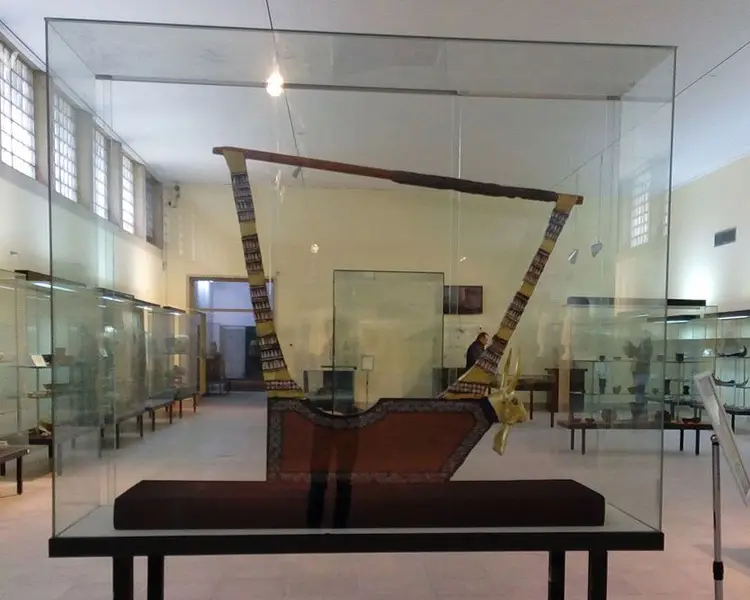
03 & 04 The Civilization of the Sumerian Ages Halls
Iraqi National Museum
The Sumerian Hall at the Iraqi National Museum is more than just an archaeological exhibit it is a journey through time to one of the earliest civilizations known to humanity.
Between 2900 and 2004 BCE, the first cities of Mesopotamia flourished, laying the foundations of what we now call civilization in its truest sense.
In this gallery, the names Uruk, Ur, Lagash, Nippur, and Eridu stand as powerful witnesses to the emergence of the first Sumerian city-states.
These were not mere settlements but fully developed urban societies, governed by advanced political, economic, and religious systems.
Central to this era is the figure of Gilgamesh, the legendary king of Uruk, who would later inspire one of the world’s oldest and greatest literary epics.
Among the Sumerians’ most transformative achievements was the invention of cuneiform writing.
These were not just marks pressed into clay they were a complete language used to record laws, treaties, myths, and administrative documents.
This invention paved the way for the world’s first known legal code: the Code of Ur-Nammu, which predates even the famous laws of Hammurabi.
Scientifically and technologically, the Sumerians were remarkably advanced.
They invented the wheel and the plow, developed sophisticated irrigation systems that ensured agricultural stability, and introduced mathematical and temporal concepts that still define our lives today such as dividing the hour into 60 minutes, and the minute into 60 seconds, based on their sexagesimal (base-60) system.
They also founded the world’s first formal schools, known as the “House of Tablets”, where young scribes studied writing, mathematics, and engineering.
In this gallery, you will encounter basalt stelae carved with religious texts and historical records, stone sculptures and clay and marble figurines depicting religious rituals and daily life scenes, as well as original walls from Uruk temples, once adorned with colorful geometric patterns.
One of the most remarkable features of the gallery is its collection of cylinder and stamp seals, used to authenticate documents and contracts. These seals are miniature masterpieces that reveal artistic details of Sumerian life.
You will also find original cuneiform tablets, inscribed on sun-dried or kiln-fired clay, offering a direct glimpse into the Sumerian world their administrative practices, spiritual beliefs, notions of justice, divinity, death, love, literature, and language.
The Sumerian Gallery is not simply a space for contemplating Iraq’s earliest cultural eras it is a vivid restoration of the human story when people first began to build cities, record thoughts, and seek meaning in their existence.
03 & 04 The Civilization of the Sumerian Ages Halls
Arabic · English
Hear this stop narrated — free in the app
Get app