
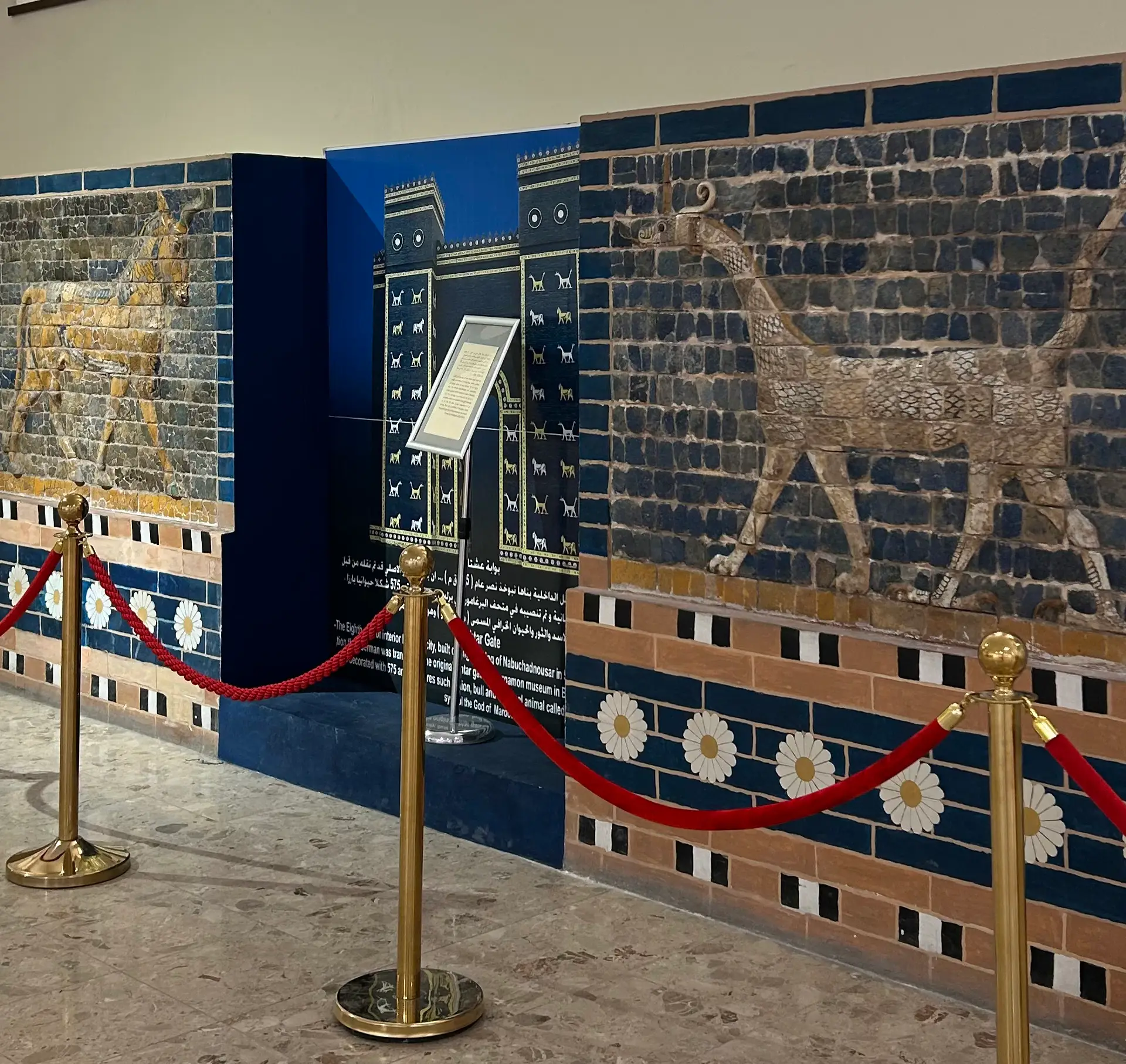
12 Neo-Babylonian Hall (Chaldean Period)
Iraqi National Museum
The Chaldean era began in 626 BC when Nabopolassar founded the Chaldean dynasty after expelling the Assyrians from Babylon, heralding a new era of power.
This transformation represented a major political and architectural renaissance that restored Babylon's historical status in Mesopotamia.
The Neo-Babylonian Empire became one of the most important powers in the ancient East.
Babylon reached the height of its greatness during the reign of Nebuchadnezzar II (605–562 BC), who led powerful military campaigns and built massive architectural projects.
Under his rule, Babylon was transformed into the jewel of the East thanks to its architecture and arts.
His era was the zenith of political and military influence for the Chaldean state.
The Hanging Gardens are one of the Seven Wonders of the World, built by Nebuchadnezzar for his wife Amytis to ease her longing for the mountains of Media.
They were distinguished by their green terraces and ingenious irrigation systems that historians considered a unique engineering achievement.
The gardens remained a global symbol of Babylonian beauty and imagination.
The Ishtar Gate was Babylon's greatest entrance, covered with blue glazed bricks and reliefs of lions, bulls, and dragons.
The gate reflects the pinnacle of Babylonian architectural art and the splendor of colored decorations.
Its replica in the Berlin Museum remains one of the most famous archaeological works in the world.
The Tower of Babel (Etemenanki Ziggurat) represented a massive religious symbol rising in graduated levels toward the sky, embodying Babylon's connection to the gods.
It was one of the city's most important temples and most influential in religious and historical memory.
The tower is associated with the well-known "Tower of Babel" story in global heritage.
The Babylonians developed a precise astronomical system that enabled them to observe planetary movements and predict lunar and solar eclipses.
Their science had a direct impact on subsequent Greek and Roman civilizations.
Babylon was an advanced center for astronomical studies in the ancient world.
The Babylonians adopted the sexagesimal system that we still use for time and angles today.
They provided mathematical solutions in algebra and geometry demonstrating a high level of advancement.
Their cuneiform tablets are among the oldest discovered mathematical models.
The Babylonians recorded diseases and their treatments on cuneiform tablets, making Babylon an important medical center.
Babylonian medicine mixed practical expertise with spiritual knowledge.
Their records became an important source for studying ancient medicine.
The Neo-Babylonian Empire extended across Mesopotamia, the Levant, and parts of Asia Minor.
Its influence reached the borders of Egypt, making it one of the greatest powers of the Near East.
It maintained its status until the mid-sixth century BC.
The empire fell in 539 BC when Cyrus the Great entered Babylon without significant resistance.
This event marked the end of the last independent state in ancient Mesopotamia.
With Babylon's fall, a page was turned on a civilization that had lasted thousands of years.
12 Neo-Babylonian Hall (Chaldean Period)
Arabic · English
Hear this stop narrated — free in the app
Get app