
05 & 06 The Civilizations of the Akkadian, Babylonian, and Kassite Periods
Iraqi National Museum
This Hall of the Iraqi National Museum extends a long timeline covering pivotal eras in the history of Mesopotamia, beginning with the rise of the Akkadians in the twenty-fourth century BC, through the era of the Early Babylonians, and reaching the Kassites and Hurrians, who left their marks in the heart of Iraqi history between 1500 and 1000 BC, in a complete tableau reflecting the transformation of Mesopotamia from Sumerian city-states to powerful kingdoms and empires with cohesive political, economic, and religious organization.
The journey begins with the Akkadian Era (2350–2159 BC), where the first unified empire in history emerged under the leadership of the famous King Sargon of Akkad, who succeeded in uniting the Sumerian city-states under one banner and imposed the Akkadian language as the official language in temples and government bureaus, paving the way for a new phase of administrative stability and cultural prosperity.
The Akkadian state was distinguished by its ability to organize far-flung territories with an effective administrative system, and its commercial networks expanded to connect the Mesopotamian valley with the Arabian Gulf, the Indian subcontinent, and Anatolia.
During this period, sculptural art flourished, and the bronze Head of Sargon of Akkad is considered one of the finest legacies of that civilization, serving as a witness to their mastery in metal casting and sculpting the features of power.
The historical narrative in the same hall continues with the Old Babylonian Era (2000–1500 BC), a period distinguished by tremendous development in law, administration, astronomy, and literary thought.
During the reign of King Hammurabi, Babylon reached the pinnacle of its prosperity, not only as the political and cultural capital of ancient Iraq, but as a center of legal and astronomical enlightenment.
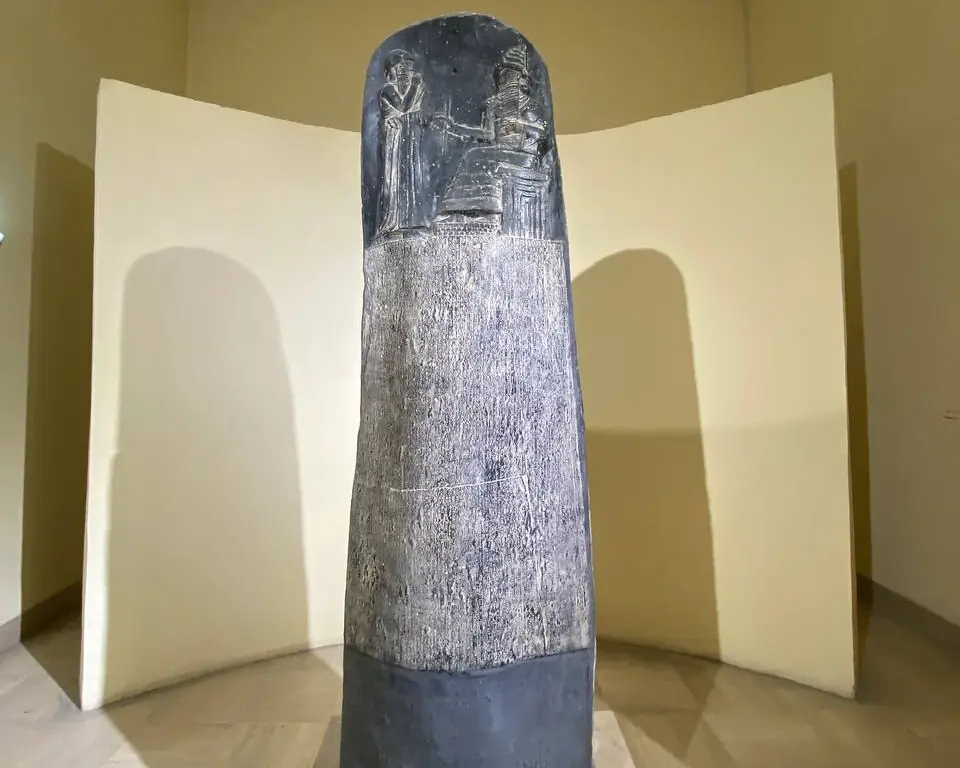
The Code of Hammurabi, inscribed on a tall stone stele, is considered one of the oldest known written law codes, and established the concept of justice and accountability in Babylonian society.
The Babylonians also knew astronomical tables and divided the day into 24 hours, in a scientific achievement whose echo still extends to the modern era.
In terms of literature, they recorded the Epic of Creation (Enuma Elish) on clay tablets, expressing their vision of the universe, the relationship between humans and gods, and the question of order and chaos.
Under Hammurabi's rule, the legend of the Tower of Babel was built, and news spread of the Hanging Gardens, which were considered one of the Seven Wonders of the World, giving the city an almost mythical character in the global imagination.
Displayed in this hall is a rare collection of Akkadian era artifacts, including pieces of inscribed marble stelae, small stone sculptures, clay statues representing the goddess Ishtar, alongside an elegant collection of precise cylinder seals that were used to authenticate contracts and correspondence.
The visitor's attention is also drawn to the presence of a plaster copy of the famous Stele of Hammurabi, which contains more than 280 legal articles, a copy identical to the original displayed today in the Louvre Museum in Paris.
Alongside the Akkadian and Babylonian artifacts, the visitor finds references to the Kassite and Hurrian civilizations who lived between 1500 and 1000 BC and also left their marks in the military, artistic, and religious fields, thus forming a rich link in the chain of civilizational diversity for which Mesopotamia was known.
This hall, with its precise exhibits and deep historical dimensions, embodies the transition of humans in ancient Iraq from local authority to centralized state, from clay symbols to written legislation, from improvisation to organization, in a civilizational narrative reflecting the maturation of human consciousness thousands of years ago.
05 & 06 The Civilizations of the Akkadian, Babylonian, and Kassite Periods
Arabic · English
Hear this stop narrated — free in the app
Get app