
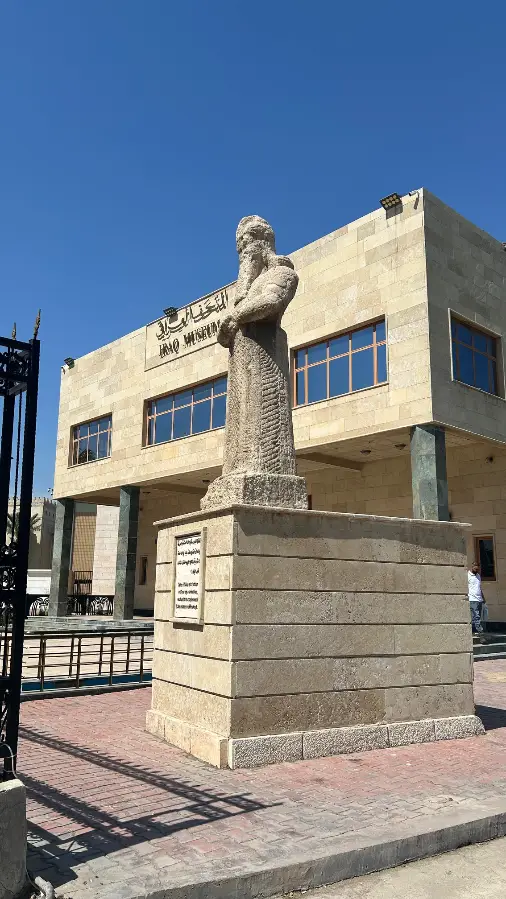
Statue of the God Nabu
Iraqi National Museum
Before you cross the threshold of the museum, Nabu will greet you standing tall as he always was, his hands clasped in a posture exuding wisdom and dignity. As if he never left, but chose to remain a guardian on the threshold of time.
Nabu is the god of writing, wisdom, and knowledge in Mesopotamian mythology. His name is derived from the Semitic root meaning "to speak" or "to proclaim," as if the civilization that created him wanted to make the word itself a god.
His name was associated with everyone who carries a pen or seeks knowledge, for he was the patron of scribes, scholars, and astrologers alike.
He is the son of the great god Marduk (the supreme god of Babylon) and inherited from his father a lofty position among the gods. Indeed, his influence increased in the Neo-Babylonian period until he almost rivaled him in importance.
He was assigned the sacred number forty, and was associated with the planet Mercury in the Mesopotamian astronomical tradition. His most prominent symbol was the stylus and writing reed, and sometimes the winged dragon known as "Mushhushshu".
His wife was the goddess Tashmetu, also goddess of writing, so the word and knowledge united them in everything.
His worship was centered in the city of Borsippa near Babylon, where the temple "Ezida" (meaning "The Eternal House") was built for him, which was a shrine for scholars and priests from throughout Mesopotamia.
Nabu was the guardian of the Tablet of Destinies, that cosmic tablet on which the fates and lifespans of humans are recorded.
At each Babylonian New Year during the great Akitu celebrations, priests believed that he renewed the writing of human destinies for the coming year, so prayers rose to him in fear and hope.
His status was so great that the great royal libraries, such as the Library of Ashurbanipal in Nineveh, were placed under his patronage, and warnings in his name were written on their tablets for anyone who dared to steal or destroy the tablets.
Many of the great kings bore compound names containing his name, foremost among them Nebuchadnezzar, the greatest king of Babylon, Nabopolassar, founder of the Neo-Babylonian Empire, and Nabonidus, its last king as if association with Nabu's name granted the king an aura of wisdom and divine legitimacy that no other attribute could provide.
Statue of the God Nabu
Arabic · English
Hear this stop narrated — free in the app
Get app