
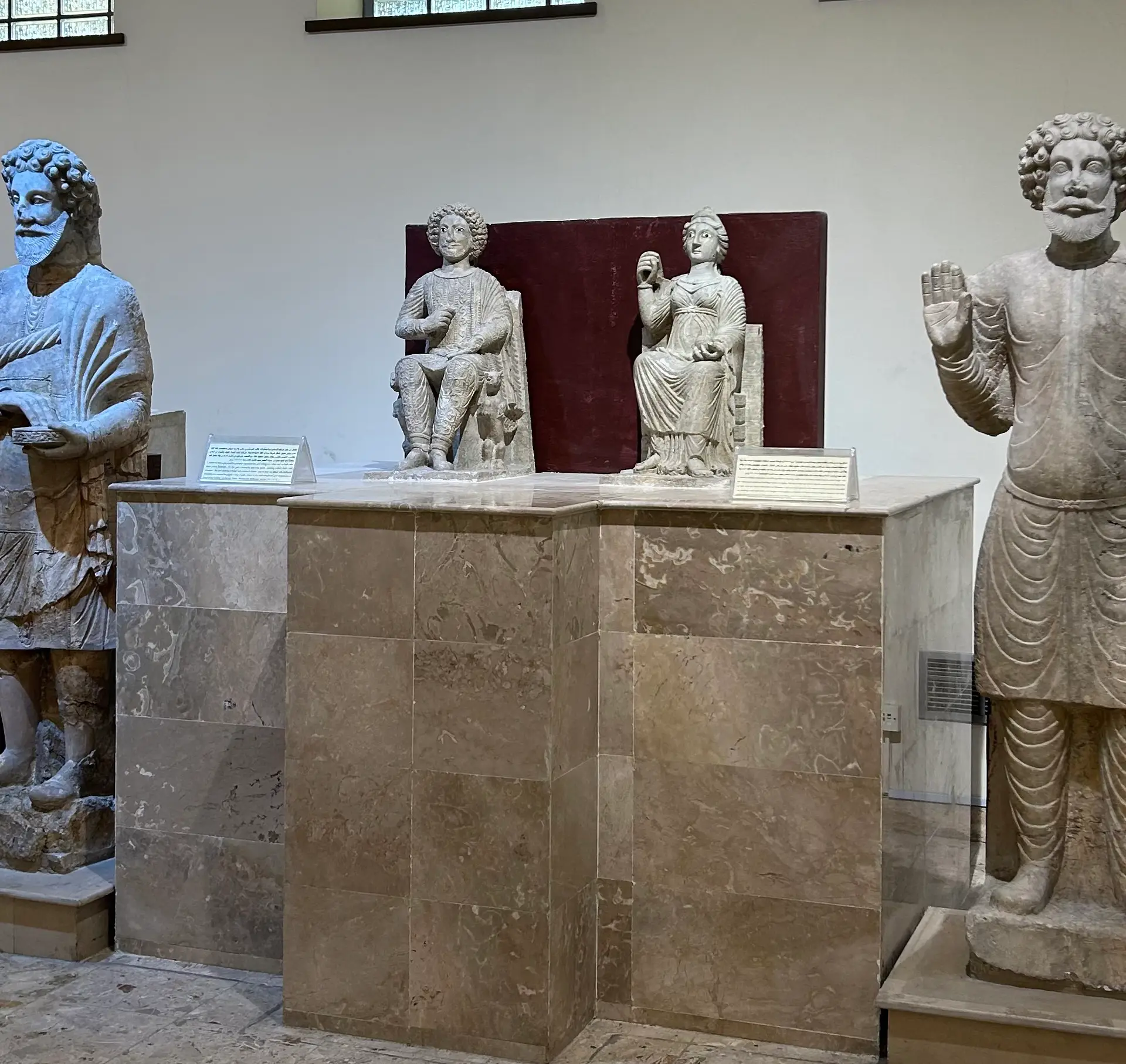
13 & 15 Hatra Period Halls
Iraqi National Museum
The period of the Kingdom of Hatra extends from around 100 BCE to 241 CE, and it represents one of the most significant historical eras in northern Mesopotamia.
The city arose in northwestern Iraq and was a flourishing cultural and civilizational center.
It was distinguished by its urban development and the strength of its religious and political institutions.
Hatra prospered thanks to its strategic location along the trade routes between the Roman and Persian empires.
This position made it a major stop for caravans and an influential commercial hub in the region.
Its archaeological remains combine Eastern and Western artistic styles, giving its art a unique and distinctive character.
Hatra was famous for its massive walls, which withstood attacks from powerful armies.
The city contained numerous temples reflecting its religious diversity and rich cultural identity.
Its architectural elements are considered among the most important remnants left by Mesopotamian civilizations in the north.
The Kingdom of Hatra collapsed in 241 CE after a long siege by the Sasanian king Shapur I.
Its fall marked the end of one of the strongest fortified cities of the ancient Near East.
Despite its disappearance, its ruins have stood as a testament to its greatness for centuries.
Today, the ruins of Hatra are among the most important archaeological sites in Iraq.
UNESCO has listed them as a World Heritage Site in recognition of their historical and architectural value.
They remain a witness to a distinguished period in the history of Mesopotamia.
13 & 15 Hatra Period Halls
Arabic · English
Hear this stop narrated — free in the app
Get app